
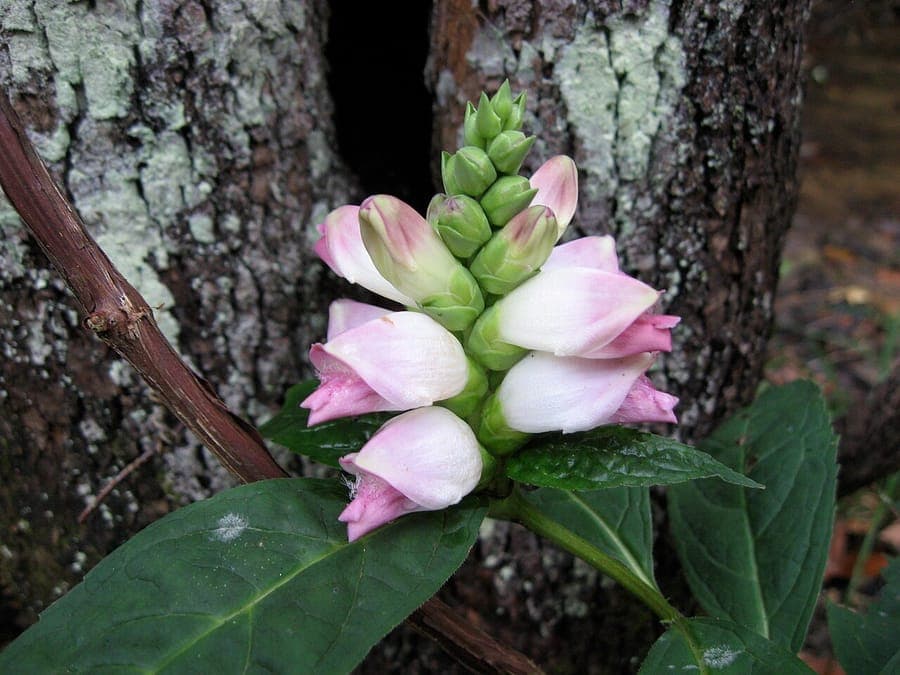
Mason Brock (Masebrock) / Public domain, via Wikimedia Commons
Chelone glabra (Turtlehead): complete guide
Chelone glabra
Want to see Chelone glabra (Turtlehead): complete guide in your garden?
1 minute, no credit card
Overview
Chelone glabra, also known as Turtlehead, Balmony, or White Turtlehead, is a fascinating perennial that thrives in moist soil conditions. This North American plant from the Plantaginaceae family produces exotic, turtle-shaped flowers in pink to red tones. With its branching growth and long-lasting blooms, it is perfect for moisture-loving borders and water gardens.
Appearance and Bloom
Chelone glabra grows to 24-36 inches tall with strong, upright stems. The leaves are elongated-lanceolate and arranged in opposite pairs. Most remarkably are the flowers that appear from August onward: they truly resemble a turtle's head with their two-lipped structure. The flowers are usually white to pale pink, though some forms have dark pink or reddish-purple blooms. They appear in dense spikes at the stem tips and bloom until October.
Ideal Location
This plant thrives in semi-shade to partial shade, though full sun works if adequate moisture is available. Provide a location with protection from harsh afternoon sun, especially in very warm climates. Drought damage occurs quickly in full sun. A spot beside a pond or along a stream is ideal.
Soil
Chelone glabra prefers consistently moist to wet soil. Heavier clay-based soil rich in organic matter is perfect. The plant has no pH preference - both slightly acidic and neutral to moderately alkaline soils work well. Add plenty of compost or leaf mold when planting to increase water-holding capacity.
Watering
This is not a drought-tolerant plant - it must be kept consistently moist, especially during growth and flowering. Never let it dry out completely. Water daily during dry spells. In very dry climates, mulch heavily around the plant with 2-3 inches of organic material to retain moisture. In wet winters, minimal supplemental watering is needed.
Free design
Want to see Chelone glabra (Turtlehead): complete guide in your garden? Make a free design now.
Pruning
Remove dead stems in spring from the previous season. This encourages new, more branched growth. After blooming (October-November), you can cut the plant back to about 6 inches above ground. This helps prevent frost damage. Also remove weak or thin stems that don't develop well.
Maintenance Calendar
Spring (March-May): Remove dead stems, add compost, ensure consistently moist soil Summer (June-August): Water regularly, especially critical during dry spells, apply fertilizer Autumn (September-October): Blooming continues, moisture remains essential, plant begins to decline Winter (November-February): Prune dead stems, minimal care needed, plant dormant
Winter Hardiness
Chelone glabra is fully hardy throughout northern and central Europe. It can tolerate temperatures down to -4 degrees Fahrenheit without problems. The plant dies back to the ground in winter and returns from the roots each spring. In very severe frost, extra leaf mold or mulch helps protect the roots.
Companion Plants
Chelone glabra combines beautifully with other moisture-loving plants. Create variety with yellow-blooming Rudbeckia, purple Lobelia cardinalis, or white Phlox. Also lovely beside tall green foliage like ferns or hostas that require the same moist conditions. In water gardens, it grows well along the banks.
Closing Thoughts
Chelone glabra is a rare gem for moisture-loving garden areas in northern and central Europe. With its exotic, turtle-shaped flowers and preference for moist soil, it is perfect for gardens near ponds, streams, or wet soils. Find this plant at specialty nurseries. Add this fascinating specimen to your moisture-loving border and enjoy years of unique blooms!
You can easily redesign your garden online at gardenworld.app. Upload your front yard photo and receive plant recommendations including moisture-loving species!
Want to see Chelone glabra (Turtlehead): complete guide in your garden? Make a free design now.
Upload a photo, pick a style, and get a photorealistic design with plant list in under a minute.
No credit card required


Similar plants
White Beardtongue: complete guide
Penstemon albidus
Discover white beardtongue (Penstemon albidus) - elegant perennial with white to cream flowers. Drought-resistant, perfect for prairie and dry gardens.
Longsepal Beardtongue: complete guide
Penstemon calycosus
Discover longsepal beardtongue (Penstemon calycosus) - beautiful perennial with lilac-blue flowers. For partial shade and moist soil. Ideal for naturalized.
Penstemon cusickii: complete guide
Penstemon cusickii
Discover Cusick's beardtongue, a compact alpine flowering plant with violet-pink blooms. Perfect choice for rock gardens and water-wise landscaping.