
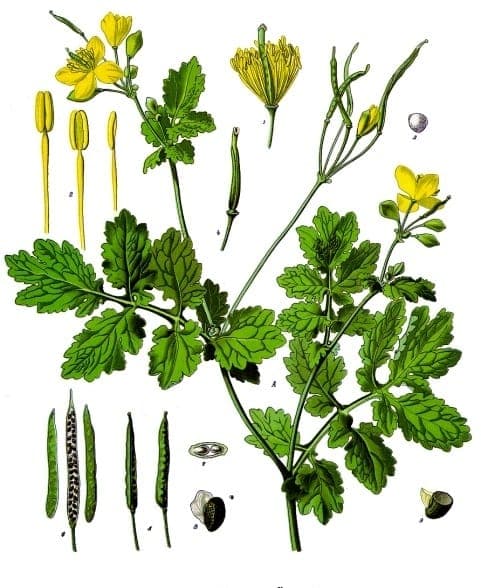
Franz Eugen Köhler, Köhler's Medizinal-Pflanzen / Public domain, via Wikimedia Commons
Celandine: complete guide
Chelidonium majus
Want to see Celandine: complete guide in your garden?
1 minute, no credit card
Overview
Celandine (Chelidonium majus) is a hardy perennial that pops up in cottage gardens, woodland edges, and rocky crevices across Europe. Despite its pungent smell when leaves are crushed-earning it the nickname 'stinking'-this member of the poppy family (Papaveraceae) brings a burst of sunny yellow in late spring. Native to countries like Austria, Belgium, and the Baltic states, it thrives in USDA zones 5 to 9 and adapts to a range of conditions with little fuss.
Often dismissed as a weed, celandine has real garden value when used intentionally. It self-seeds freely, dispersing seeds via explosive capsules that fling them several feet. This trait makes it excellent for naturalistic planting schemes. If you're designing a relaxed garden, check out gardenworld.app to visualise how celandine can weave through borders without overwhelming them.
Appearance & bloom cycle
Celandine grows 30–60 cm tall, forming loose clumps of blue-green, deeply lobed leaves that resemble those of other poppies. When broken, the stems and leaves ooze a bright yellow-orange latex-hence the name 'gouwe' or 'gall' in several languages. This sap has a sharp odour and can irritate skin, so wear gloves when handling.
From May to June, nodding clusters of four-petalled yellow flowers appear, each about 2 cm wide, with prominent golden stamens. Blooms open in full sun and close at night or on overcast days. In cooler climates, flowering may extend into early August. After blooming, slender seed pods develop and burst open when touched, scattering dark seeds up to a metre away.
Ideal location
Celandine performs best in partial shade-think under deciduous trees, along north-facing walls, or in dappled woodland settings. It tolerates full sun if the soil stays reliably moist, but in dry summers, leaves may yellow and wither early. Avoid deep shade, as this reduces flowering and promotes leggy growth.
It fits naturally in cottage gardens, wildflower meadows, or as filler in mixed borders. Due to its spreading habit, it's not ideal for formal beds. Use gardenworld.app to map out planting zones where celandine can roam without clashing with more structured elements.
Soil requirements
This plant isn't fussy. It grows in sandy, loamy, or clay soils as long as drainage is adequate. It prefers a pH between 6.0 and 7.8-slightly acidic to slightly alkaline. Rich soils encourage faster growth and more aggressive seeding, so if you want to keep it in check, avoid heavy manuring.
No fertiliser needed. In fact, feeding can lead to floppy, weak growth. Let it find its balance in average garden soil.
Free design
Want to see Celandine: complete guide in your garden? Make a free design now.
Watering
Once established, celandine is drought-tolerant. Young plants in their first season benefit from weekly watering during dry spells. Aim for deep soaking rather than frequent light sprinkles to encourage deep root development. Mature plants rarely need supplemental water, even in prolonged dry periods.
Pruning
Pruning isn't essential, but deadheading spent flowers helps maintain a tidy look and reduces self-seeding. Cut back flower stems just above a leaf node after blooming. If you want to prevent spread, remove seed pods before they ripen-usually by late June or early July.
Always wear gloves when handling. The sap can cause skin irritation or allergic reactions in sensitive individuals.
Maintenance calendar
- February–March: Watch for early leaf growth. Clear away any matted winter debris.
- April: Plant new specimens or divide existing clumps. Keep the area weed-free to give seedlings a head start.
- May–June: Peak bloom time. Monitor for slugs on young shoots and ensure moisture during dry spells.
- July: Deadhead to limit seeding. Be alert for exploding pods!
- August–September: Foliage fades naturally. No action needed.
- October–January: Dormant period. The plant dies back; roots survive underground.
Winter hardiness
Celandine is fully hardy in USDA zones 5–9. The top growth dies in autumn, but the root system persists through winter. In milder regions, you might see green leaves lingering into December. New shoots emerge in early spring, often in unexpected spots thanks to last year's seed dispersal.
Companion plants
Pair celandine with plants that complement its informal vibe:
- Lungwort (Pulmonaria officinalis) – for early spring interest and contrasting foliage
- Foamflower (Tiarella cordifolia) – as a shade-tolerant groundcover
- Jacob's ladder (Polemonium caeruleum) – for soft blue flowers and airy texture
- Dame's mantle (Alchemilla mollis) – for frothy lime-green blooms
- Wild ginger (Asarum europaeum) – for evergreen ground cover in deep shade
Avoid pairing with slow-growing alpines or formal bedding plants. Celandine thrives where spontaneity is welcome.
Closing
Celandine isn't for every garden, but if you appreciate resilient, self-sustaining plants with a wild edge, it's a winner. It's low-maintenance, long-blooming, and supports early pollinators. Just be mindful of its spread.
You can find celandine at garden centres like B&Q, Wyevale, or local independents, usually in the perennial or native plant section. Never plant it near edibles-its sap is toxic. Always wear gloves and wash hands after handling. With a little planning-say, a layout from gardenworld.app-celandine can become a charismatic, carefree presence in your garden.
Want to see Celandine: complete guide in your garden? Make a free design now.
Upload a photo, pick a style, and get a photorealistic design with plant list in under a minute.
No credit card required


Similar plants
Papaver gorodkovii: complete guide
Papaver gorodkovii
Papaver gorodkovii, the arctic poppy, thrives from Alaska to Russia's Far East. Discover how to grow this rare, extremely cold-hardy rock garden treasure.
Papaver setiferum: complete guide
Papaver setiferum
Papaver setiferum is a hardy giant Caucasian poppy with fiery red blooms. Discover siting, soil, deadheading and winter hardiness.
Pale Poppy: complete guide
Papaver alboroseum
Discover pale poppy (Papaver alboroseum) - rare alpine poppy with white-pink flowers. Precious beauty from Kamchatka. Cultivation in alpine and rock gardens.