
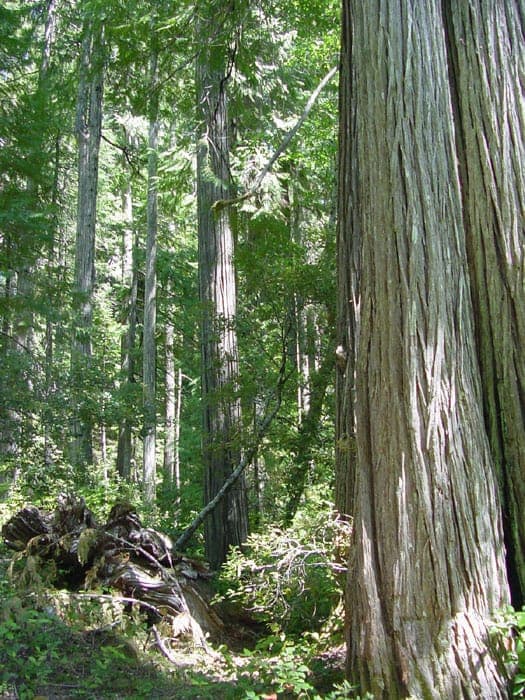
US Forest Service Dorena Genetic Resource Center / Public domain, via Wikimedia Commons
Lawson's cypress: complete guide
Chamaecyparis lawsoniana
Want to see Lawson's cypress: complete guide in your garden?
1 minute, no credit card
Overview
Chamaecyparis lawsoniana, commonly known as Lawson's cypress, is a graceful evergreen tree native to the coastal regions of Oregon and northern California. In garden settings across the UK and northern Europe, it's prized for its soft, feathery foliage and upright, pyramidal form. While it can reach towering heights in the wild, garden varieties typically stay between 5 and 15 metres, depending on the cultivar. Its slow to moderate growth rate and year-round appeal make it a solid choice for hedges, screens, or as a specimen tree. If you're planning a new layout, try using gardenworld.app to visualise how a mature Lawson's cypress will fit into your garden's long-term design.
Appearance & bloom cycle
Lawson's cypress features scale-like, aromatic foliage that ranges from deep green to silvery-blue or golden hues, depending on the variety. Cultivars like 'Alumii' offer striking blue-green tones, while 'Chilworth Silver' displays silvery tips that brighten in winter light. The tree doesn't produce showy flowers; instead, it forms small, egg-shaped cones about 1 cm long that mature in autumn. These are hardly noticeable but add subtle seasonal interest. The foliage remains dense and lush throughout the year, providing consistent structure. Dwarf forms like 'Pembury Blue' grow to just 1.5 metres, perfect for containers or small borders.
Ideal location
This conifer thrives in full sun to partial shade. For the richest foliage colour, aim for at least 6 hours of direct sunlight daily. However, in hotter inland areas, afternoon shade can prevent foliage scorch. Avoid planting in deep shade, as this leads to thinning and leggy growth. Good air circulation is crucial – tight spaces between plants increase the risk of fungal diseases like cypress canker. Allow at least 1.5 to 2 metres between trees for standard cultivars. Urban gardens benefit from its tolerance to pollution and compacted soils.
Soil requirements
Lawson's cypress prefers moist but well-drained soil with a pH from 4.2 to 7.5. It adapts to a range of soil types but struggles in heavy, waterlogged clay. Improve drainage by mixing in compost or grit when planting. On sandy soils, add organic matter to boost moisture retention. In containers, use a loam-based compost like John Innes No. 2 with added perlite. Avoid highly alkaline soils – if your pH is above 7.5, consider growing in a pot with ericaceous mix.
Free design
Want to see Lawson's cypress: complete guide in your garden? Make a free design now.
Watering
Water newly planted specimens deeply once a week during the first growing season, especially from April to September. Provide about 10 litres per tree weekly in dry spells. Once established (after 2–3 years), the tree is moderately drought-tolerant but benefits from watering during prolonged dry periods. Never let the rootball dry out completely in containers. Use rainwater when possible, as tap water can contribute to lime buildup, which may cause yellowing foliage.
Pruning
Pruning is minimal. Shape young trees in late spring (May–June) to encourage dense growth. Avoid cutting into old wood without foliage, as it won't regenerate. For hedges, light trimming once a year is sufficient – avoid late summer pruning, as new growth may not harden before winter. Use sharp, clean secateurs to prevent disease spread. Cultivars like 'Columnaris' can be lightly shaped to maintain a narrow profile.
Maintenance calendar
- Jan: Check for winter damage
- Feb: None required
- Mar: Remove any dead or broken branches
- Apr: Begin light feeding, inspect for scale insects
- May: Light pruning if needed, increase watering during dry spells
- Jun: Monitor for poor airflow in dense plantings
- Jul: Water consistently in drought
- Aug: No pruning – new growth needs time to harden
- Sep: Final feed with slow-release fertiliser
- Oct: Clear fallen debris, check for fungal spots
- Nov: Protect young plants with hessian wraps in exposed sites
- Dec: Observe for wind rock or frost damage
Winter hardiness
Lawson's cypress is hardy in USDA zones 5 to 8. In the UK, it generally survives winter well, but harsh, dry winds can cause bronzing or tip dieback. Young trees are more vulnerable – protect them with windbreak fabric or temporary fencing. Mulching in autumn helps insulate roots. Avoid planting in frost pockets or exposed, windy locations.
Companion plants
Pair Lawson's cypress with other evergreens like yew (Taxus baccata), boxwood (Buxus sempervirens), or holly (Ilex aquifolium) for year-round structure. Underplant with shade-tolerant perennials such as hostas, ferns, or epimediums. For sunny spots, add lavender or hardy geraniums. Avoid plants with aggressive root systems like willow or sycamore. Use gardenworld.app to test companion plant pairings and create balanced, layered planting schemes.
Closing
Lawson's cypress brings elegance and permanence to the garden. With proper siting and basic care, it can thrive for decades. Choose your cultivar wisely – some stay compact, others become large specimens. Buy healthy stock from reputable garden centres, where you can inspect root balls and foliage. Remember, this is a long-term investment. Plan for its mature size, and you'll enjoy a striking, low-maintenance feature for years to come.
Want to see Lawson's cypress: complete guide in your garden? Make a free design now.
Upload a photo, pick a style, and get a photorealistic design with plant list in under a minute.
No credit card required


Similar plants
Cupressus macnabiana: complete guide
Cupressus macnabiana
The Fragrant Cypress offers elegant growth with fine, aromatic foliage. Perfect for temperate climates and as specimen trees in contemporary gardens.
Cupressus guadalupensis: complete guide
Cupressus guadalupensis
The Guadalupe cypress: an elegant conifer for gardens. Complete cultivation guide for this Mexican cypress. Information about care, location, form and maintenance.
Austrocedrus chilensis: complete guide
Austrocedrus chilensis
Discover Austrocedrus chilensis, the Chilean Cedar ornamental conifer. Elegant specimen with fine foliage and columnar form for permanent structure.