
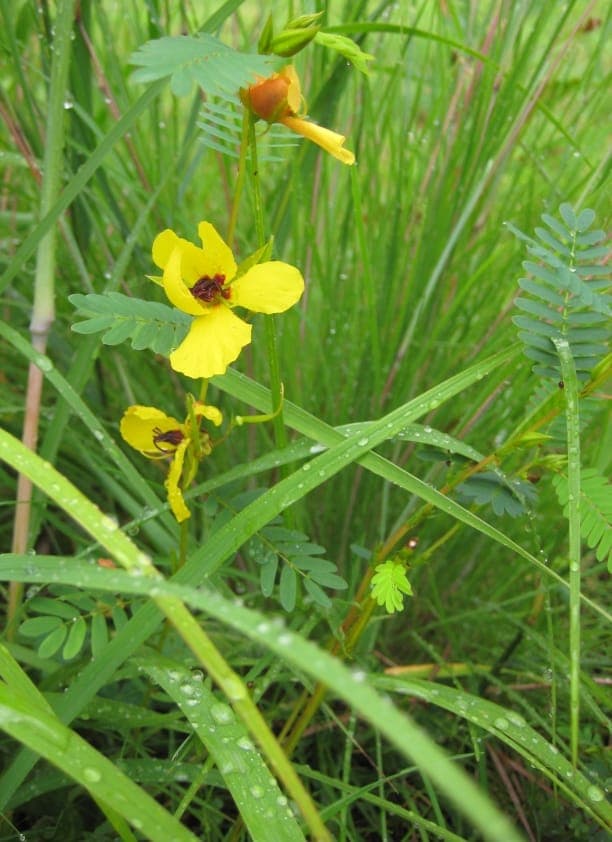
Crazytwoknobs / CC BY 3.0, via Wikimedia Commons
Partridge pea: complete guide
Chamaecrista fasciculata
Want to see Partridge pea: complete guide in your garden?
1 minute, no credit card
Overview
Partridge pea (Chamaecrista fasciculata), also called golden cassia, prairie senna, or sensitive pea, is a fast-growing annual herb in the legume family (Fabaceae). Native to the eastern and central United States - from Texas and Florida north to Minnesota and Massachusetts - it colonises open prairies, roadsides, sandy stream banks, and disturbed ground that most other plants find inhospitable.
One of the most remarkable features of partridge pea is its ability to fix atmospheric nitrogen through a root symbiosis with Bradyrhizobium bacteria. As it grows, it enriches the soil around it, leaving the ground more fertile than it found it. This makes it particularly valuable for gardens with poor, sandy, or depleted soils. On top of this soil-building role, the plant is an outstanding pollinator magnet: the bright yellow flowers attract bumblebees that 'buzz pollinate' - vibrating rapidly to release pollen from poricidal anthers - along with numerous butterflies and solitary bees.
Perhaps most intriguing is the presence of extrafloral nectaries: small, cushion-shaped glands on the leaf stalks that secrete sugary nectar even when the plant is not in bloom. These attract ants, which in turn deter herbivorous insects, effectively giving the plant its own security force. Partridge pea is also a larval host plant for several butterfly species, including the cloudless sulphur, little yellow, and sleepy orange.
For the gardener seeking a low-maintenance, ecologically rich plant for a hot, dry corner, partridge pea delivers exceptional value. It grows rapidly to 60-90 cm (occasionally to 120 cm), blooms prolifically from July through September, and self-seeds reliably where conditions suit it. At gardenworld.app, you can plan a naturalistic garden design that incorporates species like this alongside other pollinator-friendly plants.
Appearance & bloom cycle
Partridge pea has an erect to lightly branched stem reaching 60-90 cm in average conditions, with fine, somewhat hairy texture. The leaves are pinnately compound, with 10 to 15 pairs of small, oblong leaflets measuring 1-2 cm each. The foliage is fresh mid-green. A distinguishing characteristic is the plant's nyctinastic leaf movement: the leaflets fold inward when touched or in darkness, earning it the name 'sensitive pea'. This movement is less dramatic than Mimosa pudica but clearly observable on a still afternoon.
At the base of each compound leaf sits a small, raised extrafloral nectary - a nectar-secreting gland visible to the naked eye as a tiny knob on the petiole. Ants visit these glands constantly throughout the growing season.
Flowers appear in the leaf axils from July through September. Each flower has five bright yellow petals, with the uppermost petal typically slightly larger and marked with a small reddish-brown spot at the base. The stamens are bicoloured - some yellow, some purplish-brown - giving the flower a striking two-toned centre. Flowers measure about 2-3 cm across and are produced in such quantity that a mature plant in full bloom is a cloud of yellow from a distance.
Following flowering, elongated brown seed pods develop, each 5-7 cm long and containing 4-10 seeds. The pods ripen in August through October. At maturity they dehisce explosively, flinging seeds up to a metre away with an audible snap. This ballistic dispersal mechanism explains how dense stands of partridge pea can re-establish rapidly from year to year.
Ideal location
Partridge pea demands full sun - at least six hours of direct sunlight daily. It performs best in the warmest, most exposed spots: south- or southwest-facing borders, sunny terrace edges, dry slopes, and open meadow plantings. It tolerates partial shade but flowers much less abundantly and grows more compactly under reduced light.
The plant is superbly suited to hot, dry corners where many ornamentals struggle. It thrives on neglected ground, on roadsides, at the edges of gravel paths, and in naturalistic prairie-style plantings. Once established, it is impressively drought-resistant. Avoid permanently wet soils and heavy shade.
Its rapid growth habit also makes it useful as a temporary filler on bare ground during the establishment phase of a new planting, or as a quick-cover pioneer on recently disturbed earth.
Soil requirements
Partridge pea is most at home on poor, dry, lightly acidic to neutral soils. The optimal pH range is 5.5 to 7.5. It tolerates sandy and gravelly substrates better than nearly any other flowering plant. On rich, humus-heavy soils it grows vigorously but tends to invest more in leafy growth at the expense of flowers.
For sowing: loosen the soil surface to 5-10 cm depth, remove persistent weeds, and sow seeds at 20-30 cm spacing. On heavy clay, work in a layer of coarse sand or horticultural grit to improve drainage. Standing water and consistently wet roots are fatal to this plant.
The Bradyrhizobium bacteria needed for effective nitrogen fixation are not universally present in garden soils. When introducing partridge pea to a new site, inoculating the seeds with an appropriate Bradyrhizobium inoculant (available from specialist seed suppliers) substantially improves nitrogen fixation efficiency and overall plant vigour - well worth the modest extra step.
Free design
Want to see Partridge pea: complete guide in your garden? Make a free design now.
Watering
Once established, partridge pea is exceptionally drought-resistant. Its deep root system draws moisture from lower soil layers efficiently. During the germination and seedling phase - the first four to six weeks after sowing - consistent moisture is important, as young seedlings are more vulnerable to desiccation. Water once a week during this initial period in dry weather.
Once established, supplemental irrigation is only warranted during extended dry spells of more than two weeks without rainfall. A mild degree of drought stress does not harm the plant appreciably; it adjusts its growth rate while continuing to flower.
Avoid overwatering and waterlogging. Poor drainage causes root rot, which degrades the nitrogen-fixing root nodules and leads to rapid wilting. Aim for a soil drainage rate of roughly 2-3 cm per hour if growing on heavier ground.
Pruning
As an annual, partridge pea requires no traditional pruning. The entire plant dies following the first hard frost, usually in October or November. If you want the plant to self-seed for next year, allow the pods to ripen fully and dehisce naturally before removing stems. Dead stems left standing through winter serve as valuable wildlife habitat: they shelter overwintering insects, provide perches for seed-eating birds that feed on the remaining seeds, and add architectural structure to the winter border.
If you prefer a tidier autumn garden, cut the stems at ground level after seed dispersal is complete but while the pods are still rattling - which signals that most seeds have already been released. Never pull the entire plant before seeds have matured if you want a self-sustaining colony.
Maintenance calendar
February-March: Sow seeds directly once the ground is frost-free. Lightly rake in. No covering needed. Seeds germinate best at soil temperatures of 15-20 °C. Scarify hard seeds with sandpaper or soak overnight to improve germination rates.
April-May: Seedlings emerge. Thin to 20-30 cm spacing in dense patches. Water during dry spells. Hand-weed while seedlings are still small and vulnerable.
June: Rapid growth phase. No feeding required - the plant fixes its own nitrogen.
July-September: Full bloom. Observe visiting bumblebees, butterflies, and the ants patrolling the extrafloral nectaries. No deadheading needed; spent flowers fall naturally.
August-October: Seed pods ripen. Allow pods to dehisce for self-seeding. Collect seeds from pods just before they split if you want to sow at a different location.
October-November: Plant dies back after first hard frost. Leave stems standing as winter structure.
December-January: Leave dry stems intact for wildlife. Remove in February, just before the new sowing season.
Winter hardiness
Partridge pea is a true annual (USDA zones 3-9) and does not overwinter as a mature plant. It dies completely at the first hard frost. What persists are the seeds, which can remain viable in the soil for years and tolerate temperatures well below -20 °C. Overwintered seeds germinate spontaneously in spring once soil temperatures rise sufficiently above 15 °C.
In milder climates (USDA zone 9 and above), the plant can behave almost as a short-lived perennial because it has time to flower, set seed, and sometimes re-sprout from the crown before true winter arrives. In northern European gardens it is strictly annual. Self-seeding is reliable where soil remains undisturbed and sunny - populations can persist in one spot for decades through continuous self-renewal.
Visit gardenworld.app for more profiles of ecologically valuable plants like partridge pea, with planting guides adapted for European garden conditions.
Companion plants
The light, airy structure and rich bloom of partridge pea suits it well to naturalistic prairie borders and ecological garden designs. Effective companions include:
- Echinacea purpurea (purple coneflower): shared drought tolerance and overlapping bloom season make these a powerful combination for pollinators.
- Rudbeckia hirta (black-eyed Susan): yellow flowers echo partridge pea perfectly; both thrive in full sun and lean soils.
- Schizachyrium scoparium (little bluestem): fine-textured, blue-green grass that provides architectural contrast to the floriferous partridge pea.
- Liatris spicata (blazing star): blooms alongside partridge pea July through September, extremely attractive to monarch butterflies.
- Lupinus perennis (wild blue lupine): another native nitrogen-fixer, together creating a self-sustaining, soil-enriching prairie duo.
- Gaillardia grandiflora (blanket flower): slightly earlier-blooming but overlapping with partridge pea, outstanding for pollinator diversity.
Avoid aggressive groundcovers or densely matting perennials immediately adjacent: partridge pea seedlings need open, undisturbed soil surface for reliable germination.
Closing
Partridge pea is a modest but ecologically extraordinary plant for the sunny, dry garden. It builds soil fertility, attracts pollinators in abundance, self-seeds reliably, and asks for almost nothing in return. For a naturalistic prairie border or a neglected sunny corner with lean soil, it is an ideal choice that renews itself year after year with minimal intervention.
Want to see Partridge pea: complete guide in your garden? Make a free design now.
Upload a photo, pick a style, and get a photorealistic design with plant list in under a minute.
10,000+ gardens designed already
No credit card required


Similar plants
Tall Silky Lupine: complete guide
Lupinus elatus
Tall silky lupine is a fast-growing Californian perennial with silvery foliage and blue-purple flower spikes, ideal for a prairie-style garden.
Garfield Lupine: complete guide
Lupinus garfieldensis
The Garfield lupine is a rare, fast-growing American perennial for alkaline, dry grassland gardens, with striking blue flower spikes.
Lupinus elegans: complete guide
Lupinus elegans
Lupinus elegans, the elegant lupine, is a spectacular blooming plant from Mexico with blue flower spikes. Care, cultivation and garden use.