
Abraham Jacobus Wendel / Public domain, via Wikimedia Commons
Chinese-quince: complete guide
Chaenomeles speciosa
Want to see Chinese-quince: complete guide in your garden?
1 minute, no credit card
Overview
Chaenomeles speciosa, commonly called Chinese-quince, is a rugged, flowering shrub that brings bold color to gardens when little else is blooming. Native to central and southeastern China, Tibet, and Xinjiang, this member of the Rosaceae family thrives in temperate climates and is widely grown across USDA hardiness zones 5 to 9. It typically reaches a height of 3 to 5 feet (100–150 cm) with a similar spread, making it an excellent choice for borders, low hedges, or container planting in small yards. The plant is deciduous, with spiny stems and a dense, upright-spreading habit that fills space without overwhelming it.
On gardenworld.app, you can design a seasonal garden layout that highlights the early spring impact of Chinese-quince, ensuring it stands out when paired with complementary foliage and bloom cycles.
Appearance & bloom cycle
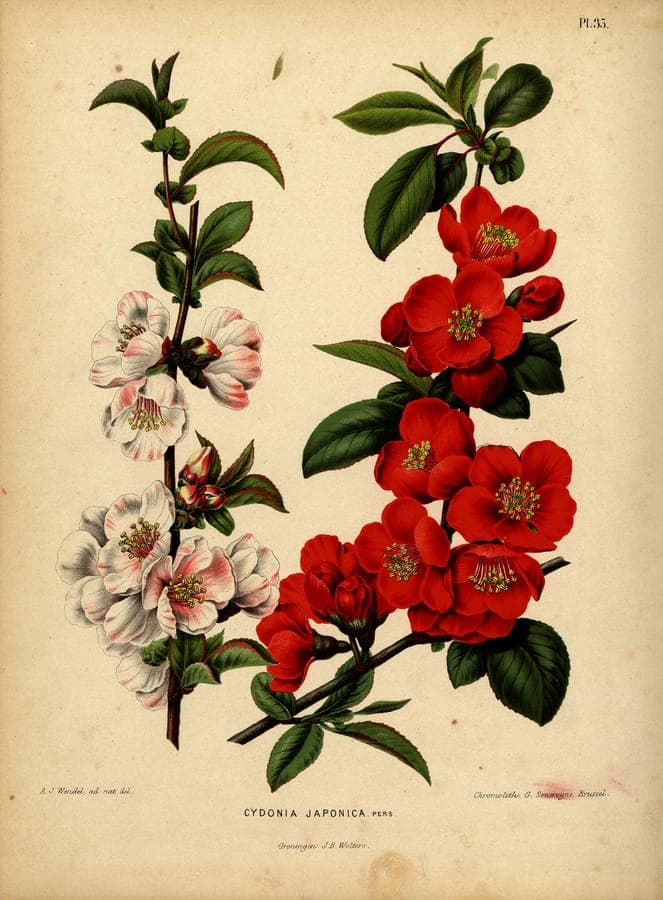
Expect the first floral display from late February through April, depending on your local climate. The flowers emerge before the leaves, bursting from knobby, thorny branches in shades of fiery orange-red, though white and soft pink cultivars like 'Nivalis' and 'Pink Lady' are also popular. Each flower is 1.5 to 2 inches (3–4 cm) wide and has a subtle, sweet fragrance that draws early pollinators like honeybees and hoverflies.
After flowering, small, hard, apple-like fruits form-about 2 inches (5 cm) long. These are technically edible but extremely tart; they're best used cooked into jams, jellies, or liqueurs. The leaves are oval, 2 to 3 inches (5–8 cm) long, medium green, and slightly fuzzy underneath. Fall color is modest, sometimes turning pale yellow or bronze, but it's not a primary ornamental feature.
Ideal location
Plant Chinese-quince in full sun to light shade. For maximum bloom, aim for at least 6 hours of direct sunlight daily. It performs well in urban gardens, cottage borders, or as a barrier plant due to its thorny stems. Avoid placing it near footpaths or play areas where thorns could be a hazard. It's also effective as a low, informal hedge-just allow 4 to 5 feet (120 cm) between plants for full coverage.
Soil requirements
This shrub is adaptable to a wide range of soils as long as drainage is good. It grows well in sandy, loamy, or clay soils with a pH between 5.5 and 7.5. Avoid waterlogged areas-poor drainage leads to root rot. If planting in heavy clay, amend the soil with compost or grit to improve aeration. Once established, Chaenomeles speciosa is quite drought-tolerant, making it suitable for xeriscaping in milder regions.
Free design
Want to see Chinese-quince: complete guide in your garden? Make a free design now.
Watering
During the first growing season, water weekly with 10–15 liters, especially during dry spells. After that, it rarely needs supplemental watering except in prolonged droughts. Overhead watering should be avoided to reduce the risk of fungal diseases like powdery mildew. Use drip irrigation or water at the base to keep foliage dry.
Pruning
Prune immediately after flowering, by late May at the latest. Remove up to one-third of the oldest stems at ground level to encourage new growth and maintain vigor. Cut back any crossing or crowded branches to improve air circulation. Avoid pruning in fall or winter, as this removes the flower buds set the previous summer. Use clean, sharp loppers and disinfect tools between cuts to prevent disease spread.
Maintenance calendar
- Jan: Inspect for winter damage. Check for broken stems.
- Feb: Flowers begin to open. Monitor for early pollinators.
- Mar: Peak bloom. No pruning. Keep area weed-free.
- Apr: Bloom fades. Begin pruning. Apply compost around base.
- May: Finish pruning. Watch for aphids on new growth.
- Jun-Aug: Minimal care. Water only in extended droughts.
- Sep: Harvest fruits if desired. Test for ripeness-firm and yellow-green.
- Oct: Leaves drop. Clean up fallen debris to reduce disease risk.
- Nov-Dec: No action needed. Mulch young plants for winter protection in zone 5.
Winter hardiness
Chaenomeles speciosa is reliably hardy down to -20°C (-4°F), making it suitable for USDA zones 5–9. In colder zones, young plants benefit from a 2–3 inch (5–8 cm) mulch layer of bark or compost to insulate roots. Mature plants need no protection and often retain some dried fruit through winter, adding visual interest.
Companion plants
Pair Chinese-quince with early spring bulbs like Narcissus 'Tête-à-Tête' or Muscari armeniacum for a vibrant display. Underplant with creeping perennials such as Ajuga reptans or Pachysandra terminalis to cover bare lower stems. For structure, combine with evergreens like boxwood or holly. Avoid planting too close to large trees that cast deep shade, as this reduces flowering.
On gardenworld.app, use the companion planting tool to test how Chaenomeles speciosa fits with your existing garden scheme, ensuring balanced light, space, and seasonal rhythm.
Closing
Chaenomeles speciosa is a hard-working shrub that delivers color, structure, and even harvestable fruit in a compact form. Its early bloom time supports pollinators, while its thorny nature deters pests and adds security. With minimal care and adaptability to various soils, it's a smart addition to any garden. You can find it at garden centres across the UK and US, often sold in 3- or 5-liter containers, ready for planting in spring or autumn.
Want to see Chinese-quince: complete guide in your garden? Make a free design now.
Upload a photo, pick a style, and get a photorealistic design with plant list in under a minute.
No credit card required


Similar plants
Siberian crab apple: complete guide
Malus x robusta
Complete guide to the Siberian crab apple (Malus x robusta): location, soil, pruning, winter hardiness and the best companion plants for your garden.
Chinese flowering crabapple (Malus x spectabilis): complete guide
Malus x spectabilis
Meet the Chinese flowering crabapple (Malus x spectabilis): a classic spring bloomer with carmine buds and pink blossom.
Potentilla crassinervia: complete guide
Potentilla crassinervia
Potentilla crassinervia, the Corsican cinquefoil, grows wild on Corsica and Sardinia's peaks. Discover how to grow this hardy alpine rock garden gem.