
Katsudanso / CC BY-SA 4.0, via Wikimedia Commons
Flowering-quince: complete guide
Chaenomeles japonica
Want to see Flowering-quince: complete guide in your garden?
1 minute, no credit card
Overview
Chaenomeles japonica, commonly known as flowering-quince, is a hardy deciduous shrub from the Rosaceae family that brings bold colour to gardens when little else is flowering. Native to Japan and Korea, this compact shrub typically reaches 60–80 cm in height with a spread of up to 1.2 meters, making it ideal for borders, rock gardens, or foundation planting. It spreads slowly by suckers, forming a dense thicket over time. Its early bloom period and adaptability to various conditions make it a reliable choice for gardeners seeking low-effort, high-impact plants. On gardenworld.app, you can design a seasonal planting scheme that highlights its vibrant spring display.
Appearance & bloom cycle
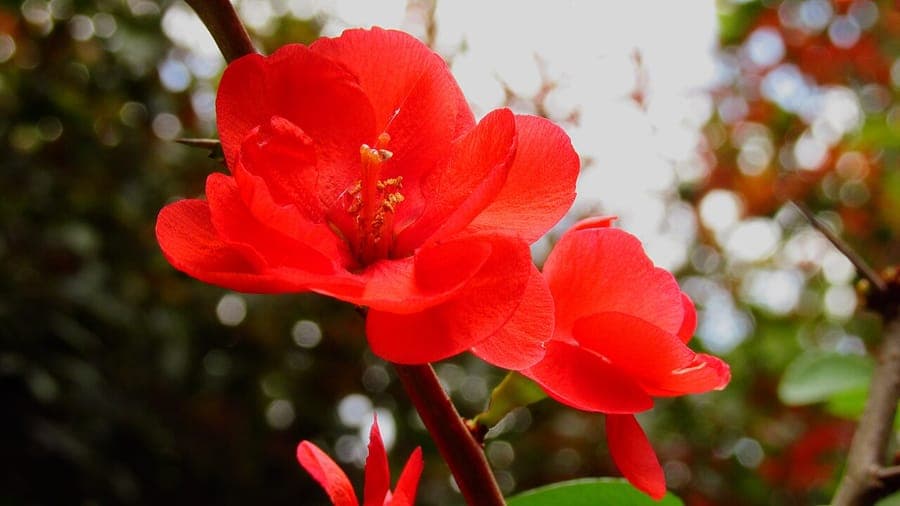
Flowering-quince bursts into bloom from late February through April, depending on climate. The flowers-ranging from deep coral to soft pink and golden yellow-emerge directly from the woody stems before the leaves appear, creating a striking silhouette. Each flower has five petals and a cluster of prominent stamens, attracting early pollinators like bumblebees. After flowering, small apple-like fruits develop, measuring 2–3 cm in diameter. These hard, sour quinces ripen in autumn and can be used for jellies or potpourri, though they're rarely eaten raw. The foliage is medium green, oval, and slightly glossy, turning yellow in fall before dropping in colder zones.
Ideal location
This shrub thrives in full sun to light shade. At least five hours of direct sunlight daily ensures the densest flowering. In deep shade, growth becomes leggy and bloom production drops significantly. It adapts well to urban gardens, courtyards, and mixed borders. Its compact size also makes it suitable for containers on patios or balconies. When planting near walkways, keep in mind the stems have small thorns, so place it where accidental brushing is unlikely.
Soil requirements
Flowering-quince is tolerant of a wide pH range from 4.5 to 8.0, growing well in sandy, loamy, or clay soils as long as drainage is adequate. Avoid waterlogged areas, as poor drainage leads to root rot. If planting in heavy clay, amend the soil with compost or coarse sand to improve aeration. A neutral to slightly acidic soil tends to promote the healthiest growth. For gardeners unsure about their soil type, gardenworld.app offers a soil analysis tool to guide planting decisions.
Free design
Want to see Flowering-quince: complete guide in your garden? Make a free design now.
Watering
Water regularly during the first growing season to establish a strong root system. Once established, Chaenomeles japonica is moderately drought-tolerant but performs best with occasional deep watering during prolonged dry spells. Mulch with organic material like bark chips to retain moisture and suppress weeds. Avoid overwatering, especially in winter when the plant is dormant.
Pruning
Pruning is minimal but beneficial. The best time is right after flowering, in May or early June, to avoid cutting off next year's flower buds. Remove up to one-third of the oldest stems at ground level to encourage new growth and maintain shape. If the shrub becomes too dense, thin out crossing or inward-growing branches. Use clean, sharp secateurs and disinfect between cuts to prevent disease spread.
Maintenance calendar
- January: Inspect for winter damage; protect potted plants from hard frost.
- February: Flowers begin to open; avoid pruning.
- March: Peak bloom; monitor for aphids or fungal spots.
- April: Flowers fade; remove spent blooms if desired.
- May: Prune after flowering; cut back old wood.
- June: Check for pests; water during dry weeks.
- July–August: Minimal care; water only in extended drought.
- September: Fruits ripen; watch for birds or slugs.
- October: Leaves may yellow and drop; leave fallen leaves as mulch.
- November: No action needed; prepare potted plants for winter.
- December: Clear debris; avoid compacting soil around base.
Winter hardiness
Hardy in USDA zones 5 to 9, flowering-quince withstands temperatures down to -20°C (-4°F). In zone 5, it may lose all leaves but resprouts vigorously in spring. Potted specimens should have their root balls insulated with hessian or bubble wrap during extreme cold. Avoid placing containers on frozen ground-elevate them on feet to prevent root damage.
Companion plants
Pair flowering-quince with early bloomers like snowdrops (Galanthus), winter aconite (Eranthis hyemalis), or hellebores (Helleborus orientalis) for continuous winter interest. Later in the season, it contrasts beautifully with purple sage (Salvia officinalis) or catmint (Nepeta). Avoid overcrowding-give it at least 60 cm of space on all sides for air circulation and ease of maintenance.
Closing
Flowering-quince is a dependable, long-lived shrub that punches above its weight in visual impact. With minimal care and a bold early display, it's a smart addition to any garden. Available at garden centres across the UK and online, it's an affordable way to add structure and colour. Whether massed in a border or grown solo in a pot, it delivers season after season. For layout ideas and planting combos, visit gardenworld.app and explore seasonal design tools.
Want to see Flowering-quince: complete guide in your garden? Make a free design now.
Upload a photo, pick a style, and get a photorealistic design with plant list in under a minute.
No credit card required


Similar plants
Siberian crab apple: complete guide
Malus x robusta
Complete guide to the Siberian crab apple (Malus x robusta): location, soil, pruning, winter hardiness and the best companion plants for your garden.
Chinese flowering crabapple (Malus x spectabilis): complete guide
Malus x spectabilis
Meet the Chinese flowering crabapple (Malus x spectabilis): a classic spring bloomer with carmine buds and pink blossom.
Potentilla crassinervia: complete guide
Potentilla crassinervia
Potentilla crassinervia, the Corsican cinquefoil, grows wild on Corsica and Sardinia's peaks. Discover how to grow this hardy alpine rock garden gem.