
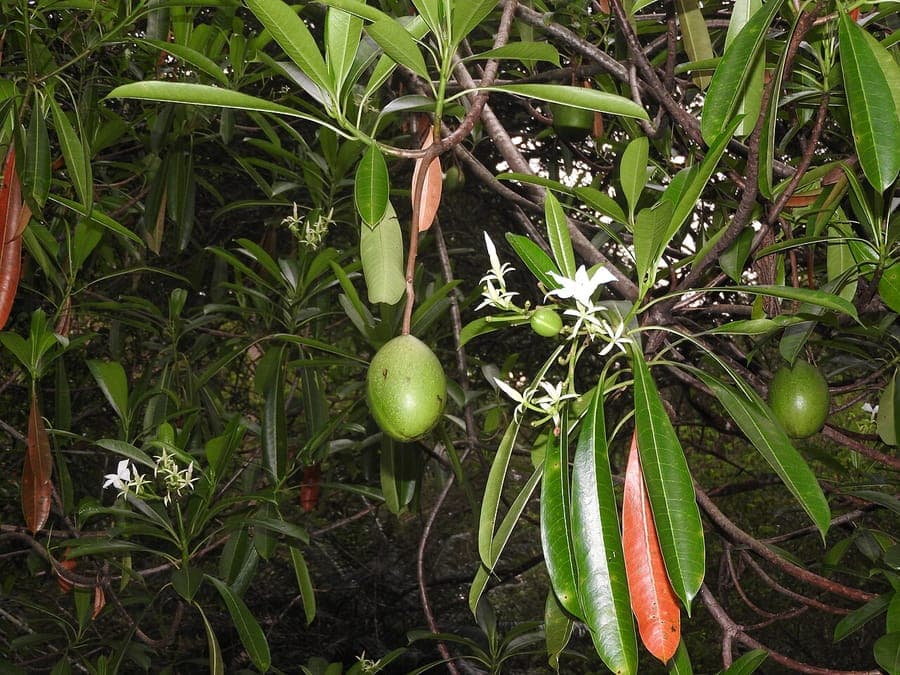
Yercaud-elango / CC BY-SA 4.0, via Wikimedia Commons
Sea-Mango: complete guide
Cerbera manghas
Want to see Sea-Mango: complete guide in your garden?
1 minute, no credit card
Introduction
The Sea-Mango (Cerbera manghas), also known as Beach Milkwood or Pink-eyed Cerbera, is a beautiful, full-sized coastal tree native to the Indo-Pacific region. This tree grows along the coasts of Southeast Asia, Australia, and islands throughout the Pacific Ocean. In its natural habitat, it reaches heights exceeding 8 meters. The plant is renowned for its ability to tolerate salt spray and strong winds, making it perfectly suited for coastal garden situations.
Appearance and Characteristics
The Sea-Mango grows into a medium to large tree with a round, full crown. The leaves are oblong, glossy green, and can reach 20 centimeters in length with a soft texture. The flowers are the star: elegant, white tubular flowers with pink or red centers bloom year-round in tropical settings or during warm seasons. The fruits are yellow to orange-red, approximately mango-sized, but are extremely toxic and must never be eaten.
Ideal Location
The Sea-Mango thrives in full sun to light shade positions with at least 5-6 hours of direct sunlight daily. The plant is highly salt-tolerant and inhales fine sea spray without issue. The tree is extremely wind-tolerant due to its flexible stems and rubbery leaves. Coastal locations are actually its preferred habitat.
Soil
The Sea-Mango is very tolerant of various soil types. Sandy coastal soils, calcareous soils, and even moderately acidic soils are all well-tolerated. The plant thrives in salt-saturated soils where other trees would fail. Good drainage is preferred, but this tree can also survive under slightly moist conditions.
Free design
Want to see Sea-Mango: complete guide in your garden? Make a free design now.
Watering
Once established, the Sea-Mango has moderate drought tolerance. In tropical areas with regular rainfall, the tree will water itself regularly. During dry seasons or in arid regions, supplemental watering may be necessary. Young newly planted trees should be watered regularly during the first growing season.
Pruning
Pruning is minimally required. The tree grows naturally into a well-balanced form. Overgrown or damaged branches can be removed after flowering. Formal pruning is not necessary but can be done for shaping. The tree responds well to pruning and will recover quickly.
Maintenance Calendar
Spring (April-May): Check for pests. Summer (June-August): Water regularly during dry periods. Autumn (September-October): Possible feeding. Winter (November-March): Minimal maintenance in cold climates.
Winter Hardiness
The Sea-Mango is marginally hardy and does not tolerate temperatures below approximately 10°C. In areas with freezing winters, this tree cannot remain permanently outdoors and must be overwintered in a protected greenhouse. In tropical and subtropical zones (USDA 10b+), it can grow outdoors year-round.
Companion Plants
The Sea-Mango grows well with other coastal-tolerant plants such as coconut palms, casuarinas, and various salt-hardy palms. Low salt-tolerant shrubs can grow beneath it.
Toxicity
ALL PARTS of this tree are highly toxic and can cause serious symptoms. The seeds are extremely poisonous. The sap can cause skin irritation. Children and pets must be protected from ingestion.
Conclusion
The Sea-Mango is a beautiful, functional choice for coastal gardens in tropical and subtropical zones. With its salt and wind tolerance and elegant white flowers, it is a distinguished addition for seaside gardeners. Available at tropical garden centers worldwide.
Want to see Sea-Mango: complete guide in your garden? Make a free design now.
Upload a photo, pick a style, and get a photorealistic design with plant list in under a minute.
No credit card required


Similar plants
Asclepias speciosa: complete guide
Asclepias speciosa
Showy milkweed: striking pink-white flowers, fragrant blooms. Essential monarch butterfly host plant.
Plumeria obtusa: complete guide
Plumeria obtusa
Discover the Singapore graveyard flower: an exotic evergreen with mesmerizing white blooms and exquisite fragrance. Expert cultivation, care, and maintenance tips.
Wrightia arborea: complete guide
Wrightia arborea
Wrightia arborea, known as doodhi, is an elegant tree from South Asia with delicate white flowers. Discover how to cultivate this exotic plant.