
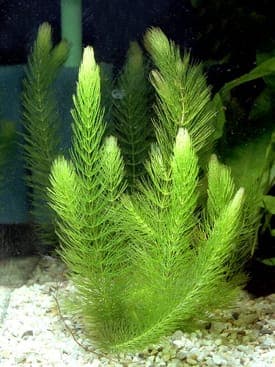
Totodilefan / Public domain, via Wikimedia Commons
Common hornwort: complete guide
Ceratophyllum demersum
Want to see Common hornwort: complete guide in your garden?
1 minute, no credit card
Overview
Common hornwort (Ceratophyllum demersum) is a submerged, free-floating aquatic perennial that thrives in still or slow-moving freshwater. Native to regions across North America, Europe, and parts of Africa and Asia, it's a popular choice for garden ponds and aquariums due to its rapid growth and excellent oxygenating properties. Unlike rooted plants, it lacks true roots and absorbs nutrients directly through its stems and leaves. This makes it an efficient natural filter, helping to reduce algae by competing for nitrates and phosphates. On gardenworld.app, you can design a pond layout that includes Common hornwort to balance water chemistry and create habitat for small aquatic life.
Appearance & bloom cycle
Common hornwort forms dense, feathery clusters of dark green stems that can reach 30–150 cm in length. The leaves grow in whorls of 6–12, giving the plant a spiky, textured look. Though technically flowering, the blooms are tiny, green, and inconspicuous, typically appearing from July to September. Most propagation happens vegetatively – broken stems float away and take root elsewhere. This rapid clonal spread means the plant rarely goes dormant and can fill a pond section within weeks under ideal conditions.
Ideal location
Plant Common hornwort in areas with moderate to bright light (6/10 on the light scale). It performs best in still or gently moving water, at depths of 30–90 cm. Avoid strong currents that can tear the delicate stems. In garden ponds, simply place loose stems on the bottom or tuck them into a mesh basket with no soil – the plant will stay suspended as it grows toward the surface. Full sun to partial shade works well, but too much direct light without shade from floating plants may encourage algae. On gardenworld.app, you can simulate how different light levels affect hornwort growth and plan your pond zones accordingly.
Soil requirements
Since Common hornwort doesn't develop true roots, it doesn't rely on soil for nutrients. Instead, it draws nitrogen, phosphorus, and minerals directly from the water column. However, using a heavy clay or pond substrate helps anchor the plant temporarily. Avoid compost-rich or peaty soils, as they release excess nutrients and cloud the water. A neutral to slightly alkaline pH (6.0–8.6) is ideal, but the plant adapts well to most freshwater conditions found in outdoor ponds.
Free design
Want to see Common hornwort: complete guide in your garden? Make a free design now.
Watering
As a fully submerged species, Common hornwort requires no traditional watering – it must remain underwater at all times. Ensure the water is clean and well-oxygenated, with minimal turbulence. Partial water changes of 10–20% monthly help maintain nutrient balance. In summer, the plant grows aggressively, absorbing excess nutrients that would otherwise feed algae. Keep water temperatures below 28°C; beyond this, growth slows and decay may set in.
Pruning
Due to its fast growth (up to 5 cm per day in peak season), regular pruning every 3–4 weeks is essential. Trim the top 10–20 cm of stems to prevent overcrowding and maintain water flow. Use sharp, clean scissors to avoid spreading pathogens. Remove cuttings from the pond – don't compost them near natural water bodies, as hornwort can become invasive. Pruning encourages bushier growth and prevents the lower stems from dying off due to light blockage.
Maintenance calendar
- Jan: Dormant phase. Remove dead or rotting material.
- Feb: Prepare for spring. Check for overwintering pests.
- Mar: Growth begins. Monitor pH and water clarity.
- Apr: Active growth starts. First trim if needed.
- May: Increase pruning frequency. Watch for algae.
- Jun: Peak growth. Prune every 3 weeks.
- Jul: Blooming (rarely visible). Ensure good circulation.
- Aug: Continue regular maintenance. Avoid overheating.
- Sep: Growth slows. Reduce trimming.
- Oct: Remove excess biomass before leaf fall.
- Nov: Growth stops. Prepare for winter.
- Dec: Dormancy. Minimal intervention needed.
Winter hardiness
Common hornwort is hardy in USDA zones 5–11. In ponds deeper than 60 cm, it survives winter as dormant fragments on the pond floor. The top growth may die back, but new shoots emerge in spring. In shallow containers or above-ground ponds, bring a portion indoors in a bucket of water at 5–10°C to overwinter. Never allow it to freeze.
Companion plants
Pair Common hornwort with other submerged plants like Elodea or Vallisneria for variety. Floating plants such as water lilies (Nymphaea) or frogbit provide shade and reduce algae. Marginal plants like cattails (Typha) or rushes add structure. Avoid overly aggressive species like hydrilla, which can outcompete hornwort for light. You can test these combinations using the pond planner tool on gardenworld.app.
Closing
Common hornwort is a low-maintenance, high-impact plant for any water feature. It oxygenates water, supports aquatic life, and controls nutrients naturally. Keep it pruned, monitor water quality, and enjoy its resilience. Find healthy stock at garden centres across the UK and US. With proper care, it returns year after year, making it a staple in sustainable pond design.
Want to see Common hornwort: complete guide in your garden? Make a free design now.
Upload a photo, pick a style, and get a photorealistic design with plant list in under a minute.
No credit card required


Similar plants
Acer pycnanthum: complete guide
Acer pycnanthum
Acer pycnanthum, the Japanese swamp maple, is a fast-growing tree with early red flowers and brilliant autumn color, ideal for damp garden settings.
Freeman maple: complete guide
Acer × freemanii
Everything about the Freeman maple (Acer x freemanii): a fast-growing shade tree with spectacular autumn colour for large gardens.
Silver vine: complete guide
Actinidia polygama
Discover silver vine (Actinidia polygama): a hardy climbing plant with silvery foliage, loved by gardeners and cats alike.