
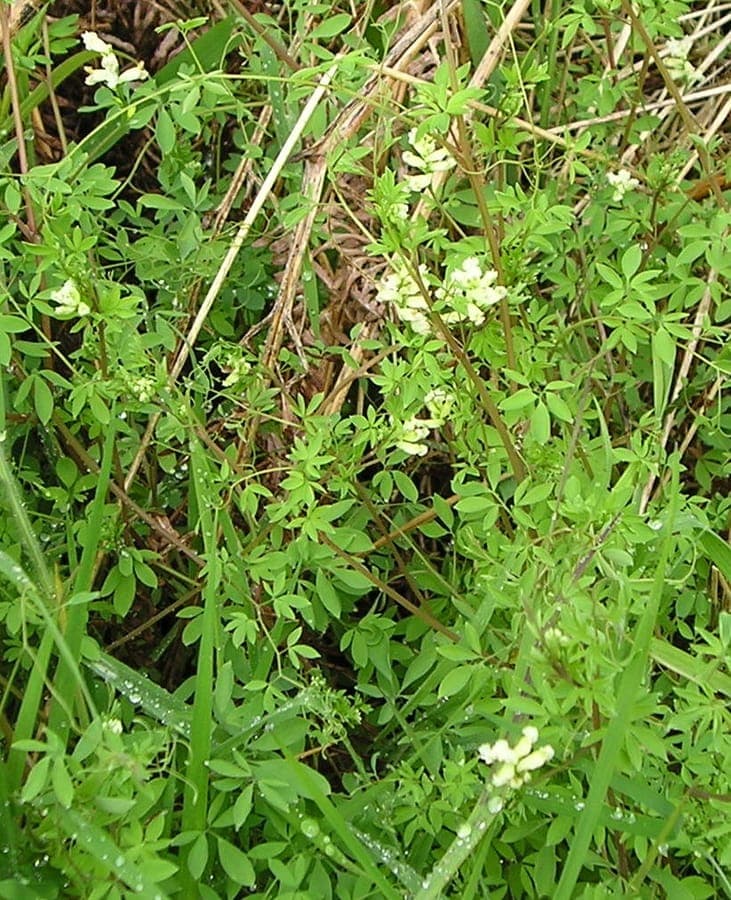
Cwmhiraeth / CC BY-SA 3.0, via Wikimedia Commons
Climbing corydalis: complete guide
Ceratocapnos claviculata
Want to see Climbing corydalis: complete guide in your garden?
1 minute, no credit card
Overview
Climbing corydalis (Ceratocapnos claviculata) is a graceful perennial climber that brings delicate beauty to shaded corners of the garden. Once classified under Corydalis, this plant now belongs to the genus Ceratocapnos within the Papaveraceae family. Native to woodlands and hedgerows across western Europe - including Great Britain, Ireland, France, and the Benelux - it thrives in cool, moist environments with filtered light. Its slender, twining stems can reach 60–100 cm in length, using modified leaf tips to grasp onto supports, making it a natural choice for softening vertical spaces.
Unlike many corydalis species that form clumps, this one climbs, giving it unique value in vertical gardening. It's perfect for growing through shrubs, over low walls, or along rustic trellises. In the UK and Ireland, it's often found naturalised in ancient woodlands, where it spreads slowly via creeping rhizomes. It's not invasive, but will form gentle colonies over time in ideal conditions.
On gardenworld.app, you can design a shade garden layout that highlights climbing corydalis alongside ferns, epimediums, and hellebores for a woodland effect.
Appearance & bloom cycle
The foliage of climbing corydalis is finely divided, soft grey-green, and almost fern-like, creating a light, airy texture. Each leaf is composed of numerous small, oval leaflets arranged oppositely along the stem. The true show begins in April, when slender racemes of dangling white flowers emerge and continue blooming through September, peaking in May and June.
Each flower is about 1–1.5 cm long, with a distinctive spurred shape typical of the poppy family. The blooms are pure white, sometimes with a pale pink blush in cooler weather. They hang in clusters from the leaf axils, swaying gently in the breeze, giving the plant a whimsical, ethereal quality.
After flowering, the plant produces small seed pods that dehisce explosively when ripe, flinging seeds several feet. This natural dispersal mechanism means the plant may pop up in nearby spots the following year, though never aggressively. Deadheading isn't required but can reduce self-seeding if desired.
Ideal location
Climbing corydalis thrives in partial to full shade, with a light rating of 5/10 - meaning it prefers dappled sunlight or north-facing exposures. Avoid hot, dry south-facing walls or open, sunny borders. It performs best under deciduous trees, where it receives spring light before canopy closure, then shade in summer.
Plant 15–20 cm apart for quicker coverage. Provide a soft support like twigs, wire mesh, or a low obelisk. The plant's tendrils will attach naturally, but young stems may need gentle guidance at first. It's excellent for cottage gardens, woodland edges, or shaded containers.
Use gardenworld.app to simulate how climbing corydalis will grow in your specific garden layout, including light patterns and plant spacing.
Free design
Want to see Climbing corydalis: complete guide in your garden? Make a free design now.
Soil requirements
This plant prefers humus-rich, well-drained soil with a pH between 4.5 and 5.0. It does best in moist but not waterlogged conditions. Heavy clay soils should be amended with leaf mould or composted bark to improve structure. Sandy soils benefit from added organic matter to retain moisture.
Avoid chalky or alkaline soils - climbing corydalis will struggle or fail to thrive. A 5–7 cm mulch of leaf litter or compost in spring helps retain moisture and suppress weeds.
Watering
Water regularly during dry spells, especially in the first year after planting. Established plants are moderately drought-tolerant but perform best with consistent moisture. Never let the soil dry out completely in summer. Use a soaker hose or water at the base to avoid wetting foliage, which can encourage fungal issues.
Pruning
Minimal pruning is needed. In late autumn or early spring, cut back old stems to 5–10 cm above ground level to encourage fresh growth. If you want to limit self-seeding, deadhead spent flower spikes before seeds form.
In mild winters, you can leave the stems intact for winter interest and added root protection.
Maintenance calendar
- Jan: Check mulch layer; protect from prolonged frost if needed.
- Feb: Prepare planting sites; inspect for early growth.
- Mar: Plant new specimens; clear away winter debris.
- Apr: Growth resumes; flowers begin to appear.
- May: Peak bloom; monitor soil moisture.
- Jun: Continue blooming; watch for seed development.
- Jul: Flowers persist; consider deadheading.
- Aug: Blooming tapers off; cut back if desired.
- Sep: Final blooms; collect seeds or trim back.
- Oct: Leave or cut foliage; apply fresh compost.
- Nov: Mulch with leaf mould.
- Dec: Dormant period; minimal care required.
Winter hardiness
Climbing corydalis is hardy in USDA zones 6–9 (-23°C to -4°C). It dies back in winter but returns reliably each spring from underground rhizomes. No winter protection is usually necessary in the UK, Ireland, or Pacific Northwest. In colder zones, a light mulch helps prevent frost heave.
Companion plants
Excellent partners include:
- Ferns (Dryopteris, Athyrium)
- Helleborus orientalis
- Epimedium spp.
- Hosta spp.
- Pulmonaria officinalis
Avoid competitive groundcovers like ivy or periwinkle, which can smother it. Plant in drifts for a naturalised look.
Closing
Climbing corydalis is a reliable, long-flowering gem for shaded gardens. With its elegant form and minimal care needs, it's a smart choice for gardeners wanting beauty without fuss. Buy from local garden centres in spring. For planting ideas and garden designs, visit gardenworld.app.
Want to see Climbing corydalis: complete guide in your garden? Make a free design now.
Upload a photo, pick a style, and get a photorealistic design with plant list in under a minute.
No credit card required


Similar plants
Papaver gorodkovii: complete guide
Papaver gorodkovii
Papaver gorodkovii, the arctic poppy, thrives from Alaska to Russia's Far East. Discover how to grow this rare, extremely cold-hardy rock garden treasure.
Papaver setiferum: complete guide
Papaver setiferum
Papaver setiferum is a hardy giant Caucasian poppy with fiery red blooms. Discover siting, soil, deadheading and winter hardiness.
Pale Poppy: complete guide
Papaver alboroseum
Discover pale poppy (Papaver alboroseum) - rare alpine poppy with white-pink flowers. Precious beauty from Kamchatka. Cultivation in alpine and rock gardens.