
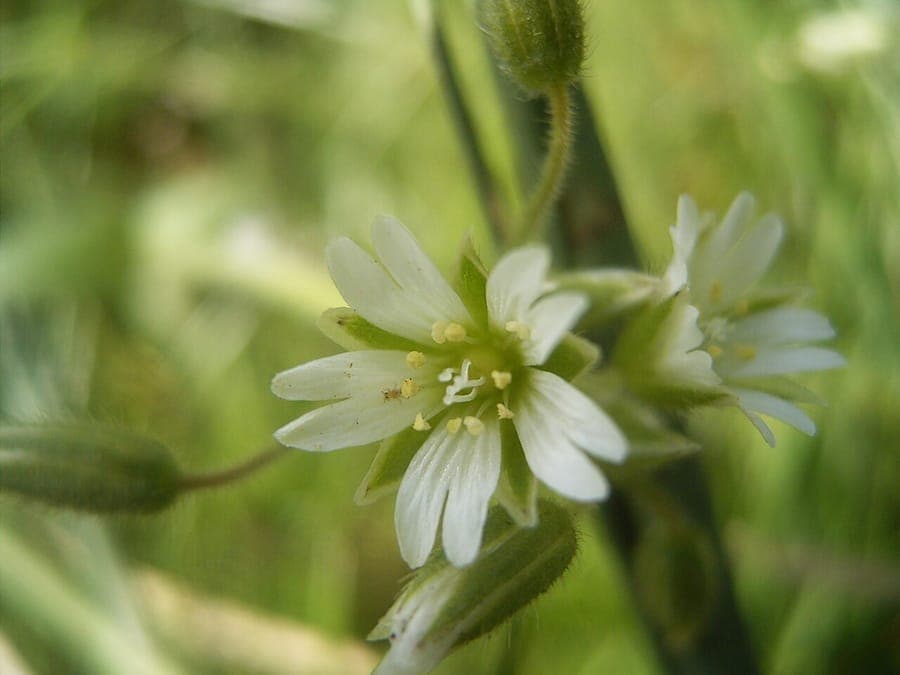
Me / Public domain, via Wikimedia Commons
Common mouse-ear: complete guide
Cerastium fontanum
Want to see Common mouse-ear: complete guide in your garden?
1 minute, no credit card
Overview
Cerastium fontanum, commonly known as common mouse-ear, is a low-growing, spreading herbaceous perennial that thrives across temperate regions of Europe. Belonging to the Caryophyllaceae family, it forms dense mats of fuzzy, bright green foliage and produces a long succession of small white flowers from March through October. While some gardeners dismiss it as a weed, this plant is actually a fantastic ground cover, especially in informal or wildlife-friendly gardens.
Native to countries like Great Britain, Germany, and Austria, common mouse-ear adapts easily to a range of garden conditions. It's particularly useful for stabilising soil on slopes, filling gaps between pavers, or softening the edges of stone paths. If you're planning a natural-looking garden, use gardenworld.app to visualise how Cerastium fontanum can be integrated into your design.
Appearance & bloom cycle
This plant grows 5–10 cm tall and spreads indefinitely under favourable conditions. The leaves are narrow, lance-shaped, and densely covered in fine white hairs, giving them a soft, velvety texture. These hairs also help reduce water loss, contributing to its drought tolerance.
Flowering begins as early as March and continues into October, peaking in May and June. The white, five-petaled flowers are about 1 cm wide and appear in loose clusters at the stem tips. Each flower lasts a few days, but the overall bloom period is impressively long. After flowering, seed capsules form and disperse easily by wind or foot traffic, allowing the plant to colonise new areas.
Ideal location
Common mouse-ear performs best in full sun to light shade, requiring a light level of 7 out of 10. This means at least 5–6 hours of direct sunlight daily. In deep shade, the plant becomes leggy and blooms poorly.
It's ideal for cottage gardens, rockeries, gravel beds, and between stepping stones. Its mat-forming habit suppresses weeds naturally and reduces soil erosion. For optimal placement, try using gardenworld.app to map out your garden layout and see where Cerastium fontanum will thrive without overwhelming slower-growing neighbours.
Soil requirements
This species is adaptable but prefers well-drained, slightly acidic to neutral soil with a pH between 5.5 and 6.5. Heavy clay soils should be amended with sand or grit to improve drainage. Avoid waterlogged conditions, as they can lead to root rot.
Interestingly, Cerastium fontanum does better in poorer soils. Rich, heavily fertilised ground encourages lush foliage at the expense of flowers. A light top-dressing of compost in early spring is sufficient for nutrient support.
Free design
Want to see Common mouse-ear: complete guide in your garden? Make a free design now.
Watering
Once established, common mouse-ear is quite drought-tolerant. During the first few weeks after planting, water regularly to help roots settle-about 1–2 times per week, depending on rainfall.
Water at the base to avoid wetting the hairy leaves, which can promote fungal diseases like powdery mildew. Rainwater is preferable, as the plant can be sensitive to high calcium levels in tap water.
Pruning
Pruning isn't essential, but a light trim in mid-summer (July or August) can rejuvenate the plant and encourage a second flush of blooms. Cut back overgrown stems by 3–5 cm using clean shears.
If the plant spreads too aggressively, edge it with a spade to contain its growth. While not invasive in most gardens, it can outcompete slower ground covers if left unchecked.
Maintenance calendar
- March: Remove old foliage. Lightly fertilise if needed.
- April – June: Active growth phase. Monitor for pests and water during dry spells.
- July – August: Peak bloom. Trim back if leggy.
- September: Watch for seed dispersal. Thin if overcrowded.
- October: Allow final blooms to fade. No pruning.
- November – February: Dormant period. No maintenance required, except in extreme cold.
Winter hardiness
Common mouse-ear is winter hardy to USDA zone 4 (-34°C). In the UK and most of Europe (zones 7–9), it remains evergreen through winter and resumes growth early in spring.
In prolonged freezing conditions without snow cover, the top growth may suffer some dieback, but the roots survive. Mulching isn't usually necessary, but a thin layer of leaf litter can offer extra protection in exposed sites.
Companion plants
Pair Cerastium fontanum with other low-growing companions like Thymus serpyllum, Ajuga reptans, or Sedum spurium. It also works well with early spring bulbs such as Chionodoxa or Scilla, which bloom before the mouse-ear fully spreads.
Avoid planting it with delicate alpines or slow-growing succulents that it might smother. In mixed borders, use it as a soft edging plant in front of taller perennials like Nepeta or Salvia.
Closing
Cerastium fontanum is a tough, adaptable plant that deserves more recognition in the garden. It's perfect for beginners and experienced gardeners alike who want a low-effort, high-reward ground cover. With its long bloom time, soft texture, and ecological benefits, it's a smart addition to any informal planting scheme.
You can find common mouse-ear at garden centres across the UK or online. Look for plugs or small pots in spring. To maximise its potential, use a tool like gardenworld.app to plan your layout and create a garden that balances beauty with practicality.
Want to see Common mouse-ear: complete guide in your garden? Make a free design now.
Upload a photo, pick a style, and get a photorealistic design with plant list in under a minute.
No credit card required


Similar plants
Dianthus karami: complete guide
Dianthus karami
Dianthus karami is a rare Lebanese mountain pink with fringed pink blooms on limestone cliffs, ideal for rock gardens and troughs.
Sicilian pink: complete guide
Dianthus siculus
Discover Dianthus siculus, an elegant purple bloomer from Sicily. Cultivation, June-September flowering and garden combinations.
Alpine mouse-ear chickweed: complete guide
Cerastium pedunculatum
Full growing guide for Cerastium pedunculatum: ideal location, soil, watering, winter hardiness, and companion plants for rock gardens.