
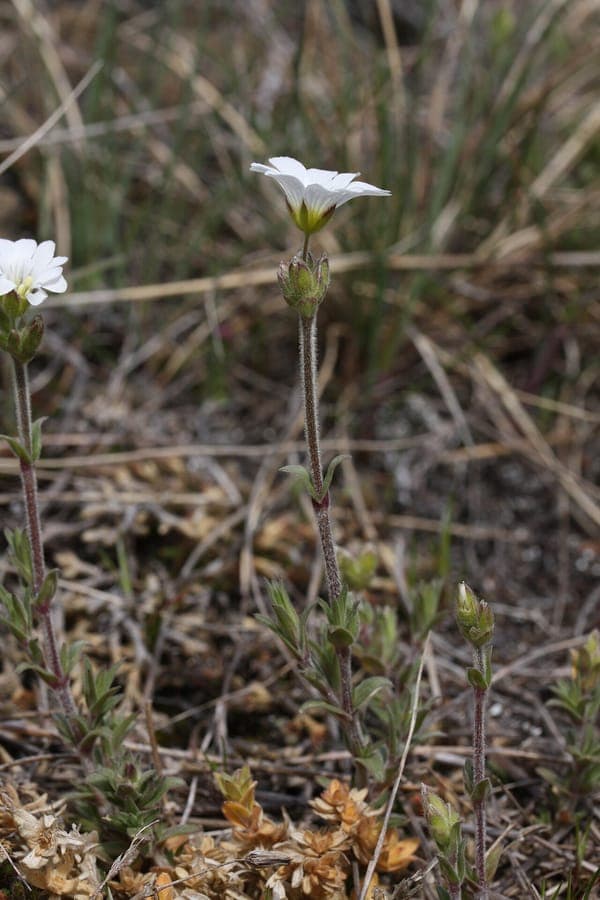
Walter Siegmund (talk) / CC BY-SA 3.0, via Wikimedia Commons
Cerastium arvense: complete guide
Cerastium arvense
Want to see Cerastium arvense: complete guide in your garden?
1 minute, no credit card
Overview
Cerastium arvense, commonly known as field chickweed or mouse-ear chickweed, is a low, herbaceous wildflower from the Caryophyllaceae family. Growing only 15-30 cm tall, this plant forms broad, compact mats with very fine, gray-green foliage. Flowers are pure white and appear in massive numbers in late spring. This is a plant for devotees of subtle, low growth and natural texture.
Appearance and Bloom Cycle
Field chickweed features very fine, hairy, gray-green leaves lying closely together. Stems are low and sprawling, forming rectangular mats that hold together without spreading excessively. Flowers are the highlight: pure white, approximately 1-1.5 cm across, appearing in countless numbers.
Blooming peaks from April through June. After flowering, small seed heads form that remain attractive deep into summer. Foliage stays green year-round, making Cerastium arvense an important texture element even in winter.
Ideal Location
Field chickweed thrives in full sun. This is non-negotiable; in shade the plant grows poorly and barely flowers. Provide at least 6-8 hours of direct daily sunlight.
Place field chickweed between stones, in dry borders, along pathways, or as groundcover between low-growing flowers. The plant pairs well with other drought-lovers like hens-and-chicks and sedums.
Soil Requirements
This is a plant for poor, lean soil. Cerastium arvense grows well in sandy, stony, or grit-rich soils that drain extremely freely. Heavy, moist clay soils are unsuitable.
A neutral to slightly alkaline pH (6.5-7.5) is ideal. Fertilizing is unnecessary and can be harmful; it stimulates excessive foliage at the expense of flowering.
Watering
Once established, field chickweed is very drought-tolerant. The plant accepts natural rainfall and needs no supplemental water except in the driest summers. Excess water is more harmful than drought.
In very wet winters on poor soils, the plant may perish. Always ensure excellent drainage.
Free design
Want to see Cerastium arvense: complete guide in your garden? Make a free design now.
Pruning and Maintenance
Field chickweed requires minimal maintenance. After blooming, you can lightly prune to maintain compact form, though this isn't always necessary. In spring, remove any winter die-back.
The plant self-seeds; manage this if unwanted.
Maintenance Calendar
Spring (March-April): Light pruning, remove winter damage Summer (May-August): Allow flowering, leave seed heads attractive Autumn (September-October): Minimal care, moisture management Winter (November-February): No maintenance; foliage remains ornamental
Winter Hardiness
Cerastium arvense is very hardy to USDA zone 2 (-45°C). This plant survives all Dutch, Belgian, and French winters without protection. Foliage remains green year-round and retains ornamental value.
Companion Plants
Field chickweed pairs well with:
- Hens-and-chicks (Sempervivum)
- Sedum (Sedum)
- Cranesbill (Geranium)
- Lavender (Lavandula)
- Thrift (Armeria)
- Pasque flower (Pulsatilla vulgaris)
The white flowers enhance other colors beautifully.
Closing Remarks
Cerastium arvense is for those who love low, fine texture and prefer minimal maintenance. Not a spectacular plant, but a stalwart for natural growth in rock gardens and dry borders. Garden centers stock seed and plants readily. With gardenworld.app, easily design rock garden combinations where field chickweed plays a soft, textural supporting role, backed by taller structural plants.
Sow field chickweed from seed for minimal cost, or purchase plants for immediate effect. The plant demands nothing but delivers reliable, quiet elegance year after year.
Discover on gardenworld.app how to feature this texture plant optimally in your front garden.
Want to see Cerastium arvense: complete guide in your garden? Make a free design now.
Upload a photo, pick a style, and get a photorealistic design with plant list in under a minute.
No credit card required


Similar plants
Dianthus karami: complete guide
Dianthus karami
Dianthus karami is a rare Lebanese mountain pink with fringed pink blooms on limestone cliffs, ideal for rock gardens and troughs.
Sicilian pink: complete guide
Dianthus siculus
Discover Dianthus siculus, an elegant purple bloomer from Sicily. Cultivation, June-September flowering and garden combinations.
Alpine mouse-ear chickweed: complete guide
Cerastium pedunculatum
Full growing guide for Cerastium pedunculatum: ideal location, soil, watering, winter hardiness, and companion plants for rock gardens.