
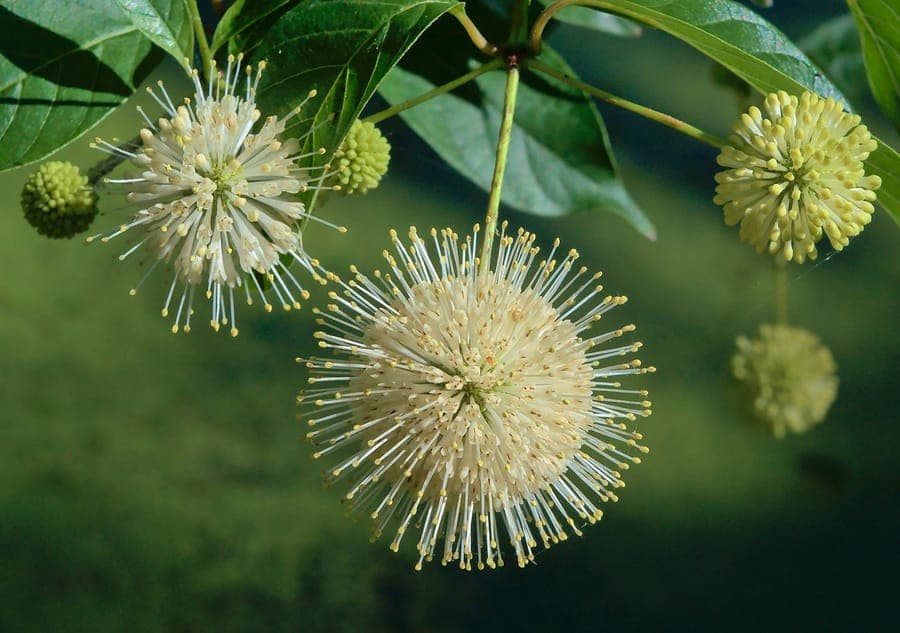
The Cosmonaut / CC BY-SA 4.0, via Wikimedia Commons
Common buttonbush: complete guide
Cephalanthus occidentalis
Want to see Common buttonbush: complete guide in your garden?
1 minute, no credit card
Overview
Common buttonbush (Cephalanthus occidentalis) is a North American wetland-adapted ornamental shrub. This native plant grows excellently along ponds, ditches and low-lying areas. The characteristic ball-shaped white flowers bloom in summer and attract pollinators.
This plant plays a vital role in local ecosystems, providing food and habitat for waterfowl and insects. For gardeners, it's an important specimen for rainwater management and biodiversity goals.
Appearance & Bloom
Common buttonbush grows into a rounded, multi-branching shrub of 1-3 meters height. The foliage is green and lanceolate, arranged opposite or in whorls. Summer foliage is lush and provides full texture.
The bloom is the highlight: compact, ball-shaped white to yellowish-white flower clusters appear June through September. These knob-like blossoms have pleasant fragrance and produce dense pollen. Later, characteristic brown ball-shaped seed heads form.
Ideal Location
Common buttonbush thrives optimally in fully sunny spots but tolerates partial shade well. A minimum of 4 hours direct sunlight ensures healthy growth and maximum blooming.
The plant prefers proximity to water - plantings along ponds, ditches, marshes and water features yield best results. Constantly moist soil is essential; this plant tolerates periodic water overflow.
Soil
Common buttonbush grows optimally in heavy, moist soils with good organic material. Clay to loam soils are ideal; this plant prefers rich, constantly moist conditions.
Addition of compost or leaf mould increases moisture retention and soil quality. The plant can tolerate water-saturated ground without problems - in fact, this is the preferred condition.
Free design
Want to see Common buttonbush: complete guide in your garden? Make a free design now.
Watering
Common buttonbush requires consistently moist soil during the growing season. In non-irrigated conditions water regularly, especially during dry season.
Once mature, many specimens can sustain themselves from natural rainfall, especially in wet regions. In dry regions supplement water during extreme droughts. This plant prefers NOT dry - consistently moist soil ensures best health.
Pruning
Common buttonbush can be pruned after blooming to support compact form. Remove dead or damaged branches in early spring.
Mild pruning encourages bushier growth and more blooms next year. However, this is an optional plant - natural form is also acceptable. Avoid excessive pruning.
Maintenance Calendar
Spring: Prune to limit form, monitor water given. Summer: Monitor moisture content, deadhead faded flowers for further blooms. Fall: Let seed heads stand for bird food. Winter: Minimal maintenance.
This is low-maintenance once established in suitable location.
Winter Hardiness
Common buttonbush is winter-hardy in temperate zones and tolerates temperatures to -10°C. In very cold regions winter damage may occur, but the plant regrows from the base.
Protection from harsh wind directions increases winter survival. In continental zones mulch around the base for extra protection in winter months.
Companion Plants
Plant Common buttonbush with other water-lovers such as joe-pye weed (Eupatorium), cardinal flower (Lobelia cardinalis) and iris plants (Iris). This combination creates authentic wetland ecosystem.
Addition of aquatic plants such as yellow water-lily (Nuphar) increases ecological value.
Closing
Common buttonbush is an invaluable specimen for gardens with moist zones, marshes or water features. This American classic delivers decades of blooms, pollinator-friendships and bird habitat. For eco-conscious gardeners, this plant is a must-have for gardenworld.app.
Want to see Common buttonbush: complete guide in your garden? Make a free design now.
Upload a photo, pick a style, and get a photorealistic design with plant list in under a minute.
No credit card required


Similar plants
Oregon bedstraw: complete guide
Galium oreganum
Everything about Oregon bedstraw (Galium oreganum): shade planting, soil requirements, care and use as a low groundcover in woodland and shade gardens.
Awned woodruff: complete guide
Asperula aristata
Full guide to growing Asperula aristata, the awned woodruff: sunny location, alkaline soil, minimal watering, and companion plants for dry or rock gardens.
Purple woodruff: complete guide
Asperula purpurea
Full guide to Asperula purpurea, purple woodruff: sunny sites, chalky soil, watering, pruning, winter hardiness and companion plants for rock and dry gardens.