
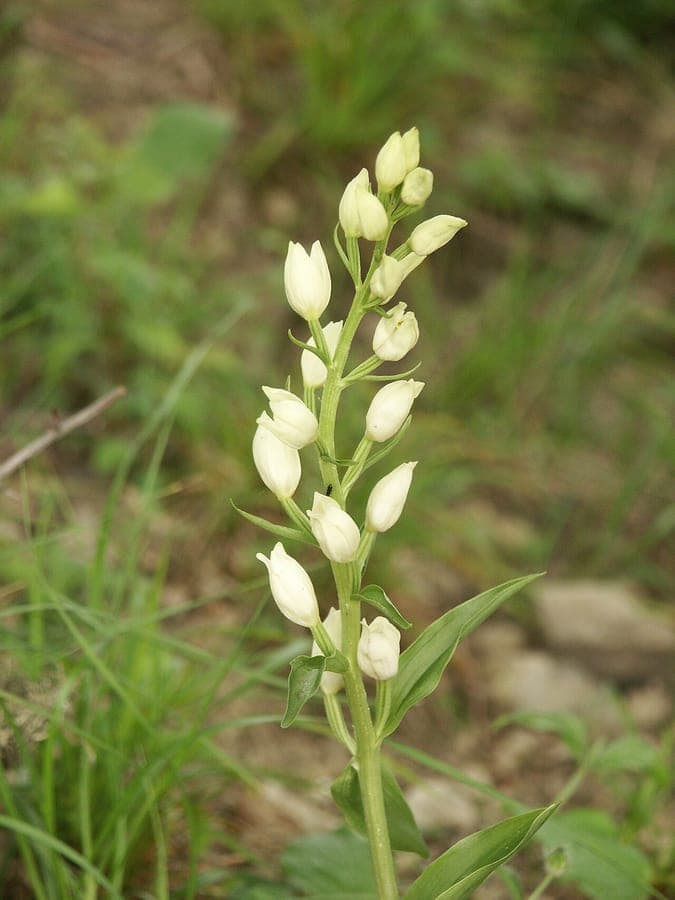
Bernd Haynold / CC BY 2.5, via Wikimedia Commons
White helleborine: complete guide
Cephalanthera damasonium
Want to see White helleborine: complete guide in your garden?
1 minute, no credit card
Overview
The white helleborine (Cephalanthera damasonium) is a quiet star of the woodland floor. Native to old European forests, this orchid thrives where few gardeners dare to plant - in deep, stable shade with alkaline soil. Found across southern UK, Belgium, and into central Europe, it's a plant for those who value subtlety. As a horticulturist, I've seen it succeed only when its needs are met precisely. This isn't a garden centre impulse buy; it's a long-term project. On gardenworld.app you can design a woodland layout that mimics its natural habitat, increasing your chances of success.
Part of the Orchidaceae family, it's a tuberous perennial that dies back each winter. Despite the name, it's not related to true hellebores. It grows slowly, often taking two to three years to bloom after planting. Patience is non-negotiable. It's also protected in many countries, so never collect from the wild. Buy only from licensed nurseries or garden centres that propagate ethically.
Appearance & bloom cycle
Expect a height of 30 to 60 cm. The stem is upright, pale green, and usually unbranched. Leaves are lance-shaped, 5–10 cm long, arranged in a spiral. They're matte green with a slight fuzz on the underside - helpful for ID in late spring.
Blooms appear from late May to June. Each stem carries 3 to 8 flowers, facing slightly forward. The blooms are pure white to pale yellow, 1.5–2 cm across, with a ruffled lip and a narrow hood. They have a faint, sweet scent - barely detectable unless you're close. Flowering lasts about three weeks. After that, seed capsules form and split open in August, releasing dust-like seeds. These need specific mycorrhizal fungi to germinate, so don't expect self-seeding.
Ideal location
This orchid needs dappled shade - a 5 on the light scale (1 = full shade, 10 = full sun). Think under mature deciduous trees like beech, maple, or hornbeam. Morning sun with afternoon shade works best. Avoid south-facing spots with hot midday sun, especially in June.
North-east or east-facing slopes under open canopies are ideal. Never plant under dense conifers - they acidify the soil and block light. On gardenworld.app, use the shade-mapping tool to preview light levels before planting.
Soil requirements
Alkaline soil is non-negotiable. Aim for pH 7.0 to 7.5. The soil must be well-drained but moisture-retentive, rich in humus. Sandy or heavy clay? Amend with leaf mould and crushed oyster shell for calcium. Never use artificial fertiliser - it burns delicate roots.
Structure matters: mix in some fine bark or wood chips to prevent compaction. The soil should feel crumbly, not sticky. If your soil is acidic, consider raised beds with imported woodland soil. This plant won't adapt - you must adapt to it.
Free design
Want to see White helleborine: complete guide in your garden? Make a free design now.
Watering
Keep the soil lightly moist, especially in April and May when the tuber is waking up. Water once a week in dry spells - about 10 litres per m². Apply at ground level; avoid wetting the leaves to prevent fungal issues.
In wet summers, do nothing. Let nature handle it. Use rainwater if possible - tap water can be too chlorinated or too hard. During droughts, never let the soil dry out completely. A 2–3 cm mulch of leaf litter helps retain moisture and keeps roots cool.
Pruning
No pruning needed. Let the plant die back naturally. Cutting stems early disrupts energy storage. In November, when all foliage is brown, you can trim dead growth if it bothers you. Otherwise, leave it - it protects the tuber and feeds the soil.
If you want to collect seed, cover the capsule with a fine mesh bag in late July. But be realistic: germination rates are near zero without symbiotic fungi.
Maintenance calendar
- Jan: Check for frost heave, keep area clear of debris
- Feb: Add thin layer of leaf mould
- Mar: Inspect for early growth, remove weeds by hand
- Apr: Water lightly if dry
- May: Blooms start, avoid disturbance
- Jun: Peak bloom, maintain moisture
- Jul: Seeds develop, no feeding
- Aug: Capsules split, collect if desired
- Sep: Let plant rest
- Oct: Foliage dies back
- Nov: Trim if needed
- Dec: Dormant phase, no action
Winter hardiness
Hardy in USDA zones 6–8. In zone 7 (most of southern UK and central Europe), it survives well with minimal care. The tuber sits 5–8 cm deep and tolerates frost, but prolonged freezing can damage it. A mulch of fallen leaves or wood chips offers insulation without trapping moisture.
Avoid walking over the spot - compaction kills tubers. Don't use plastic covers; they encourage rot.
Companion plants
Pair with ferns like Dryopteris filix-mas, wood anemone (Anemone nemorosa), and barren strawberry (Potentilla sterilis). Avoid aggressive spreaders like ivy or periwinkle. Buxus or yew make good structural backdrops if they don't steal too much moisture.
Other orchids like Platanthera bifolia can work, but space them out. On gardenworld.app, you can preview plant spacing and root competition in 3D.
Closing
The white helleborine rewards patience and precision. It won't thrive in average garden soil, and it won't bloom on demand. But when it flowers - quietly, in late spring - it feels like a secret shared. Buy from reputable sources like garden centres with ethical propagation. Expect a 2–3 year wait before bloom. When it finally happens, you'll know your woodland garden has found its balance.
Want to see White helleborine: complete guide in your garden? Make a free design now.
Upload a photo, pick a style, and get a photorealistic design with plant list in under a minute.
No credit card required


Similar plants
Ram's-head lady's slipper: complete guide
Cypripedium arietinum
Everything you need to know about growing Cypripedium arietinum, a rare woodland orchid for cool, moist garden settings. Soil, care and planting tips.
Sparrow's-egg lady's slipper: complete guide
Cypripedium passerinum
Everything about growing Cypripedium passerinum, a cold-hardy subarctic orchid suited to cool, moist, shaded garden spots. Soil, care and companion plants.
Algerian Butterfly-orchid: complete guide
Platanthera algeriensis
Everything about Platanthera algeriensis, the rare Mediterranean orchid with greenish flowers native to Algeria, Morocco, Corsica and Spain.