
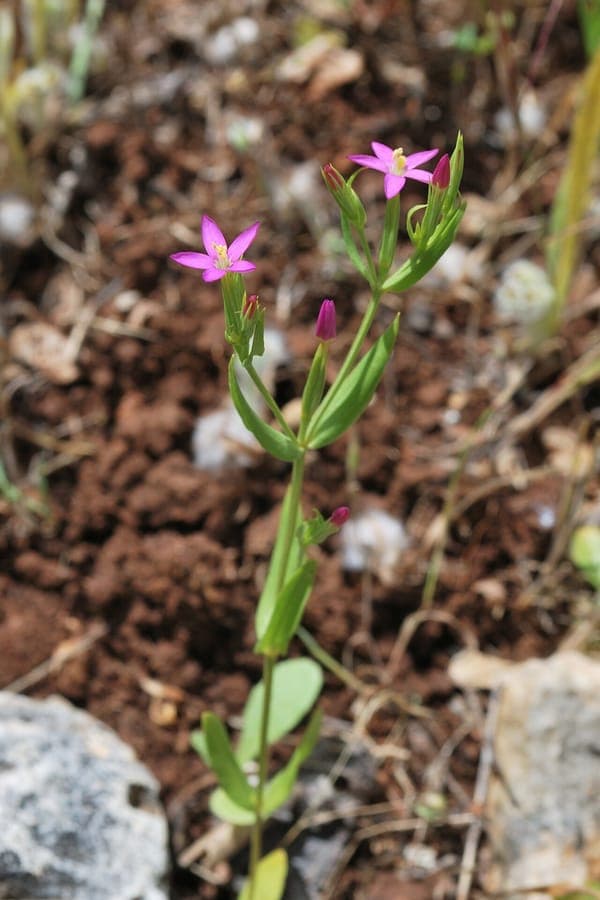
Gideon Pisanty (Gidip) / CC BY 3.0, via Wikimedia Commons
Centaurium tenuiflorum: complete guide
Centaurium tenuiflorum
Want to see Centaurium tenuiflorum: complete guide in your garden?
1 minute, no credit card
Overview
Centaurium tenuiflorum, known as slender centaury or channel centaury, is a graceful, delicate annual herb from the Gentianaceae family. Native to the Mediterranean region and southwestern Europe, this charming plant flowers abundantly from June to August with tiny pink blooms.
Despite appearing fragile, slender centaury thrives in warm, dry garden locations requiring virtually no maintenance. Growing to approximately 20-40 centimeters tall, it becomes a delightful addition to Mediterranean gardens and rocky slopes. Its fine texture and prolific flower production make it a botanist's favorite for naturalistic plantings.
Appearance and bloom
Slender centaury is an upright, delicately branched plant with threadlike stems. The foliage is extremely fine, with leaves barely 1-2 millimeters wide, giving the plant a grass-like, ethereal appearance. Along the stems, from June through August, appear countless tiny, bright pink flowers.
Each flower measures approximately 5-8 millimeters across and groups into loose, airy clusters. After flowering, tiny seeds form and readily self-sow, often establishing spontaneous populations in subsequent years. The entire plant disappears in autumn after seed production.
Ideal location
Place slender centaury in warm, sunny locations within your garden. The plant thrives best on dry, impoverished soils. This herb excels in rock gardens, between stones, on pergola bases, and in Mediterranean garden elements. It also thrives in containers and window boxes on terraces and balconies.
The plant enjoys growing through gravel and between paving stones, making it perfect for crevice planting. Less suitable are shaded locations or perpetually moist ground.
Soil
Slender centaury has minimal soil demands, provided drainage is excellent. Sand, gravel, and loam are ideal; it prefers neutral to slightly acidic soil (pH 6.5-7). Avoid heavy clay soils and waterlogged locations.
On poor, infertile soils, this plant thrives most. Incorporate sand into heavy soils to improve drainage. Fertilizing is unnecessary - excess nutrition actually inhibits growth and flowering.
Free design
Want to see Centaurium tenuiflorum: complete guide in your garden? Make a free design now.
Watering
Once established, slender centaury requires minimal water. This is a true drought survivor. Even during warm summers, occasional water is needed only during extreme drought. Shortly after sowing or transplanting, modest watering helps, but afterward becomes unnecessary.
Strictly avoid waterlogging - this plant cannot tolerate wet feet. In rainy climates, additional drainage may be necessary.
Pruning
Slender centaury requires no pruning. The plant naturally maintains a compact form. After flowering, you may remove seed heads if desired, but this is unnecessary - the plant self-manages seed distribution.
Leave some dead material standing; this helps seeds tumble and germinate in protected garden locations.
Maintenance calendar
May: Direct-sow seeds or transplant seedlings. June-August: Enjoy profuse blooms, water sparingly. September-October: Allow plants to produce and scatter seed. November-April: Winter dormancy; no maintenance needed. Following spring: Expect spontaneous seedlings from self-sown seeds.
Winter hardiness
Slender centaury is an annual plant that dies following first frost. Winter hardiness in the traditional sense does not apply. However, through seed production, new plants reliably appear in subsequent summers. This makes it an exceptionally sustainable choice despite its brief lifespan.
Companion plants
Combine slender centaury with other Mediterranean annuals such as bachelor's button and sunflower. It also pairs well with stonecrop sedums and alpine plants. Group multiple plants together for enhanced visual impact.
In wild gardens, late sowing encourages natural spontaneous distribution.
Conclusion
Slender centaury is perfect for those seeking delicate pink blooms with utterly minimal care requirements. The plant demands virtually no maintenance, provides refined beauty, and spontaneously produces offspring. Ideal for warm, dry garden corners in Mediterranean plantings.
Purchase seeds easily online or at garden centers. For garden design inspiration, consult gardenworld.app.
Want to see Centaurium tenuiflorum: complete guide in your garden? Make a free design now.
Upload a photo, pick a style, and get a photorealistic design with plant list in under a minute.
No credit card required


Similar plants
Branched gentianella: complete guide
Gentianella ramosa
Full growing guide for Gentianella ramosa, the branched Alpine gentianella of the SW Alps - location, soil, watering, winter care and companion plants.
Spiked centaury: complete guide
Schenkia spicata
Full growing guide for Schenkia spicata (spiked centaury): sunny position, dry soil, bloom season and garden companions.
Narrow-leaf gentian: complete guide
Gentiana angustifolia
Narrow-leaf gentian growing guide: intense blue trumpet flowers in May-July on well-drained limestone. Full cultivation tips.