
HermannSchachner / CC0, via Wikimedia Commons
Sea centaury: complete guide
Centaurium littorale
Want to see Sea centaury: complete guide in your garden?
1 minute, no credit card
Overview
Sea centaury (Centaurium littorale) is a low-key but elegant herb native to coastal and sandy inland areas across northern and central Europe. In the wild, it thrives in open, disturbed ground-think dunes, roadside verges, and coastal meadows. As a garden plant, it's perfect for naturalistic designs, dry rock gardens, or gravel borders. It's an annual or biennial that self-seeds reliably, so once established, it comes back year after year with minimal effort. If you're planning a wildflower meadow or coastal-inspired garden, sea centaury fits right in. On gardenworld.app, you can design a layout that highlights its airy blooms and integrates it with complementary textures and heights.
Appearance & bloom cycle
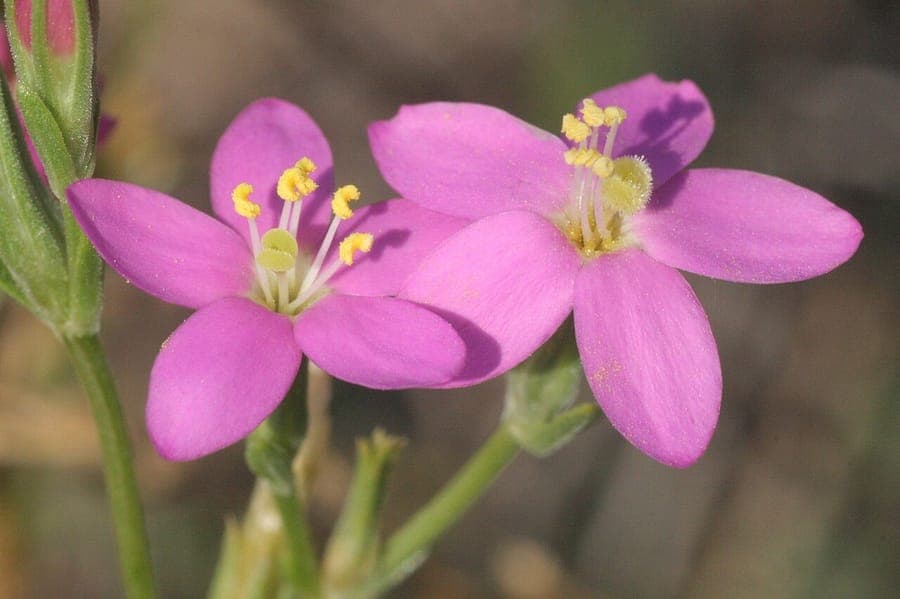
Growing 15–30 cm tall, sea centaury has slender, upright stems with narrow, lance-shaped leaves. The flowering season runs from June through August, peaking in July. The flowers are small-about 1 cm across-but cluster in terminal cymes that catch the eye. They're a soft purple with darker veining and greenish sepals. Each petal often has a tiny white or cream spot at the base, adding delicate contrast. These flowers only open fully in bright sunlight, closing at dusk or on cloudy days, giving them a responsive, almost shy character. This sun-tracking behavior makes them a joy to observe in midday light.
Ideal location
Sea centaury demands full sun-rate it an 8 out of 10 for light exposure. South- or southwest-facing slopes, dry walls, or open rock gardens are ideal. It performs poorly in shade or under dense canopies. Avoid planting near vigorous perennials that could overshadow it. It's excellent for crevices between paving stones or as a filler in gravel pathways. If your garden has sandy or thin soil, this is the plant to make the most of it. Use gardenworld.app to map sun patterns in your yard and pinpoint the best spot for sea centaury before planting.
Soil requirements
This plant evolved in lean, fast-draining soils. It prefers sandy, gritty substrates with a pH between 6.5 and 7.0. Heavy clay soils should be amended with horticultural grit or coarse sand to improve drainage. Fertility isn't necessary-rich soil promotes leggy growth and fewer flowers. A touch of crushed shell or limestone gravel mimics its natural seaside habitat. Avoid compost-heavy mixes; they encourage foliage over blooms.
Free design
Want to see Sea centaury: complete guide in your garden? Make a free design now.
Watering
Once established, sea centaury is drought-tolerant and rarely needs supplemental watering. Overwatering is a bigger risk than underwatering, leading to root rot in poorly drained soils. During extended dry spells (three weeks or more without rain), light irrigation can help young plants get established. Mature plants handle dry conditions with ease. If possible, use collected rainwater to avoid introducing excess minerals.
Pruning
No pruning required. This is a plant that thrives on neglect. Deadheading isn't necessary unless you want to limit self-seeding. Let the plant complete its life cycle naturally. In late autumn, the stems collapse and can be left in place to provide winter shelter for insects, or cleared to tidy the bed. Either approach works-just match it to your garden style.
Maintenance calendar
- Jan: Monitor seed bank; no action
- Feb: Prepare sowing areas; clear light debris
- Mar: Sow seeds directly or transplant seedlings
- Apr: Check seedling emergence; protect from slugs
- May: Thin overcrowded seedlings; avoid overwatering
- Jun: Bloom begins; watch for pollinators
- Jul: Peak bloom; ideal for garden photos
- Aug: Flowering tapers off; collect seeds if desired
- Sep: Allow seed ripening; assess spread
- Oct: Cut back or leave for wildlife
- Nov: Clear spent growth if needed
- Dec: Dormant period; observe soil condition
Winter hardiness
Sea centaury is hardy in USDA zones 5–8. In the UK and Ireland (zone 8), it typically survives as seeds in the soil. The parent plant dies after flowering, but self-sown seedlings appear the following spring. No winter protection is needed, even in colder regions. In wet winters, seed viability may drop, so consider saving a small batch for backup sowing.
Companion plants
Pair sea centaury with other sun-loving, drought-tolerant plants like thrift (Armeria maritima), sea holly (Eryngium), or dwarf lavender. In gravel gardens, it works well with sedums, thymes, and catmint. Avoid aggressive spreaders like mint or bindweed. The soft purple flowers contrast beautifully with yellow blooms such as rudbeckia or coreopsis. For a coastal theme, combine with sea campion or marram grass.
Closing
Sea centaury won't dominate your garden, but it adds quiet charm and supports biodiversity. It's perfect for low-maintenance designs where you want color without fuss. Look for it at garden centres across the UK and Ireland, especially those specializing in native or wildlife-friendly plants. Once you've grown it, you'll appreciate its resilience and understated beauty. Let it drift through your borders-you'll be surprised how much character a small purple flower can bring.
Want to see Sea centaury: complete guide in your garden? Make a free design now.
Upload a photo, pick a style, and get a photorealistic design with plant list in under a minute.
No credit card required


Similar plants
Branched gentianella: complete guide
Gentianella ramosa
Full growing guide for Gentianella ramosa, the branched Alpine gentianella of the SW Alps - location, soil, watering, winter care and companion plants.
Spiked centaury: complete guide
Schenkia spicata
Full growing guide for Schenkia spicata (spiked centaury): sunny position, dry soil, bloom season and garden companions.
Narrow-leaf gentian: complete guide
Gentiana angustifolia
Narrow-leaf gentian growing guide: intense blue trumpet flowers in May-July on well-drained limestone. Full cultivation tips.