
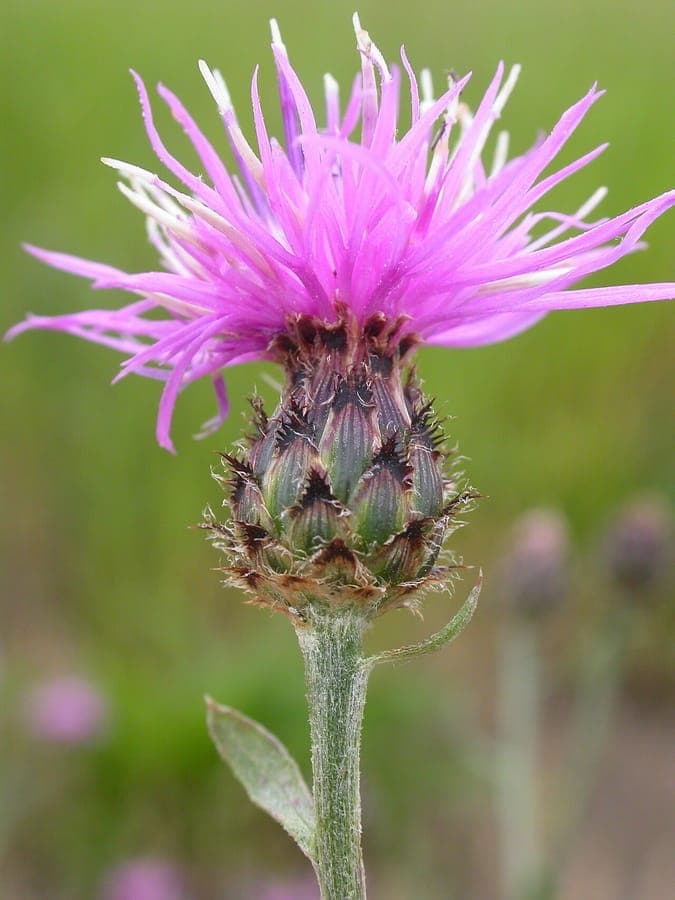
Matt Lavin from Bozeman, Montana, USA / CC BY-SA 2.0, via Wikimedia Commons
Spotted knapweed: complete guide
Centaurea stoebe
Want to see Spotted knapweed: complete guide in your garden?
1 minute, no credit card
Overview
Spotted knapweed, or Centaurea stoebe, is a resilient flowering plant that thrives in dry, sunny conditions. Native to Central and Eastern Europe, it's found its way into many gardens for its long bloom period and low care needs. In temperate climates, it grows 50 to 80 cm tall and spreads 30 to 40 cm wide. It blooms from June through October, making it one of the longest-flowering perennials you can grow.
While it's a great plant for poor soils and harsh conditions, be aware: in North America, it's considered invasive. In garden settings, it's usually well-behaved if kept in check. If you're designing a xeriscape or naturalistic garden, Spotted knapweed deserves a spot. On gardenworld.app you can create a custom garden layout that highlights where this plant fits best in your space.
Appearance & bloom cycle
The plant has slender, branched stems with narrow, grey-green leaves that feel slightly hairy. The flowers are the real showstoppers - deep pink to purple, with dark, fringed bracts that look like tiny black spots around the edges. Each flower head is 1.5 to 2 cm across and sits atop upright stems.
Bloom starts in early summer and continues non-stop until the first hard frost. Individual flowers last a few days, but new buds open steadily, ensuring a constant display. Bees, butterflies, and hoverflies flock to the nectar-rich blooms. Plant in groups of 3 to 5 for visual impact and better pollinator support.
Ideal location
Full sun is a must. Spotted knapweed needs at least 6 to 8 hours of direct sunlight daily. In shade, it becomes leggy and flops over. It excels in hot, dry areas - south-facing slopes, gravel gardens, or poor soil borders. It's also ideal for roadside plantings or low-fertility zones where other plants struggle.
Avoid overcrowding. Give it space to branch out. When planning your layout, use gardenworld.app to simulate how light moves across your garden and where Spotted knapweed will get maximum exposure.
Soil requirements
It prefers well-drained, sandy, or loamy soils with a pH from 6.0 to 7.5. Rich, heavy soils encourage weak growth and flopping. Don't amend the soil with compost or fertilizer - this plant actually grows better in poor conditions. Overly fertile ground leads to lush foliage but fewer flowers and weaker stems.
Clay soils are a problem unless you improve drainage with sand or gravel. Raised beds or sloped areas help prevent root rot in wet winters. This plant hates sitting in water.
Free design
Want to see Spotted knapweed: complete guide in your garden? Make a free design now.
Watering
Once established, Spotted knapweed is extremely drought-tolerant. During the first growing season, water weekly if there's no rain. After that, it rarely needs supplemental watering, even in prolonged dry spells. Water at the base to avoid wetting the foliage, which can encourage fungal diseases.
Overwatering is the biggest threat. Let the soil dry out completely between waterings. In most UK and US zones, rainfall is sufficient after year one.
Pruning
Cut back old stems in late winter or early spring, just before new growth emerges. Leave them over winter - they add structure and shelter for overwintering insects. In spring, trim to 5–10 cm above ground level.
To prevent self-seeding, deadhead spent flowers before seeds mature. While self-seeding can fill gaps, it may lead to overcrowding. If you want to limit spread, remove flower heads in late summer.
Maintenance calendar
- Jan: leave stems standing, minimal care
- Feb: monitor for new growth
- Mar: cut back old growth, remove debris
- Apr: check for seedlings, thin if needed
- May: plant settles, watch for slugs
- Jun: first blooms appear, full sun exposure
- Jul: peak flowering, no feeding
- Aug: continue bloom, deadhead to control spread
- Sep: allow some seed heads for wildlife, or remove
- Oct: stop deadheading, prepare for winter
- Nov: leave standing
- Dec: no action required
Winter hardiness
Spotted knapweed is hardy in USDA zones 3 to 7. It survives temperatures down to -40°C. The plant behaves as a short-lived perennial or biennial, returning via seed or rootstock. In milder zones, it may act as a short perennial.
Wet winters are more dangerous than cold. Ensure soil drains well. In heavy clay areas, consider planting in raised beds. The standing dead stems help protect the crown from freeze-thaw cycles.
Companion plants
Pair with other drought-tolerant perennials: yarrow (Achillea), coneflower (Echinacea), catmint (Nepeta), and ornamental grasses like Festuca or Stipa. Avoid moisture-loving plants such as hostas or astilbes.
It also works well with upright growers like Russian sage (Perovskia) or blazing star (Liatris). These combinations create texture and movement. Plan your pairings on gardenworld.app to visualize height, color, and bloom time harmony.
Closing
Spotted knapweed isn't flashy, but it's dependable. It thrives where other plants fail and supports pollinators for months. It's perfect for gardeners who want beauty with minimal work. Just keep an eye on its spread - it can self-seed vigorously. Buy young plants from trusted garden centres to avoid invasive strains. With the right placement and care, it earns its spot in any low-maintenance garden.
Want to see Spotted knapweed: complete guide in your garden? Make a free design now.
Upload a photo, pick a style, and get a photorealistic design with plant list in under a minute.
No credit card required


Similar plants
Calendula stellata: complete guide
Calendula stellata
Complete guide to Calendula stellata, the star-flowered marigold from Sicily: location, soil, watering and companion planting tips.
Korean chrysanthemum: complete guide
Chrysanthemum x rubellum
Chrysanthemum x rubellum is a hardy autumn perennial with single pink to copper flowers from August to November. Care and combinations.
Helianthus divaricatus: complete guide
Helianthus divaricatus
Helianthus divaricatus is a North American woodland sunflower with yellow summer blooms, ideal for naturalistic borders and shady edges.