
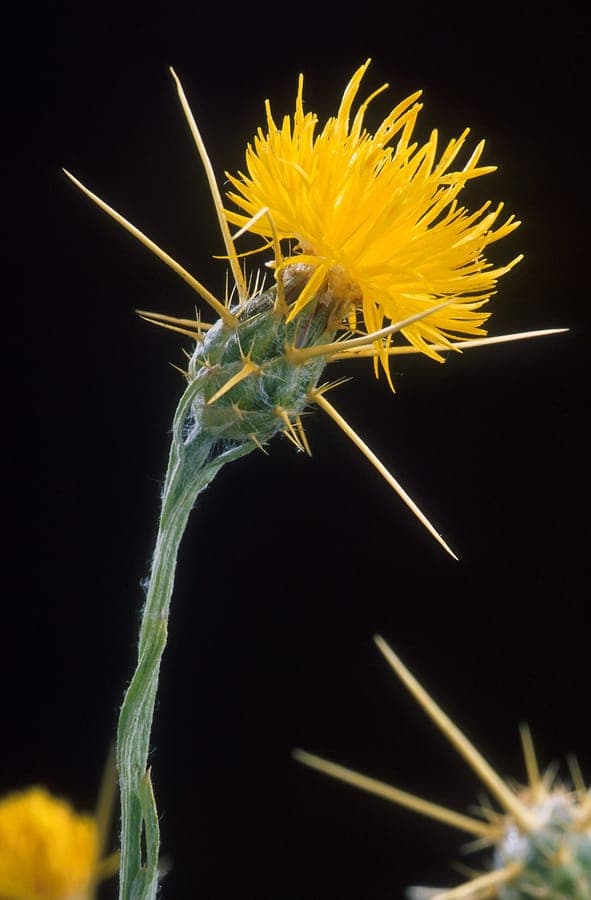
Peggy Greb / Public domain, via Wikimedia Commons
Golden star thistle: complete guide
Centaurea solstitialis
Want to see Golden star thistle: complete guide in your garden?
1 minute, no credit card
Overview
Golden star thistle, or Centaurea solstitialis, is an annual forb in the Asteraceae family. Native to parts of southern and central Europe, it's adapted to hot, dry conditions and thrives where other plants struggle. While it's often labeled a weed in agricultural settings, especially in regions like California where it's invasive, in the right garden context, it can add bold structure and vivid color to naturalistic planting schemes.
On gardenworld.app, you can design a drought-tolerant garden layout where Golden star thistle plays a supporting role among native grasses and hardy perennials. Its upright form and golden blooms make it a standout in late summer borders, especially when massed for impact.
Appearance & bloom cycle
This plant typically reaches 30 to 80 cm in height, with stiff, branching stems covered in fine hairs. The leaves are pinnately lobed, grayish-green, and slightly prickly to the touch. Lower leaves are larger and more densely arranged, while upper foliage tapers off as the plant climbs toward bloom.
Flowering occurs from July through September, peaking in August. The flower heads are bright yellow, about 2–3 cm wide, and surrounded by spiny bracts that flare outward like a starburst-hence the name. Each flower lasts several weeks, and the overall display remains vibrant under full sun. Bees and butterflies are frequent visitors, drawn to the nectar-rich blooms.
Ideal location
Golden star thistle thrives in full sun. Aim for a spot that receives 8 out of 10 on the light scale-meaning 7 to 9 hours of direct sunlight daily. South- or southwest-facing slopes, dry borders, or gravel gardens are ideal. Avoid shaded areas, as insufficient light leads to weak, leggy growth and poor flowering.
This plant works well in cottage-style gardens, wild meadows, or low-input urban plots. Use gardenworld.app to analyze your garden's sun exposure and select the best microclimate for establishing this sun-loving species.
Soil requirements
It prefers well-drained, neutral to slightly alkaline soils with a pH between 7.0 and 7.5. Sandy, gravelly, or chalky soils are perfect; heavy clay should be avoided unless amended for drainage. The plant doesn't need rich soil-overly fertile conditions promote leafy growth at the expense of blooms.
Do not add compost or manure. If planting in a garden bed, choose a lean, open site. This discourages competition and mimics the plant's natural habitat along roadsides and disturbed soils.
Free design
Want to see Golden star thistle: complete guide in your garden? Make a free design now.
Watering
Once established, Golden star thistle is highly drought-tolerant. Water young plants weekly for the first 4–6 weeks to help roots settle. After that, supplemental watering is rarely needed-even during extended dry spells.
If watering is required, do so deeply but infrequently, allowing the soil to dry between sessions. Overwatering, especially in cool or humid conditions, increases the risk of root rot. This is a plant that performs best when left alone.
Pruning
No regular pruning is needed. However, cutting back spent flower stalks before seeds mature can help control self-seeding, which is advisable in smaller gardens. Wear gloves when handling the plant-its spiny stems and bracts can be sharp.
If you want to encourage reseeding, leave some flower heads intact through autumn. The dried seed heads add winter texture and provide food for birds like goldfinches.
Maintenance calendar
- Jan–Mar: Dormant season. No action needed.
- Apr: Monitor for emerging seedlings. Thin if overcrowded.
- May: Keep soil free of aggressive weeds. Water lightly during dry spells.
- Jun: Plants reach 20–40 cm. Ensure they receive full sun.
- Jul–Sep: Peak bloom. Watch for pests like aphids, though infestations are rare.
- Oct: Cut back or leave for winter interest. Collect seeds if desired.
- Nov–Dec: Soil undisturbed. Seeds lie dormant, ready to germinate in spring.
Winter hardiness
As an annual, Golden star thistle doesn't survive winter as a living plant. However, its seeds are cold-hardy and germinate reliably in spring when soil temperatures rise. It's suitable for USDA zones 7 to 10. In zone 8 (like much of the UK and Pacific Northwest), it often reappears naturally if conditions are favorable.
No winter protection is required. In fact, leaving some plant debris can support overwintering insects-a plus for ecological gardening.
Companion plants
Pair Golden star thistle with other drought-tolerant species: Achillea millefolium, Echinacea purpurea, Stachys byzantina, and ornamental grasses like Calamagrostis or Deschampsia. These create layered, textured plantings that thrive in hot, dry spots.
Avoid pairing with aggressive groundcovers or moisture-loving plants. This thistle needs space and sun, not competition.
Closing
Golden star thistle isn't a traditional garden favorite, but in the right setting, it brings bold color and ecological value. It's perfect for gardeners embracing low-maintenance, wildlife-friendly designs. Just be mindful of its potential to spread-especially in regions where it's considered invasive.
Check local regulations before planting. In the UK and Europe, it's not widely problematic, but vigilance helps. You can find seeds at garden centres or online retailers. For precise garden integration, test layouts on gardenworld.app. Seeds are often available at general garden centres, though not always labeled widely-ask staff for wildflower or native seed sections.
Want to see Golden star thistle: complete guide in your garden? Make a free design now.
Upload a photo, pick a style, and get a photorealistic design with plant list in under a minute.
No credit card required


Similar plants
Calendula stellata: complete guide
Calendula stellata
Complete guide to Calendula stellata, the star-flowered marigold from Sicily: location, soil, watering and companion planting tips.
Korean chrysanthemum: complete guide
Chrysanthemum x rubellum
Chrysanthemum x rubellum is a hardy autumn perennial with single pink to copper flowers from August to November. Care and combinations.
Helianthus divaricatus: complete guide
Helianthus divaricatus
Helianthus divaricatus is a North American woodland sunflower with yellow summer blooms, ideal for naturalistic borders and shady edges.