
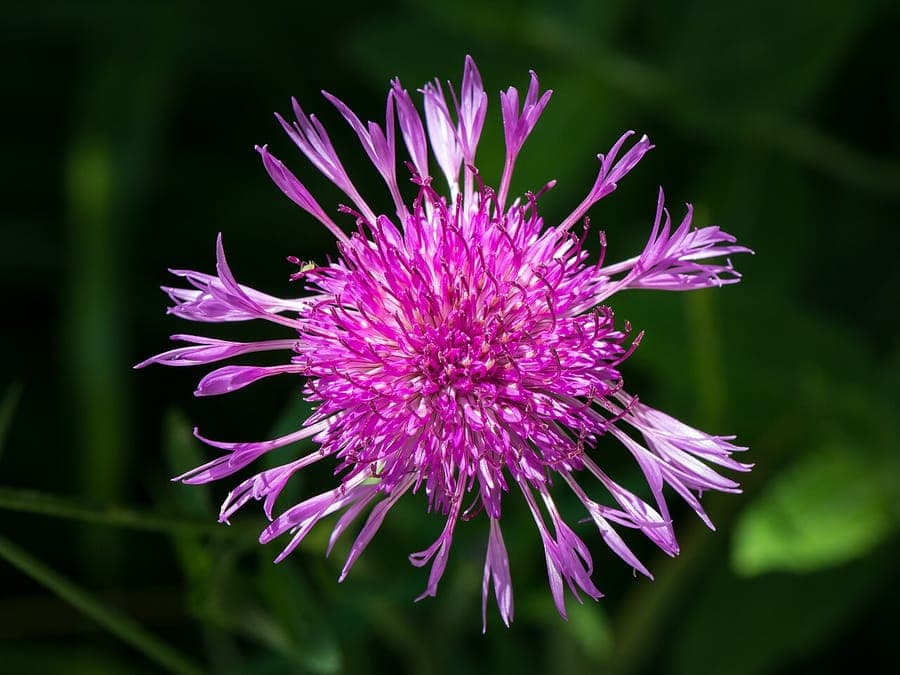
Uoaei1 / CC BY-SA 3.0, via Wikimedia Commons
Brown knapweed: complete guide
Centaurea jacea
Want to see Brown knapweed: complete guide in your garden?
1 minute, no credit card
Overview
Brown knapweed (Centaurea jacea) is a hardy, adaptable forb that thrives in open, sunny areas across Europe. Native to regions like the Baltic States, Austria, and the Balkans, it's a familiar sight in grasslands, roadside verges, and dry slopes. Standing 30 to 60 cm tall, this herbaceous perennial or biennial brings long-lasting purple blooms from early summer into autumn. It's a top pick for gardeners wanting to support pollinators without sacrificing visual appeal.
Despite being less common in formal gardens, Brown knapweed is gaining popularity among eco-conscious gardeners who value low-input, high-impact plants. It's perfect for wildflower meadows, cottage borders, or gravel gardens. On gardenworld.app, you can design a garden layout that highlights Brown knapweed alongside other native wildflowers for maximum ecological benefit.
Appearance & bloom cycle
Flowering begins in June and runs through September, peaking in July and August. The blooms are deep purple with dark, thistle-like centers - giving them their characteristic 'knapweed' look. Each flower head is 2–3 cm wide and sits atop slender, branching stems. The leaves are lance-shaped, slightly toothed, and grow more compact as the plant matures.
The flower structure follows the Asteraceae pattern: tiny disc florets in the center surrounded by fringed, petal-like bracts. This design is a magnet for bees, butterflies, and hoverflies. Because it blooms for over three months, it provides a reliable nectar source during a critical window for pollinators.
Ideal location
Brown knapweed craves full sun - aim for at least 8 hours daily (light level 8). It performs best in open, unshaded spots, such as sunny borders, dry banks, or meadow-style gardens. It can also grow in containers (minimum 30 cm depth) on sunny patios or rooftops.
Light shade is tolerated, but flowering will be reduced. Ensure good air circulation to prevent powdery mildew, especially in humid summers. This plant self-seeds readily and often returns year after year, making it ideal for low-maintenance or naturalistic gardens.
Soil requirements
It prefers well-drained, light to medium soils with a pH between 6.5 and 7.0. Avoid heavy clay or waterlogged ground - these conditions cause root rot. If your soil is dense, mix in sand or gravel to improve drainage.
Brown knapweed thrives in poor to moderately fertile soil. Too much nitrogen leads to lush foliage but fewer flowers. Don't add compost or fertilizer. This species evolved in nutrient-poor environments, so rich soil does more harm than good. When preparing a new bed, lightly disturb the soil - it helps seeds germinate and establish.
Free design
Want to see Brown knapweed: complete guide in your garden? Make a free design now.
Watering
Once established, Brown knapweed is highly drought-tolerant. Water weekly during the first few weeks after sowing or planting, especially in dry spells. Give about 1–2 liters per plant depending on heat.
After the first month, reduce watering gradually. In average conditions, no supplemental irrigation is needed. During extreme drought (3+ weeks without rain), a light soak helps, but avoid wetting the foliage to reduce fungal risk.
Pruning
Cut back flower stems only after they've fully faded. This gives seeds time to mature and disperse. If you want to limit self-seeding, deadhead before seeds form.
Don't cut it back in autumn. Leave the dead stems through winter - they protect overwintering insects and insulate the crown. In March, remove old growth to make space for new shoots.
Maintenance calendar
- Jan: Leave stems intact; check for insect shelters.
- Feb: No action needed.
- Mar: Cut back dead stems; sow seeds if desired.
- Apr: Watch for seedlings; water lightly in dry spells.
- May: Growth accelerates; keep an eye on slugs.
- Jun: First blooms appear; ensure full sun.
- Jul: Peak flowering; no feeding.
- Aug: Blooms continue; water only in severe drought.
- Sep: Allow seed heads to form for natural reseeding.
- Oct: No maintenance.
- Nov: Leave plant debris for winter habitat.
- Dec: Dormant period.
Winter hardiness
Brown knapweed is fully hardy down to -20°C (USDA zones 5–9). It often behaves as a biennial, forming rosettes the first year and flowering the second. However, it self-seeds so reliably that it appears perennial in well-suited gardens.
Avoid covering it with mulch or plastic - this traps moisture and encourages rot. A light layer of leaf litter is sufficient protection.
Companion plants
Pair Brown knapweed with other sun-loving, drought-tolerant species like yarrow, thyme, purple coneflower (Echinacea), or ornamental grasses such as Festuca glauca. Avoid aggressive spreaders like mint or bindweed.
On gardenworld.app, you can preview plant combinations and see how Brown knapweed fits into different garden styles - from wildlife-friendly borders to structured gravel schemes.
Closing
Brown knapweed is an underrated gem for pollinator gardens and low-effort landscapes. It's tough, long-blooming, and supports biodiversity with minimal care. Whether you're a beginner or a seasoned gardener, this plant earns its place. Pick up seeds or plugs from trusted garden centres, and give it a sunny spot - you'll be rewarded with months of color and buzzing life.
Want to see Brown knapweed: complete guide in your garden? Make a free design now.
Upload a photo, pick a style, and get a photorealistic design with plant list in under a minute.
No credit card required


Similar plants
Calendula stellata: complete guide
Calendula stellata
Complete guide to Calendula stellata, the star-flowered marigold from Sicily: location, soil, watering and companion planting tips.
Korean chrysanthemum: complete guide
Chrysanthemum x rubellum
Chrysanthemum x rubellum is a hardy autumn perennial with single pink to copper flowers from August to November. Care and combinations.
Helianthus divaricatus: complete guide
Helianthus divaricatus
Helianthus divaricatus is a North American woodland sunflower with yellow summer blooms, ideal for naturalistic borders and shady edges.