
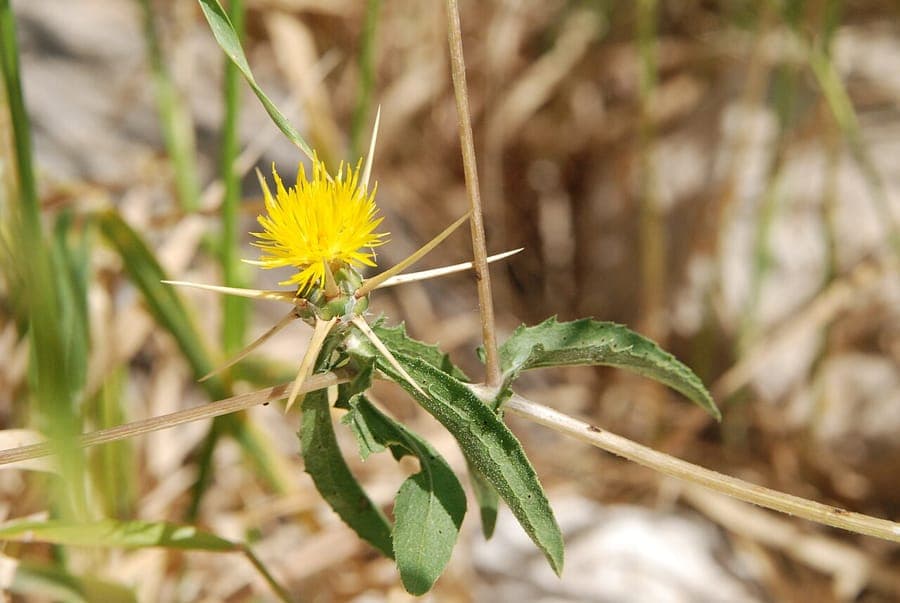
Banitt81 / CC BY-SA 3.0, via Wikimedia Commons
Centaurea hyalolepis: complete guide
Centaurea hyalolepis
Want to see Centaurea hyalolepis: complete guide in your garden?
1 minute, no credit card
The eastern star-thistle (Centaurea hyalolepis) is a charming flowering plant originating from North Africa to Iran. This plant grows as a semi-upright to erect shrub 40-60 cm tall and produces characteristically dark blue flowers on stiff stems throughout a long season (May through October). The flower has the familiar centaurea-family appearance with toothed, purplish outer bracts.
This is a plant for gardens in warm, dry environments. Though native to the Mediterranean region, it can also grow in the Netherlands in sheltered, sunny spots with well-draining soil. Both in southern Netherlands and temperate areas it can bloom for one to two summers before frost ends its life.
Centaurea hyalolepis is perfect for sunny borders where minimal water and maintenance are desired. The flowers attract bees and butterflies and are suitable for cut flowers. Dry the blooms for winter decoration.
Appearance and Bloom
The plant grows as an erect, branched shrub with thin, grayish stems. Leaves are elongated and somewhat gray-green, giving a soft, southern appearance. Flowers appear from May through October and are dark blue to violet with characteristic, light, translucent outer bracts (from which the name 'hyalolepis' derives).
Each flower is approximately 2-3 cm across and grows at the end of long stems. If not cut, seed pods appear later and birds can harvest the seeds. The flowers have a long bloom duration and last at least two weeks per bloom.
Cutting flowers stimulates more blooms to form. Regular cutting keeps the plant blooming until October. Without cutting, the plant sets seed sooner and flowering ceases earlier.
Ideal Location
Choose a spot in full sun for Centaurea hyalolepis. At least 6-8 hours of direct sunlight daily is essential for good blooms. Shade causes the plant to become leggy and produce fewer flowers.
The plant loves dry, bare spots and thrives in Mediterranean xeriscapes, rocky gardens and gravel borders. Protection from heavy rain and cold wind helps, especially in northern Netherlands. A sunny south-facing wall or warm terrace is ideal.
Avoid low-lying spots where water collects. This leads to root rot and fungal diseases. The plant performs best on dry, well-draining sites.
Soil
Centaurea hyalolepis prefers dry, poor soils with pH 5.5 to 7.5. Compared to many garden plants, it is very tolerant of poor soil conditions. Heavy clay should be amended with gravel, sand or compost to improve drainage.
Add coarse sand, perlite or gravel (20-30% by volume) if you have heavy soil. This significantly improves drainage. The plant prefers poor soil to very fertile soil, which leads to excessive leaf growth and fewer flowers.
Once established, the plant needs little feeding. You need not fertilize annually. Working in lighter compost once per season is sufficient.
Free design
Want to see Centaurea hyalolepis: complete guide in your garden? Make a free design now.
Watering
Once established (after 4-6 weeks growth) Centaurea hyalolepis is very drought-tolerant. Water regularly during the first month after planting, then only during very dry periods.
In normal Dutch summers (with regular rain) you need not water after the first month. In warm, dry summers (2022-2023) water every two weeks in July-August if rain is lacking.
Avoid heavy watering: this leads to root rot. Better under than over water. In pots the plant dries out faster, requiring more watering.
Pruning
Pruning is important for a compact form and more flowers. Regularly deadhead spent flowers (May through October). This stimulates new blooms to form.
In May, when the plant is growing vigorously, you can pinch the tops to create more branching. This produces a fuller plant with more flower buds.
After October you can cut back the plant to 20-30 cm (in southern Netherlands where it survives) or remove it (elsewhere).
Maintenance Calendar
April/May: Plant after frost passes. Water well the first month. May through October: Regular deadheading, water only in very dry spells. July/August: Driest period, check water needs. September/October: Plant continues blooming until frost, water less. November through March: In the south overwintering possible. Elsewhere remove.
Winter Hardiness
Centaurea hyalolepis is frost-sensitive and survives Dutch winters outdoors only in the south (USDA zone 8-9). Elsewhere it must be treated as an annual or overwintered indoors.
Options:
- Grow as annual (sow in March, plant in May, harvest in October)
- Overwinter indoors (in cold frame or windowsill)
- Take cuttings in September for new plants next year
In southern Netherlands (Limburg, North Brabant) some plants can overwinter outdoors on very dry, sheltered spots.
Companion Plants
Centaurea hyalolepis works well in Mediterranean and drought-tolerant combinations:
- Lavender for texture and fragrance
- Sage for flowers and structure
- Artemisia for silver-gray foliage
- Allium for round flowers
- Agapanthus for blue and scale
All these plants love the same warm, dry locations and bloom together.
Closing
The eastern star-thistle is a beautiful accent for warm, dry gardens where minimal maintenance is desired. With long blooms from May through October and pollinator appeal, this is a valuable plant. Plant via garden centers as annual seedlings in May. GardenWorld can help create designs with such Mediterranean plants. GardenWorld delivers premium garden plans.
Want to see Centaurea hyalolepis: complete guide in your garden? Make a free design now.
Upload a photo, pick a style, and get a photorealistic design with plant list in under a minute.
No credit card required


Similar plants
Calendula stellata: complete guide
Calendula stellata
Complete guide to Calendula stellata, the star-flowered marigold from Sicily: location, soil, watering and companion planting tips.
Korean chrysanthemum: complete guide
Chrysanthemum x rubellum
Chrysanthemum x rubellum is a hardy autumn perennial with single pink to copper flowers from August to November. Care and combinations.
Helianthus divaricatus: complete guide
Helianthus divaricatus
Helianthus divaricatus is a North American woodland sunflower with yellow summer blooms, ideal for naturalistic borders and shady edges.