
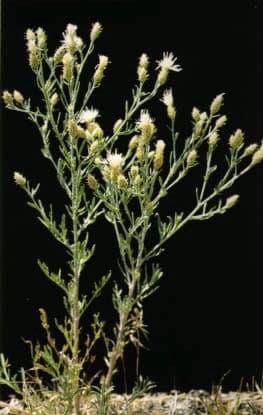
Wikimedia Commons / Public domain, via Wikimedia Commons
Tumble knapweed: complete guide
Centaurea diffusa
Want to see Tumble knapweed: complete guide in your garden?
1 minute, no credit card
Overview
Tumble knapweed (Centaurea diffusa) is a herbaceous biennial or short-lived perennial from the Asteraceae family. Native to Central and Eastern Europe, it's increasingly spotted in UK and North American gardens, though it's best managed with care due to its spreading habit. This airy plant features silvery-gray foliage and striking white flowers with purple-tinged bracts, blooming mid-summer.
While not widely sold as a garden staple, it's a natural fit for wildflower meadows, gravel gardens, or dry borders. Its name comes from its tendency to break off at the base when dry and tumble across fields, dispersing seed as it rolls. On gardenworld.app, you can create a garden plan that integrates this plant responsibly, balancing beauty with control.
Appearance & bloom cycle
Tumble knapweed grows 12–24 inches (30–60 cm) tall with a spread of about 10 inches (25 cm). The stems are branched and covered in fine, woolly hairs, giving the whole plant a soft, silvery appearance. Leaves are narrow, deeply lobed, and mostly clustered along the lower stem.
Flowering occurs from June to August. The blooms are white with a fringe of purple-tipped bracts, creating a thistle-like but refined look. Each flower head sits atop a slender stem, making them ideal for light movement in the breeze. They attract bees, butterflies, and hoverflies, adding ecological value to your garden.
After blooming, seed heads form and dry. The entire plant often detaches at the root and tumbles in the wind – a clever natural dispersal method, but one that requires attention in cultivated spaces.
Ideal location
Full sun is essential – aim for at least 6 to 8 hours of direct sunlight daily. Tumble knapweed thrives in dry, open areas with minimal competition. It's perfect for south-facing slopes, rocky crevices, or gravel pathways.
Use it in cottage-style borders, naturalistic plantings, or as part of a xeriscape design. Avoid shady or damp corners; these conditions lead to weak growth and fungal issues. When planning placement, check gardenworld.app for layout ideas that match its growth pattern and light needs.
Soil requirements
This plant prefers poor, well-drained soils – sandy, gravelly, or rocky types work best. It tolerates a pH from 6.0 to 7.5 (slightly acidic to neutral). Heavy clay should be amended with grit or coarse sand to improve drainage.
Rich, fertile soils encourage leafy growth at the expense of flowers. Avoid adding compost or manure. Tumble knapweed actually performs better in lean conditions, making it ideal for neglected or marginal garden spots.
Free design
Want to see Tumble knapweed: complete guide in your garden? Make a free design now.
Watering
Once established, it needs little to no supplemental watering. During the first month after planting, water weekly if rainfall is scarce. Use deep, infrequent watering to encourage strong root development.
In hot, dry summers, it survives on natural rainfall. Overwatering leads to root rot and weak stems. Avoid overhead irrigation – it wets the foliage and promotes mildew. Water at the base using a can or drip system.
Pruning
Pruning isn't required for health, but it helps manage spread and tidiness. Cut back flowered stems to 4 inches (10 cm) after blooming to prevent self-seeding.
If you want to limit reseeding, deadhead before seeds mature – usually by late August. Use clean, sharp shears to avoid spreading disease. For a neater winter look, cut all stems to ground level in autumn.
Maintenance calendar
- January: No action needed. Check for old plant debris.
- February: Remove any broken or tangled stems.
- March: Clear dead material and prepare soil for new seedlings.
- April: Sow seeds directly into open ground or transplant seedlings.
- May: Watch for weeds; hand-weed to reduce competition.
- June: Blooms begin. Monitor for pollinator activity.
- July: Peak flowering. No feeding required.
- August: Deadhead to control seed spread.
- September: Leave some plants for winter structure or cut back fully.
- October: Sow new seeds or plant young rosettes for next season.
- November: Seeds overwinter in soil. Minimal care needed.
- December: Dormant period. No intervention required.
Winter hardiness
Tumble knapweed is hardy in USDA zones 4–8. It tolerates freezing temperatures and snow cover with ease. As a biennial, it forms a low rosette in its first year and flowers in the second.
In harsh winters, mulching young rosettes with straw can help, but mature plants need no protection. It reseeds readily, so expect new plants each spring if conditions allow.
Companion plants
Pair with warm-colored perennials like Rudbeckia, Echinacea, or Helenium for contrast. Use lavender (Lavandula) or sage (Salvia officinalis) to anchor the planting and add fragrance.
Avoid moisture-loving plants like hostas or ferns. Instead, combine with drought-tolerant species such as Achillea, Sedum, or Stachys. On gardenworld.app, explore plant combinations that enhance texture and bloom timing.
Closing
Tumble knapweed brings a wild, airy charm to sunny, dry gardens. It's low-maintenance, pollinator-friendly, and thrives where other plants struggle. While its tumbling habit demands some management, the payoff is worth it. Look for seeds or young plants at garden centres across the UK, or source responsibly to avoid invasive spread. With thoughtful placement, it can be a standout in a naturalistic design.
Want to see Tumble knapweed: complete guide in your garden? Make a free design now.
Upload a photo, pick a style, and get a photorealistic design with plant list in under a minute.
No credit card required


Similar plants
Calendula stellata: complete guide
Calendula stellata
Complete guide to Calendula stellata, the star-flowered marigold from Sicily: location, soil, watering and companion planting tips.
Korean chrysanthemum: complete guide
Chrysanthemum x rubellum
Chrysanthemum x rubellum is a hardy autumn perennial with single pink to copper flowers from August to November. Care and combinations.
Helianthus divaricatus: complete guide
Helianthus divaricatus
Helianthus divaricatus is a North American woodland sunflower with yellow summer blooms, ideal for naturalistic borders and shady edges.