
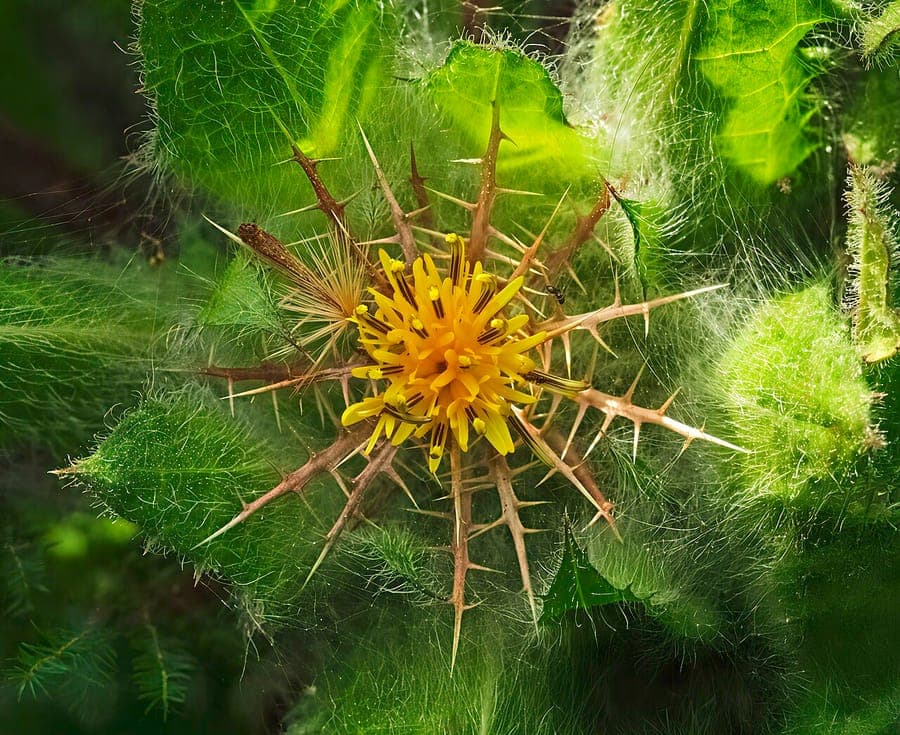
Didier Descouens / CC BY-SA 4.0, via Wikimedia Commons
Blessed thistle: complete guide
Centaurea benedicta
Want to see Blessed thistle: complete guide in your garden?
1 minute, no credit card
Overview
Centaurea benedicta, commonly known as blessed thistle, is an annual herb in the Asteraceae family with a rich history in both traditional medicine and ornamental gardening. Native to southeastern Europe and parts of western Asia-including Greece, Bulgaria, Cyprus, and Iran-this plant thrives in hot, dry conditions and is particularly well-suited to Mediterranean-style gardens. Despite its thistle-like appearance, it's far less aggressive than many of its spiny relatives, making it a manageable and attractive choice for gardeners seeking texture and resilience.
Reaching heights of 40 to 80 cm, blessed thistle grows upright with branching stems and displays striking golden-yellow flower heads surrounded by spiny, purplish bracts. It's not known for fragrance, but it does attract beneficial insects like bees and hoverflies. Historically, the leaves and young shoots were used to support digestion and liver function, though today it's grown primarily for its architectural form and low-maintenance appeal.
On gardenworld.app, you can design a planting scheme that highlights the bold silhouette of blessed thistle in a drought-tolerant or wildlife-friendly garden.
Appearance & bloom cycle
Blessed thistle blooms from June through August, producing compact, 2–3 cm wide flower heads that sit atop slender stems. The blooms are a vibrant golden yellow with a slightly tubular form, framed by stiff, spine-tipped bracts that give the plant a protective, wild look. While the spines are noticeable, they're not overly sharp, making it safe to grow near pathways as long as there's adequate spacing.
The leaves are lance-shaped, deeply lobed, and covered in fine hairs, giving them a soft, gray-green appearance. They form a loose basal rosette early in the season before the flowering stems rise. The overall habit is airy and open, allowing light to filter through and making it ideal for the middle or back of a border.
Ideal location
This plant demands full sun-rate it an 8 out of 10 for light needs-and performs best in south- or southwest-facing beds that heat up quickly in spring. It requires at least 6 to 8 hours of direct sunlight daily. Avoid shaded or damp corners of the garden, as these conditions lead to weak growth and disease.
Blessed thistle works well in cottage gardens, gravel beds, or naturalized areas. Pair it with other sun-loving perennials like yarrow, echinacea, or coreopsis. Its architectural form also contrasts beautifully with soft grasses like Stipa tenuissima. Use gardenworld.app to map your sun exposure and find the perfect spot for this bold annual.
Free design
Want to see Blessed thistle: complete guide in your garden? Make a free design now.
Soil requirements
Blessed thistle isn't picky about soil, as long as it's well-drained. It grows well in sandy, loamy, or stony soils with a pH between 7.0 and 7.5-neutral to slightly alkaline. Rich, fertile soils should be avoided, as they promote lush foliage at the expense of flowering.
If starting from seed, sow indoors in early spring using a light seed compost. Plant out after the last frost, typically from late May onwards in USDA zones 7–10. Spacing of 30–40 cm between plants ensures good airflow and prevents overcrowding.
Watering
Once established, blessed thistle is highly drought-tolerant. Young plants benefit from light, consistent watering for the first 4–6 weeks to help roots settle. After that, natural rainfall is usually sufficient, even during dry summers. When watering, go deep but infrequently to encourage strong root development.
Overwatering is a common mistake-wet feet can quickly lead to root rot, especially in heavy clay soils. Always let the soil dry out between watering sessions.
Pruning
Pruning isn't required, but deadheading spent blooms can extend flowering and prevent unwanted self-seeding. If you want the plant to reappear next year, leave a few flower heads intact to release seed in late summer. The seeds are small, dark brown, and easily dispersed by wind.
Keep an eye on volunteer seedlings in spring; thin them out to maintain spacing and prevent congestion.
Maintenance calendar
- February–March: Start seeds indoors in seed trays.
- April–May: Harden off seedlings; plant out after frost risk passes.
- June–July: Flowers open; monitor for aphids or mildew.
- August: Peak bloom; deadhead or allow seeding.
- September–October: Clear old stems if not self-seeding.
- November–January: No action needed.
Winter hardiness
As an annual, blessed thistle completes its life cycle in one growing season and does not survive winter. However, it often self-seeds reliably in suitable conditions. To encourage return, avoid mulching heavily over winter and leave some seed heads in place. It's hardy in USDA zones 7–10 as a self-sowing annual.
Companion plants
Pair blessed thistle with drought-tolerant companions like Russian sage (Perovskia), catmint (Nepeta), or globe thistle (Echinops). It also contrasts beautifully with silver-foliaged plants like lamb's ear or santolina. Avoid moisture-loving plants such as hostas or astilbes, which have conflicting needs.
Closing
Blessed thistle is a bold, low-effort annual that brings structure, color, and ecological value to sunny borders. Its resilience in poor soils and heat makes it a smart choice for sustainable gardens. While not commonly found in mainstream garden centres, seeds can sometimes be sourced from specialist herb or heirloom suppliers. Check with local retailers or browse online for reliable stock. For a tailored planting plan, use gardenworld.app to visualize how blessed thistle can enhance your garden's summer display.
Want to see Blessed thistle: complete guide in your garden? Make a free design now.
Upload a photo, pick a style, and get a photorealistic design with plant list in under a minute.
No credit card required


Similar plants
Calendula stellata: complete guide
Calendula stellata
Complete guide to Calendula stellata, the star-flowered marigold from Sicily: location, soil, watering and companion planting tips.
Korean chrysanthemum: complete guide
Chrysanthemum x rubellum
Chrysanthemum x rubellum is a hardy autumn perennial with single pink to copper flowers from August to November. Care and combinations.
Helianthus divaricatus: complete guide
Helianthus divaricatus
Helianthus divaricatus is a North American woodland sunflower with yellow summer blooms, ideal for naturalistic borders and shady edges.