
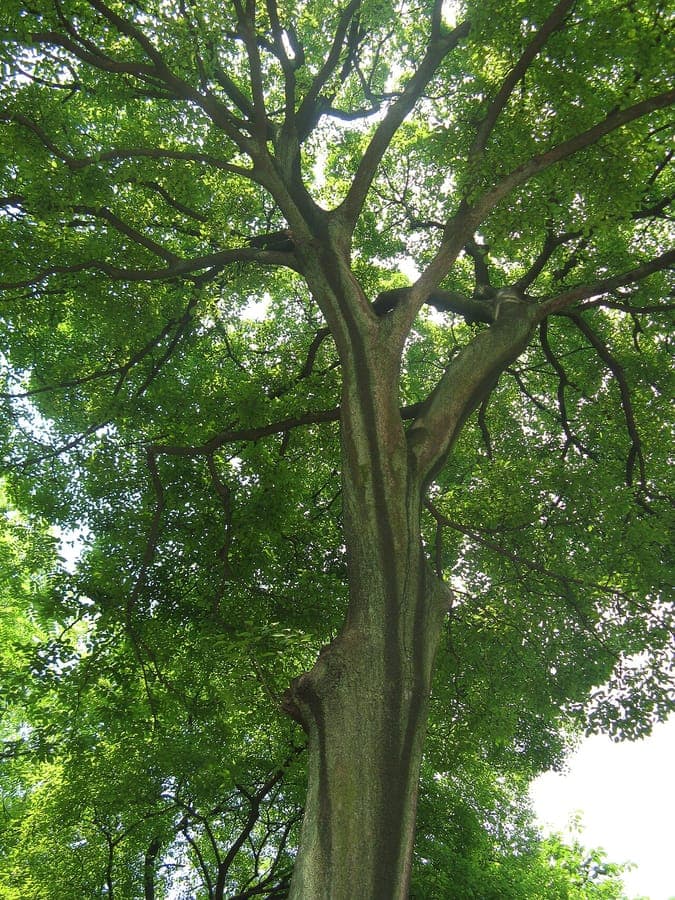
Geographer (talk) / CC BY 3.0, via Wikimedia Commons
Celtis sinensis: complete guide
Celtis sinensis
Want to see Celtis sinensis: complete guide in your garden?
1 minute, no credit card
Celtis sinensis, also known as Chinese hackberry or enoki tree, is an elegant Asian tree originating from China through Southeast Asia. This beautiful tree is worthy of large gardens and parks because of its ornamental value and useful properties.
Origin and Family Celtis sinensis belongs to the Cannabaceae family and originates from North to Southeast China, Japan, Korea, and Vietnam. This tree is native to temperate to subtropical regions and is widespread in cultivation.
Appearance and Growth The Chinese hackberry grows into a medium to large tree, usually 15-20 meters tall. It has an open, airy crown with thin branches. The leaves are small, lance-shaped, and have a beautiful light green color. In autumn they turn a lovely yellow. The bark of older trees is smooth and light gray.
Fruiting The tree produces small round fruits that start green and turn orange-red when ripe. These fruits are bird food and attract many bird species.
Ideal Location Choose a location with full sun to partial shade. The tree grows well in full sun but tolerates partial shade too. At least 4-6 hours of sunlight is optimal. This tree is hardy in temperate zones.
Soil Requirements The tree is tolerant of various soil types. It grows well in well-draining, moderately fertile soil. A pH of 6.0-7.5 is ideal. The tree can tolerate dry soil once established.
Watering Water regularly in the first two years for root establishment. Once established, the tree is quite drought-tolerant. Water deeply but less frequently. In extreme drought provide extra water.
Pruning and Maintenance Minimal pruning needed. Remove only dead branches and shaping cuts. The tree grows slowly and doesn't need much maintenance. Professional pruning can help, especially for young trees.
Maintenance Calendar Spring: Growth starts, monitor for pests Summer: Regulate watering, observe fruiting Fall: Manage bird food supply Winter: Minimal maintenance
Frost Hardiness Hardy in temperate zones. Can tolerate temperatures down to -15 degrees Celsius. In very cold zones protection may be needed for young trees.
Companion Plants Perfect companions for underplanting are shade-loving plants. The tree provides shade for groundcover plants and low shrubs.
Closing Thoughts Celtis sinensis brings elegance and bird food to large gardens. The beautiful structure and bird food form a strong combination. Available through specialty dealers. Visit gardenworld.app for more inspiration.
Want to see Celtis sinensis: complete guide in your garden? Make a free design now.
Upload a photo, pick a style, and get a photorealistic design with plant list in under a minute.
No credit card required


Similar plants
Humulus scandens: complete guide
Humulus scandens
Japanese hop - a vigorous climbing plant with characteristic hop cones and exceptional ornamental value.
Humulus lupulus: complete guide
Humulus lupulus
Discover the common hop: a very vigorous climbing plant for pergolas and tall fences. Comprehensive guide with training, harvesting and care.
Hemp: complete guide
Cannabis sativa
Learn how to grow hemp (Cannabis sativa) in your garden. Tips on light, soil, watering, and care. Ideal for garden designs on gardenworld.app.