
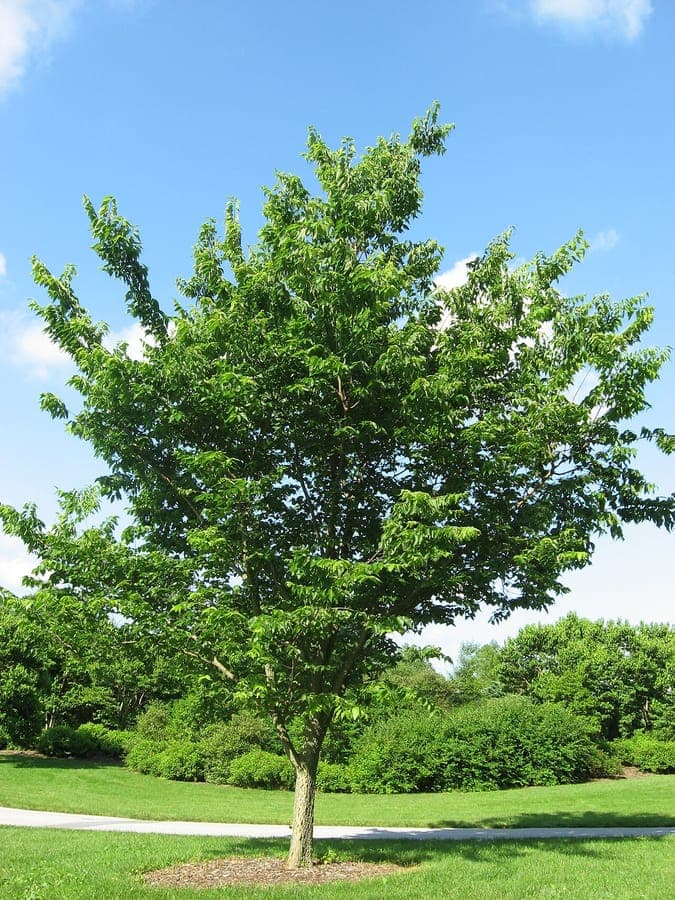
Chhe (talk) / Public domain, via Wikimedia Commons
Northern hackberry: complete guide
Celtis occidentalis
Want to see Northern hackberry: complete guide in your garden?
1 minute, no credit card
Overview
Celtis occidentalis, commonly known as northern hackberry, is a resilient and adaptable tree that thrives in a wide range of garden settings. Native to central and eastern North America, it's particularly suited to urban and suburban landscapes due to its tolerance of pollution, compacted soil, and variable moisture. Growing to 15–20 meters tall with a spread of 10–15 meters, it makes an excellent shade tree or specimen in larger gardens. It's hardy in USDA zones 3 to 9, meaning it handles cold winters down to -40°C and hot summers with ease.
What sets this tree apart is its low maintenance and ecological value. It hosts several native moth and butterfly species, and its persistent fruit feeds birds like cedar waxwings and robins well into winter. On gardenworld.app, you can design a garden layout that integrates the northern hackberry with native understory plants for maximum wildlife benefit.
Appearance & bloom cycle
The northern hackberry has an open, spreading crown with slightly zigzagging branches. The leaves are simple, alternate, 5–12 cm long, lance-shaped with a slightly serrated margin and a rough, sandpapery texture. They emerge light green in spring, darken to deep green in summer, and turn pale yellow in fall – not flashy, but quietly attractive.
In late spring (May), the tree produces small, greenish flowers that are wind-pollinated and inconspicuous. These lead to round, drupe-like fruits about 8 mm in diameter. They start green, ripen to purple-brown by September, and often remain on the tree until February. These fruits are a crucial food source during lean winter months.
The bark is one of its most distinctive features-gray with corky, wart-like ridges and irregular plates that create a textured, almost reptilian look. This makes the tree visually interesting even in winter when leafless.
Ideal location
Northern hackberry prefers full sun (6+ hours of direct light) but tolerates light shade. It performs best in open areas with good air circulation. Avoid planting too close to buildings-keep at least 3 meters from foundations to prevent root damage. It's an excellent choice for streetscapes, parklands, or as a shade tree in backyards.
While adaptable, it doesn't like constantly wet soil. Choose a site with good drainage. It handles partial root competition but thrives when given space. In urban gardens, it's a solid performer near sidewalks or driveways, provided there's enough root run.
Soil requirements
This tree is not picky about soil type. It grows in sandy, loamy, and clay soils as long as drainage is adequate. The ideal pH range is 6.0 to 7.8-slightly acidic to slightly alkaline. If your soil is extremely acidic (below 5.5), a light application of lime can help. For heavy clay, amend with compost at planting to improve structure.
Avoid over-fertilizing. Northern hackberry grows well in moderately fertile soils. Excessive nitrogen leads to weak, leggy growth and increased susceptibility to pests like hackberry nipple gall.
Free design
Want to see Northern hackberry: complete guide in your garden? Make a free design now.
Watering
Water deeply once a week during the first growing season, especially in dry spells. Give 20–30 liters per session to encourage deep root development. After the first year, it's highly drought-tolerant and rarely needs supplemental watering unless facing prolonged drought (over 4 weeks without rain).
Use drip irrigation or soaker hoses to deliver water slowly to the root zone. Avoid frequent shallow watering, which promotes shallow roots. No extra watering is needed in fall or winter.
Pruning
Pruning is minimal. Remove dead, damaged, or crossing branches in late winter or early spring. Avoid heavy pruning-this species doesn't respond well to large cuts and can develop decay. If shaping is needed, start when the tree is young and prune gradually.
Use clean, sharp tools and sterilize between cuts if disease is suspected. Cut just outside the branch collar to prevent bark tearing. Avoid pruning in summer to reduce the risk of insect infestation.
Maintenance calendar
- Jan: Inspect for structural issues and winter damage.
- Feb: Light pruning; remove any broken limbs.
- Mar: Apply compost around the base; avoid piling against the trunk.
- Apr: Monitor for new growth and gall formation.
- May: Flowering period; no action needed.
- Jun: Check for aphids or scale; hose off if severe.
- Jul: No routine care; ensure mulch is in place.
- Aug: Fruit begins to ripen; watch for bird activity.
- Sep: Leaves start to yellow; reduce watering.
- Oct: Leaves drop; leave leaf litter as natural mulch.
- Nov: Final inspection; clear debris if needed.
- Dec: Winter check; protect young trunks from rodents if necessary.
Winter hardiness
Hardy to USDA zone 3, the northern hackberry withstands extreme cold without damage. Young trees may suffer sunscald on the south-facing trunk in winter-wrap the lower trunk with paper tree guard for the first two winters. The bark's natural texture helps insulate the tree, and the persistent fruit adds winter interest.
It's deciduous, dropping leaves in November. Snow usually doesn't damage the open crown. In colder zones, avoid planting in frost pockets.
Companion plants
Pair with native understory plants like wild ginger (Asarum canadense), bloodroot (Sanguinaria canadensis), or switchgrass (Panicum virgatum). For a structured look, use sedges (Carex spp.) or low ferns. Avoid aggressive groundcovers like English ivy that can climb and damage the trunk.
Keep a 1-meter radius around the trunk free of competition. On gardenworld.app, you can create a layered planting scheme that accounts for the hackberry's shade and root spread.
Closing
The northern hackberry is an underrated gem for modern gardens. It combines toughness, longevity, and ecological value with minimal upkeep. While it won't stop traffic with bright flowers or fiery fall color, it provides steady beauty and habitat. For gardeners seeking a reliable, bird-supporting tree that handles urban stress, this is a top contender. Available at most garden centres-look for healthy specimens with straight trunks and no signs of gall or canker.
Want to see Northern hackberry: complete guide in your garden? Make a free design now.
Upload a photo, pick a style, and get a photorealistic design with plant list in under a minute.
No credit card required


Similar plants
Celtis sinensis: complete guide
Celtis sinensis
Chinese hackberry (enoki): comprehensive care guide. Discover this elegant Asian tree with fine leaves and bird food. Perfect for large gardens and parks.
Humulus scandens: complete guide
Humulus scandens
Japanese hop - a vigorous climbing plant with characteristic hop cones and exceptional ornamental value.
Humulus lupulus: complete guide
Humulus lupulus
Discover the common hop: a very vigorous climbing plant for pergolas and tall fences. Comprehensive guide with training, harvesting and care.