
Wikimedia Commons / Public domain, via Wikimedia Commons
European hackberry: complete guide
Celtis australis
Want to see European hackberry: complete guide in your garden?
1 minute, no credit card
Overview
Celtis australis, better known as the European hackberry, is a tough, long-lived tree that doesn't demand the spotlight but earns respect over time. Native to southern Europe and parts of western Asia, it thrives in hot, dry regions but adapts surprisingly well to temperate climates like those in the UK and northern Europe. Don't be fooled by its modest appearance - this is a tree that stands up to city pollution, compacted soil, and long dry spells.
Mature trees reach 15–20 metres in height with a spread of 10–12 metres, forming a broad, rounded crown. Growth is slow but steady, gaining roughly 30–40 cm per year under ideal conditions. It's not fussy about neighbours, with non-invasive roots that make it safe to plant near patios, drives, or walls - just keep a 3-metre clearance.
On gardenworld.app, you can visualise how a young hackberry will fill out over decades, helping you plan spacing and light patterns before you dig the first hole.
Appearance & bloom cycle
Young trees grow upright with a single leader, maturing into a wide-spreading canopy. The bark becomes corky and fissured with age, developing small rectangular plates that add winter interest. It's not as dramatic as plane trees, but it's subtle and dignified.
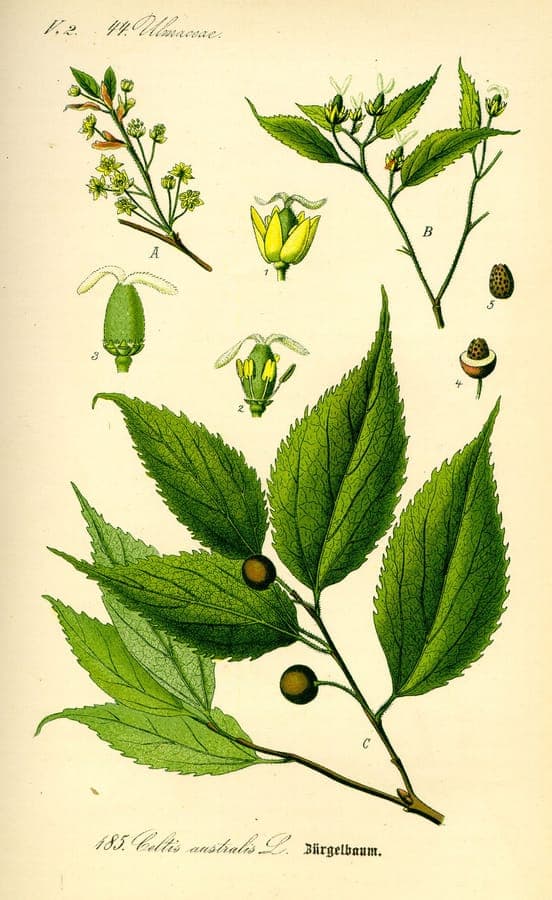
Leaves are alternate, 5–10 cm long, ovate with a slightly serrated edge and a rough texture. They emerge bright green in spring, darken in summer, and turn a soft yellow in late autumn - nothing flashy, but they hold on late, often into early November.
Flowering happens in April. The blooms are tiny, greenish, and clustered in groups of three along new shoots. They're wind-pollinated and not showy, but they support early pollinators. By late summer, small purple drupes (about 1 cm) appear and persist into winter, feeding blackbirds, thrushes, and even woodpeckers.
Ideal location
Full sun is best - aim for 6 to 8 hours of direct light daily (light level 8/10). It tolerates light shade, especially when young, but full sun ensures denser foliage and better fruiting.
This tree shines in urban settings. Plant it as a street tree, in parking lot islands, or as a standalone feature in a large garden. Avoid cramped spaces; give it room to develop. In small gardens, consider it only if you're prepared to manage its size with occasional pruning - though that goes against its natural form.
Soil requirements
Celtis australis isn't picky. It grows in sandy, loamy, or clay soils as long as drainage is adequate. The ideal pH is neutral to slightly alkaline (7.0–7.5). In acidic soils (below 6.5), watch for chlorosis - yellowing between leaf veins - which can be corrected with lime or iron chelate.
For new plantings, dig a hole 80x80x80 cm. Mix the backfill 3:1 with compost or well-rotted manure. If your soil is heavy clay, add grit or perlite to improve drainage. Don't plant too deep - the root flare should sit level with the soil surface.
Free design
Want to see European hackberry: complete guide in your garden? Make a free design now.
Watering
Water deeply once a week during the first growing season. Use a slow-running hose for 20 minutes per tree to encourage deep rooting. After year one, it's largely self-sufficient, except during extreme droughts (4+ weeks without rain).
Avoid frequent shallow watering. It promotes weak surface roots. Instead, use drip irrigation or a soaker hose to deliver moisture slowly to the root zone. Overwatering, especially in clay, can cause root rot.
Pruning
Minimal pruning is needed. Remove only dead, damaged, or crossing branches in late winter (February). Avoid summer pruning - it can lead to excessive sap loss and fungal entry.
If shaping is necessary, limit cuts to 10% of the canopy per year. Use sharp, clean tools. For thick limbs, make three-cut pruning to prevent bark tearing. Also, check for nesting birds - disturbance is illegal from March to August in many regions.
Maintenance calendar
- January: Inspect structure, remove dead wood
- February: Prune if needed
- March: No action; tree breaks dormancy
- April: Flowers appear; monitor for aphids
- May: Apply mulch to retain moisture
- June: No watering unless drought stress
- July: Watch for leaf spot in wet summers
- August: Avoid pruning; nesting season
- September: Fruits ripen; add compost around base
- October: Rake fallen leaves for compost
- November: Leave late-falling leaves as natural mulch
- December: Dormant; no care needed
Winter hardiness
Hardy to -15°C (USDA zone 7). In colder zones (5–6), young trees may suffer bark splitting from freeze-thaw cycles. Protect trunks with tree wrap or white latex paint to reflect winter sun.
In the UK and Ireland (zone 8), it's fully hardy. The main risk isn't cold - it's waterlogged soil in winter. Ensure good drainage, especially in clay.
Companion plants
Underplant with drought-tolerant, shade-loving species. Good options include:
- Herniaria glabra (rupturewort)
- Ajuga reptans 'Atropurpurea'
- Carex divulsa (sheep's fescue sedge)
- Geranium macrorrhizum
- Bergenia cordifolia
Avoid moisture-hungry plants or aggressive spreaders like bamboo. On gardenworld.app, explore planting schemes that thrive in dry, shaded areas beneath trees.
Closing
The European hackberry is an underrated performer. It's low-maintenance, pollution-tolerant, and supports wildlife. It fits perfectly in sustainable, modern gardens where resilience matters more than instant impact.
Available at major garden centres across the UK. Look for specimens with straight trunks and balanced crowns. It grows slowly - but that's part of its charm.
Want to see European hackberry: complete guide in your garden? Make a free design now.
Upload a photo, pick a style, and get a photorealistic design with plant list in under a minute.
No credit card required


Similar plants
Celtis sinensis: complete guide
Celtis sinensis
Chinese hackberry (enoki): comprehensive care guide. Discover this elegant Asian tree with fine leaves and bird food. Perfect for large gardens and parks.
Humulus scandens: complete guide
Humulus scandens
Japanese hop - a vigorous climbing plant with characteristic hop cones and exceptional ornamental value.
Humulus lupulus: complete guide
Humulus lupulus
Discover the common hop: a very vigorous climbing plant for pergolas and tall fences. Comprehensive guide with training, harvesting and care.