
Wikimedia Commons / Public domain, via Wikimedia Commons
Oriental bittersweet: complete guide
Celastrus orbiculatus
Want to see Oriental bittersweet: complete guide in your garden?
1 minute, no credit card
Overview
Oriental bittersweet (Celastrus orbiculatus) is a deciduous woody vine native to East Asia, including China, Japan, and Korea. Introduced to North America and parts of Europe in the 1860s as an ornamental, it quickly escaped cultivation. Now classified as a highly invasive species, it's banned from sale and planting in many regions, including the European Union and several U.S. states.
The plant thrives by wrapping tightly around trees and shrubs, eventually girdling them and blocking sunlight. Its aggressive growth smothers native vegetation, alters soil chemistry, and reduces biodiversity. Despite its attractive autumn display, the ecological cost far outweighs any ornamental benefit.
If you're considering this plant for a pergola or fence, think again. There are safer, equally beautiful alternatives. On gardenworld.app, you can design a custom layout using non-invasive climbers that suit your garden's size and light conditions.
Appearance & bloom cycle
This vine grows 30–60 cm per year, reaching up to 20 m in length. Stems are brown, slightly ribbed, and become woody with age. Leaves are round to oval, 4–7 cm long, with finely toothed margins. They emerge light green in spring, darken in summer, and turn golden yellow in autumn.
Oriental bittersweet is dioecious-male and female flowers grow on separate plants. Blooms appear from June to July: small, greenish-yellow, and inconspicuous. They lack fragrance and are pollinated by bees and other insects.
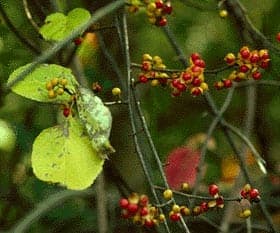
Only female plants produce fruit, but only if a male is within pollination range. From August to October, the plant develops round, green capsules that ripen to orange. These split open to reveal bright red arils-highly attractive to birds, which disperse the seeds over long distances. The berries are toxic to humans and pets.
Ideal location
In theory, this vine grows in full sun to partial shade. It prefers support structures like trees, fences, trellises, or pergolas. Full sun increases flowering and fruiting, accelerating its spread.
Do not plant it in your garden. Even in containers, root suckers and bird-dispersed seeds can lead to escape. In natural areas, it invades woodlands, forest edges, and disturbed sites, often forming dense mats that suppress native seedlings.
For gardeners with existing plants: keep growth below 1 m and monitor for new shoots. Remove any climbing onto trees immediately.
Soil requirements
Oriental bittersweet is extremely adaptable. It tolerates sandy, loamy, or clay soils, and survives in pH ranges from 5.5 to 8.0. It handles both dry and moist conditions but prefers well-drained, moderately fertile soil.
It thrives in disturbed soils-roadsides, abandoned lots, forest clearings-where competition is low. Its presence often indicates ecosystem disruption.
Avoid amending soil to improve growth; doing so only encourages more aggressive spreading.
Free design
Want to see Oriental bittersweet: complete guide in your garden? Make a free design now.
Watering
During the first growing season, water weekly during dry spells. After establishment, it's drought-tolerant and requires no supplemental watering. Overwatering increases growth rate and fruit production, raising invasion risk.
Do not water in winter. The plant is dormant, and wet soil in clay-heavy areas can lead to root rot.
Pruning
Pruning is critical-not for shape, but for containment. Cut back in late winter (November to February), when the vine is leafless. Remove all stems growing above 1 m and cut lateral shoots to 30 cm.
Wear gloves and use loppers or a pruning saw-the stems are tough. Dispose of cuttings by burning or landfill. Do not compost; seeds can survive decomposition.
For female plants, remove all fruit clusters before they split open. Even one capsule can release dozens of seeds.
Maintenance calendar
- January–February: Prune hard. Inspect for new growth near the base.
- March: Check for root suckers. Dig them out with a trowel.
- April–May: Monitor for climbing vines. Birds may have dropped seeds nearby.
- June–July: Flowering period. Identify male and female plants.
- August–October: Fruit development. Remove all fruit clusters before splitting.
- November: Final inspection. Ensure no vines are girdling trees.
On gardenworld.app, you can set seasonal reminders for invasive plant checks and generate a year-round maintenance schedule tailored to your garden's climate zone.
Winter hardiness
Oriental bittersweet is hardy in USDA zones 4–8 (-34°C to -12°C). In the UK (zone 8), it survives mild winters easily. Stems remain visible, often holding split capsules into early winter. Top dieback may occur in harsh winters, but the plant resprouts vigorously in spring.
Companion plants
There are no recommended companion plants-this vine is too aggressive. It shades out understory plants and physically damages supporting trees. If you're looking for a safe climber, consider native options like Virginia creeper (Parthenocissus quinquefolia) or clematis species that don't self-seed.
Use gardenworld.app to test how native climbers interact with your current planting scheme-digital planning helps avoid future problems.
Closing
Oriental bittersweet is a cautionary tale of ornamental planting gone wrong. Its beauty is undeniable, but its impact on native ecosystems is devastating. Once established, it's extremely difficult to eradicate.
If you already have it, remove it carefully: dig out roots, monitor for suckers, and avoid seed dispersal. Report large infestations to local conservation authorities.
Choose native, non-invasive alternatives. Your garden-and the wider environment-will be healthier for it.
Want to see Oriental bittersweet: complete guide in your garden? Make a free design now.
Upload a photo, pick a style, and get a photorealistic design with plant list in under a minute.
No credit card required


Similar plants
Fringed grass of Parnassus: complete guide
Parnassia fimbriata
Everything about Fringed grass of Parnassus (Parnassia fimbriata): growing, soil, watering and care. A delicate mountain perennial with white fringed flowers.
Euonymus cornutus: complete guide
Euonymus cornutus
Horned spindle is an intriguing shrub from central China with distinctive winged seed capsules. Learn how to grow this unique plant.
Large-Winged Spindle: complete guide to this Far Eastern shrub
Euonymus macropterus Rupr.
Discover Large-Winged Spindle (Euonymus macropterus), an elegant Japanese shrub prized for spectacular winged fruits. Perfect for Asian gardens and woodland plantings.