
Olivier BEZES / CC BY 2.5, via Wikimedia Commons
Cedar of lebanon: complete guide
Cedrus libani
Want to see Cedar of lebanon: complete guide in your garden?
1 minute, no credit card
Overview
The Cedar of Lebanon (Cedrus libani) isn't just a tree-it's a statement. If you've got the space, this slow-growing evergreen will reward you with centuries of dignified presence. Native to mountainous regions of Cyprus, Lebanon-Syria, and Turkey, it's built for resilience, handling cold winters and dry summers with ease. In the UK and northern Europe, it thrives best in deep, well-drained soils and open, sunny locations. Don't rush its growth; this is a tree meant for legacy, not instant impact. On gardenworld.app, you can visualise how a Cedar of Lebanon fits into your long-term garden layout, ensuring it won't outgrow its spot or block sunlight to other plants.
It's not a tree for small gardens. Mature specimens can reach 30–40 m in height with spreads just as wide. So think decades ahead. Once planted, moving it isn't an option. But if you're patient, you'll gain one of the most iconic conifers in horticulture.
Appearance & bloom cycle
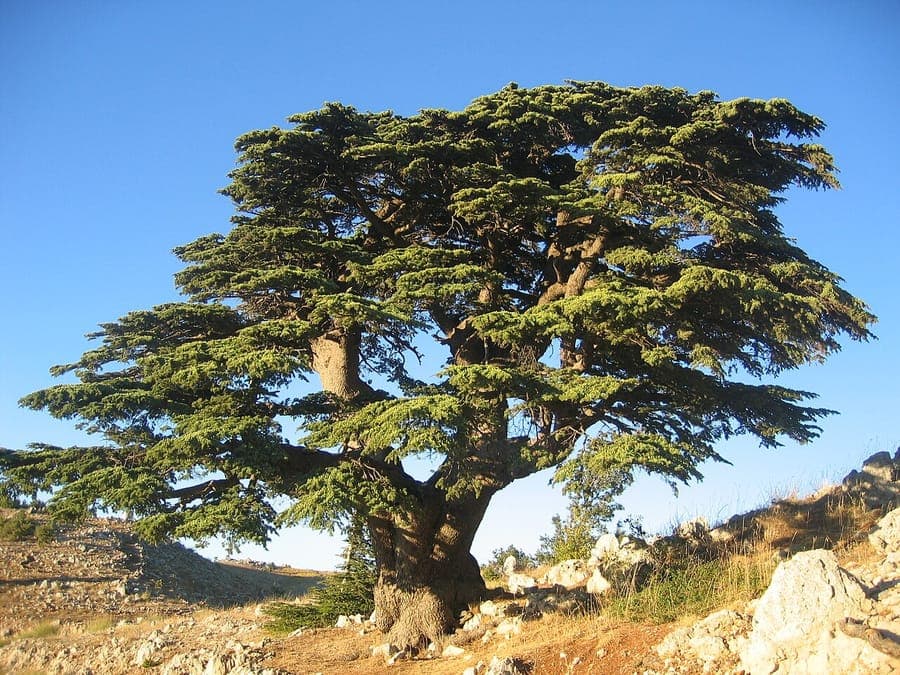
Young Cedrus libani trees are pyramidal, with upright, densely packed branches. As they age-starting around 15–20 years-the crown broadens, and branches begin to grow horizontally, forming a flattened, umbrella-like silhouette. This architectural shift is what makes mature trees so breathtaking.
The bark starts smooth and grey, developing deep fissures and a rugged texture over time. Needles are 1–2.5 cm long, stiff, and deep green, arranged in tight clusters on short spurs. They persist for 3–4 years before dropping, giving the tree a consistently full look.
Flowering occurs in late spring (May–June). Male cones are yellow, cylindrical, and hang in clusters, releasing pollen. Female cones are upright, oval, and greenish, maturing over two to three years into woody, barrel-shaped cones 7–12 cm long. When ripe, they disintegrate to release winged seeds.
Ideal location
This tree needs full sun-rate it a solid 7/10 on the light scale. Choose a spot with at least 8–10 hours of direct sunlight daily. Partial shade is tolerated, but it leads to sparse, one-sided growth. Avoid heavily shaded areas or spots under larger trees.
Space is non-negotiable. Allow a minimum of 8x8 metres, but ideally 12x12 m for mature specimens. Plant it as a focal point in large gardens, estates, or parkland. Wind isn't an issue-established trees handle exposure well. But young trees (first 3–5 years) benefit from a windbreak in exposed sites to prevent rocking and root damage.
On gardenworld.app, you can use the tree spacing tool to ensure your Cedar of Lebanon won't interfere with drains, buildings, or other plants as it matures.
Soil requirements
Cedrus libani demands well-drained soil. Heavy clay or waterlogged ground spells trouble-root rot is a real risk. Ideal soil is sandy loam or loamy with a pH between 7.0 and 7.5. If your soil is too acidic, a light application of ground limestone can help, but avoid over-liming.
Before planting, dig a hole twice as wide as the root ball and mix in sharp sand or gravel to improve drainage. Never plant too deep-the root flare should sit at or slightly above soil level. Poor drainage? Consider raised planting or mounding.
Free design
Want to see Cedar of lebanon: complete guide in your garden? Make a free design now.
Watering
Young trees need regular watering for the first two to three years, especially during dry spells. Give 10–15 litres per week, soaking the root zone deeply. Avoid frequent shallow watering-it encourages weak surface roots.
Once established (after year 3), Cedrus libani is highly drought-tolerant. Mature trees rarely need supplemental water, even in prolonged dry periods. Only during extreme heatwaves (above 30°C for over 10 days) should you consider deep watering.
Pruning
Don't prune unless absolutely necessary. The tree's natural form is its greatest asset. Remove only dead, damaged, or crossing branches, and do so in late winter (January–February) when the tree is dormant.
Never top or heavily shape a Cedar of Lebanon-this ruins its structure and invites disease. If a branch must be removed, cut just outside the branch collar to promote healing.
Maintenance calendar
- January: Inspect for storm damage. Light pruning if needed.
- February: Final pruning window. Check mulch level.
- March: Apply balanced fertiliser if soil is poor. Top up organic mulch.
- April: Monitor for aphids or scale. Water young trees if spring is dry.
- May: Flowering begins. No pruning.
- June: Watch for dry conditions. Water juveniles.
- July-August: Peak drought risk. Deep water young trees every 10–14 days if no rain.
- September: Reduce watering. Let tree harden off.
- October: Clear fallen needles and debris to reduce fungal risk.
- November: Check staking on young trees. Remove if no longer needed.
- December: Dormant period. No action required.
Winter hardiness
Hardy to USDA zones 6b–8a (-20°C to -12°C). In most of the UK and northern Europe, this isn't a concern. Young trees may benefit from burlap wrapping in severe winters to prevent desiccation and needle browning. Avoid wet, frozen soils-ensure good drainage to prevent root freeze-thaw cycles.
Companion plants
Underplant with drought-tolerant, shade-tolerant species. Think Dianthus, Lavandula, or Thymus near the base, keeping a 1–2 m clearance around the trunk for airflow. Avoid aggressive spreaders like ivy or mint. Good groundcovers include Ajuga reptans or Pachysandra terminalis, but keep them trimmed.
For design ideas, gardenworld.app features curated planting schemes that pair Cedrus libani with architectural perennials and low-maintenance groundcovers.
Closing
The Cedar of Lebanon is a commitment-not just in space, but in time. But for gardeners with vision, it's a gift to the future. Start right: choose a healthy specimen from reputable garden centres like those found across the UK, and plant it with care. You won't see its full glory in your lifetime, but that's the beauty of it. It's not for you-it's for what comes after.
Want to see Cedar of lebanon: complete guide in your garden? Make a free design now.
Upload a photo, pick a style, and get a photorealistic design with plant list in under a minute.
No credit card required


Similar plants
Abies delavayi: complete guide
Abies delavayi
Delavayi fir is an elegant, medium-sized coniferous tree from the Pinaceae family with dark green needles. This Asian evergreen is perfect for alpine gardens and large landscapes.
Taiwan fir: complete guide
Abies kawakamii
Discover the magnificent Taiwan fir, a rare evergreen conifer from Taiwan's mountain regions. Learn growth requirements, care tips, and why this beautiful tree is perfect for collectors of unique garden specimens.
Farges fir: complete guide
Abies fargesii
Discover the majestic Farges fir, an impressive conifer from China's mountains with elegant foliage and columnar form. Ideal for large gardens.