
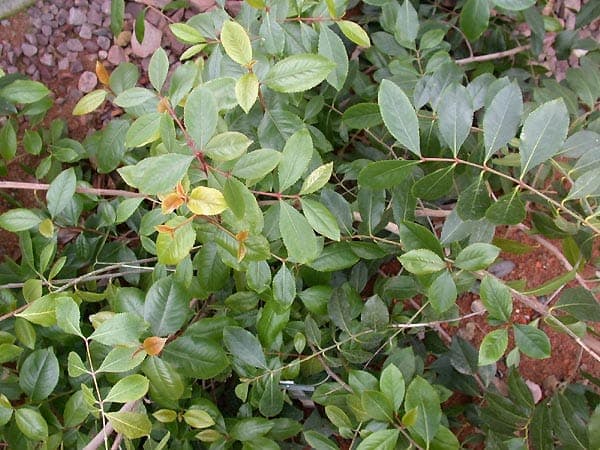
User:Katpatuka / Public domain, via Wikimedia Commons
Catha edulis: complete guide
Catha edulis
Want to see Catha edulis: complete guide in your garden?
1 minute, no credit card
Overview
Catha edulis, better known as khat or qat, is an evergreen small shrub from the mountainous regions of East Africa, particularly from Eritrea to South Africa and Yemen. This plant is notable for its glossy, aromatic foliage and represents an interesting ecological and cultural reference. In temperate climates, Catha edulis can be grown as a potted plant indoors or in a greenhouse.
Appearance and Bloom
Catha edulis grows into a compact, densely-foliaged evergreen shrub of 1-2 meters, though it can grow taller. The leaves are glossy, oval-elongate, and aromatic, distinguishing this plant. The flowers are small, white to cream-colored, appearing in prominent clusters along branches (March-May). Red to brown fruits follow flowering. The plant is visually interesting year-round.
Ideal Location
Catha edulis prefers full sun to light shade. At least 6-8 hours of direct sunlight daily is desired for dense foliage. In temperate climates, this plant is best grown indoors as a potted specimen near a bright window. Protection from cold wind and temperatures below 10degC is essential. Place in a location with strong indirect light.
Soil
Catha edulis prefers well-draining, sandy loam with neutral pH. Heavy clay should be avoided. For pot culture, use premium potting soil with added perlite or sand for drainage. The plant is not fussy about nutrients but tolerates poor soils better than very rich ones.
Watering
Catha edulis is moderately drought-tolerant once established, but thrives with regular moisture. During growing season (spring-summer), water carefully until droplets appear; allow soil to dry slightly between waterings. Far less water is needed in winter. Prevent waterlogging which damages roots. For potted plants, test soil: if dry 2-3 cm deep, water.
Free design
Want to see Catha edulis: complete guide in your garden? Make a free design now.
Pruning
Catha edulis responds well to pinching of shoot tips to encourage dense, bushy plants. Heavy pruning can be used to rejuvenate leggy specimens. Remove dead or diseased branches when observed. Early-season pruning improves overall form.
Maintenance Calendar
February-March: Begin moderate pruning, inspect for winter damage. April-May: Enjoy flowers, add monthly feeding. June-July: Peak growth, regular water and feeding. August-September: Gradually reduce feeding and water. October-January: Rest period, minimal maintenance, limited water.
Winter Hardiness
Catha edulis is not winter-hardy in temperate climates and must not be exposed to temperatures below 10degC. Outdoor growing is suitable only for Mediterranean or Mediterranean-like regions. In colder areas, grow indoors in pots or greenhouses. Protection under glass is essential.
Companion Plants
For indoor culture, other tropical plants complement Catha edulis:
- Ficus species (for structural contrast)
- Bougainvillea (for color complementing)
- Jasmine (for fragrance partnership)
- Small palm species
- Other fine-foliaged tropical plants
Closing
Catha edulis is a fascinating, exotic plant combining cultural history with botanical interest. While outdoor limitations restrict this in temperate climates, success as an indoor potted specimen adds unique intrigue to your plant collections. Grow it as a specimen under glass for years of exotic pleasure.
Specialized nurseries can supply plants. Discover more tropical plants using gardenworld.app/en!
Want to see Catha edulis: complete guide in your garden? Make a free design now.
Upload a photo, pick a style, and get a photorealistic design with plant list in under a minute.
No credit card required


Similar plants
Fringed grass of Parnassus: complete guide
Parnassia fimbriata
Everything about Fringed grass of Parnassus (Parnassia fimbriata): growing, soil, watering and care. A delicate mountain perennial with white fringed flowers.
Euonymus cornutus: complete guide
Euonymus cornutus
Horned spindle is an intriguing shrub from central China with distinctive winged seed capsules. Learn how to grow this unique plant.
Large-Winged Spindle: complete guide to this Far Eastern shrub
Euonymus macropterus Rupr.
Discover Large-Winged Spindle (Euonymus macropterus), an elegant Japanese shrub prized for spectacular winged fruits. Perfect for Asian gardens and woodland plantings.