
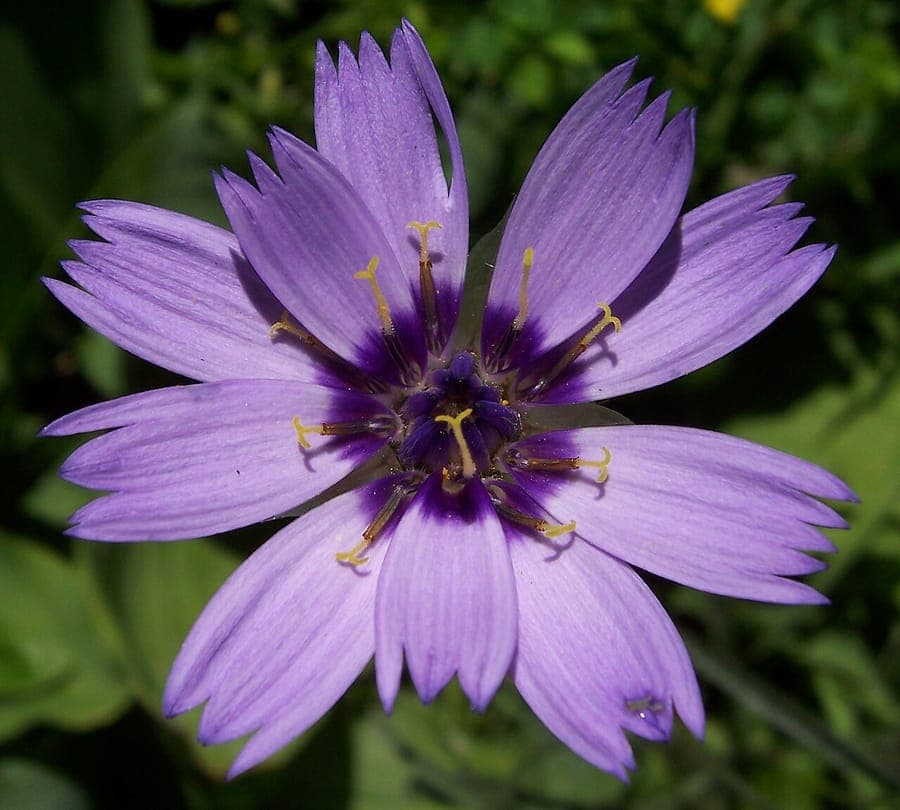
Ltshears - Trisha M Shears / CC BY-SA 2.5, via Wikimedia Commons
Cupid's-dart: complete guide
Catananche caerulea
Want to see Cupid's-dart: complete guide in your garden?
1 minute, no credit card
Overview
Catananche caerulea, commonly known as Cupid's-dart, is a striking annual that brings bold blue flowers to the garden with minimal effort. Native to the Mediterranean basin - including southern France, Spain, Italy and North Africa - it thrives in hot, dry conditions on poor, well-drained soils. In cultivation, it's a top choice for dry gardens, gravel beds and sunny borders where low maintenance is key.
This plant grows 30 to 45 cm tall, forming upright, branched stems with narrow, grey-green foliage. The flowers resemble small thistles or stiff asters, with vivid blue to pale violet ray florets surrounding a dark blue central disc. What sets it apart is its papery, straw-like calyx that remains intact after blooming, making it ideal for dried flower arrangements.
Despite the romantic common name, Cupid's-dart is tough as nails - drought-resistant, pest-free and largely ignored by deer and rabbits.
Appearance & bloom cycle
Flowering begins in June, peaks in July and August, and can continue into September if deadheaded regularly. Each flower is 4–5 cm wide and sits atop slender, wiry stems. The blooms are long-lasting on the plant and even longer when dried - they retain their shape and colour for months.
The plant self-seeds fairly reliably in well-drained soil, especially in USDA zones 7–10, though in colder climates it behaves as a true annual. In milder areas, you might see seedlings pop up in spring where flowers dropped the previous autumn.
One quirky trait: the dried flower heads rattle in the wind, earning it the German name 'Rasselblume' (rattle-flower). It's not just decorative - it's architectural.
Ideal location
Full sun is non-negotiable. Cupid's-dart needs at least 6–8 hours of direct sunlight daily. Choose a south- or west-facing spot with good air circulation. It performs best in open, unshaded areas where moisture doesn't linger.
Avoid shady corners, damp spots or areas crowded by vigorous perennials. It shines in gravel gardens, rockeries, and Mediterranean-style plantings. Don't plant it near thirsty shrubs or groundcovers that will outcompete it for resources.
Soil requirements
This plant despises wet feet. It demands sharply drained soil - think sandy loam, gritty mixes, or rocky substrates. A pH between 6.0 and 7.5 is ideal, but drainage trumps all. Heavy clay? Amend it with horticultural grit, perlite or coarse sand to improve flow.
If you're planting in a container, use a mix of 2 parts potting soil to 1 part grit. A top dressing of gravel helps keep the crown dry and prevents rot.
Free design
Want to see Cupid's-dart: complete guide in your garden? Make a free design now.
Watering
Once established, Cupid's-dart needs almost no supplemental watering. During the first 3–4 weeks after sowing or transplanting, keep the soil lightly moist - not wet. Water once a week if there's no rain, focusing at the base to avoid wetting foliage.
After that, let nature take over. Overwatering is the fastest way to kill it. In a typical UK or US summer, rainfall is usually enough. In extended droughts, a deep soak every 2–3 weeks is sufficient.
Pruning
Deadhead regularly to prolong blooming. Snip off spent flowers just above a leaf node or side shoot. Do this every 7–10 days from June through August. This not only encourages new buds but keeps the plant tidy.
Leave some late-season blooms if you want self-seeding. Cut stems in late summer for drying - hang them upside down in a dark, airy room for 7–10 days.
Maintenance calendar
- March–April: Sow seeds indoors or in a greenhouse 6–8 weeks before last frost. Or direct sow from mid-April when soil reaches 10°C.
- May: Thin seedlings to 25 cm apart. Water lightly during dry spells.
- June–September: Deadhead weekly. No feeding required.
- October: Allow some seed heads to mature for self-sowing. Clear dead stems if not wanted.
- November–February: Plant dies back. No care needed.
On gardenworld.app, you can design a low-water border that highlights Cupid's-dart alongside companions like Echinacea and Santolina.
Winter hardiness
Catananche caerulea is typically grown as an annual in temperate climates. It's not reliably perennial below USDA zone 7. Mature plants won't survive freezing winters, but seeds can overwinter in well-drained soil and germinate in spring. In milder zones (8–10), it may behave as a short-lived perennial.
No mulch or protection is needed - in fact, covering it can trap moisture and cause rot.
Companion plants
Pair Cupid's-dart with other sun-loving, drought-tolerant plants: lavender, Russian sage (Perovskia), yarrow (Achillea), sedum, and upright ornamental grasses like Stipa tenuissima. The blue tones contrast beautifully with golden yellow, silvery foliage or deep purple blooms.
Avoid moisture-loving plants like hostas or astilbes. Stick to a 'dry garden' palette: think Graptopetalum, Eryngium, and Nepeta. A triangular planting scheme works well - tall sedum at the back, Cupid's-dart in the middle, creeping thyme at the front.
Closing
Cupid's-dart is a no-fuss annual that delivers high impact. It blooms for months, attracts bees and butterflies, and dries like a pro. It's perfect for gardeners who want beauty without babysitting.
You'll find seeds or young plants at garden centres in spring, especially in cottage garden or pollinator-focused collections. Trusted retailers like Thompson & Morgan or Park Seed often carry it.
On gardenworld.app, you can visualise how this plant fits into a drought-resistant garden layout, with automatic spacing guides and seasonal care reminders.
Want to see Cupid's-dart: complete guide in your garden? Make a free design now.
Upload a photo, pick a style, and get a photorealistic design with plant list in under a minute.
No credit card required


Similar plants
Calendula stellata: complete guide
Calendula stellata
Complete guide to Calendula stellata, the star-flowered marigold from Sicily: location, soil, watering and companion planting tips.
Korean chrysanthemum: complete guide
Chrysanthemum x rubellum
Chrysanthemum x rubellum is a hardy autumn perennial with single pink to copper flowers from August to November. Care and combinations.
Helianthus divaricatus: complete guide
Helianthus divaricatus
Helianthus divaricatus is a North American woodland sunflower with yellow summer blooms, ideal for naturalistic borders and shady edges.