
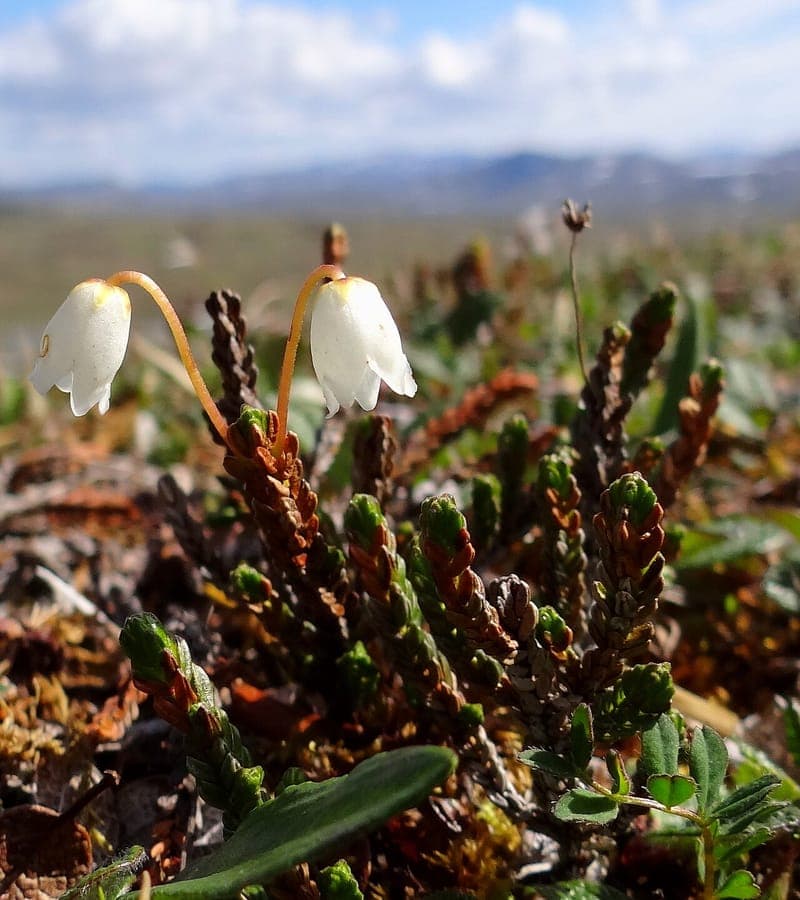
Bjørn Christian Tørrissen / CC BY-SA 3.0, via Wikimedia Commons
White Arctic Mountain Heather: complete guide
Cassiope tetragona
Want to see White Arctic Mountain Heather: complete guide in your garden?
1 minute, no credit card
Overview
White Arctic mountain heather (Cassiope tetragona), also known as four-angled mountain heather or Arctic bell heather, is a delicate alpine heath plant from the Ericaceae family. This plant naturally grows in Arctic and subarctic mountain regions from Alaska to Canada, through Siberia and Scandinavia to Iceland. The name "tetragona" refers to the four corners of leaves that arrange around the stem.
This plant is a jewel for true alpine specialists. With its snow-white flowers and dense, scale-like growth Cassiope tetragona offers unparalleled alpine charm. Cultivating it requires specific knowledge and dedication, but the reward is a plant that brings Arctic beauty to your garden.
Appearance and bloom
White Arctic mountain heather forms very compact, densely packed tussocks of tiny, square leaves. The plant reaches only 5-20 cm height, making it ideal for alpine troughs and very shallow growing areas. The leaves are extremely small (just millimetres), arranged tile-like, and prevent the plant from losing much water.
The flowering is the highlight. From May to July numerous small white bell-shaped flowers appear on thin stems. These flowers are particularly silky and delicate, a poetic contrast against dark green foliage. Flowering lasts several weeks and is abundant.
After flowering small brown seed capsules form. These remain on the plant through winter, adding texture and winter interest.
Ideal location
White Arctic mountain heather feels at home in alpine rock gardens with full sunny to half-shaded position. The plant naturally grows on mountain slopes between 1000-3000 metres elevation where intense mountain wind can occur. Choose therefore a location providing sun exposure but also protection against searing afternoon sun in warmer climates.
Protection against wet winters is essential. This plant naturally grows in Arctic regions where water effectively "freezes solid" as ice in winter. In regions with wet winters, protect the plant against rain with a glass frame or alpine shelter.
Wind is not a problem - on the contrary, Arctic flora is wind-adapted. Prevent water stagnation in all weather conditions.
Soil
White Arctic mountain heather is very particular about soil conditions. This plant naturally grows on extremely nutrient-poor, well-drained mountain soils. The ideal soil consists of:
- 50% coarse, grit-like sand
- 30% small stone chips
- 15% organic material (leaf mould, not compost)
- 5% slow-release mineral fertiliser
The pH must remain between 5.0 and 6.0 (acidic). This plant grows on acid-loving soils in its habitat. Chalky soil is absolutely unsuitable.
Micronutrients are essential. In very nutrient-poor soils the plant can weaken. Annual very light feeding helps.
In pots: use specialised alpine potting soil mixed with acid sand and granite chips, ratio 1:1:1. Perfect drainage is non-negotiable.
Free design
Want to see White Arctic Mountain Heather: complete guide in your garden? Make a free design now.
Watering
White Arctic mountain heather wants consistently moist (not waterlogged) soil during growing periods. This is a plant that requires regular water - not as a true water plant, but more as something that must stay consistently subtly moist.
In winter (October-March) give minimal water. This mimics the Arctic winter habitat where the plant sleeps under snow.
Rain water is preferred. Tap water can be problematic due to chlorine and limescale. Filter tap water where possible or let it stand 24 hours for chlorine to evaporate.
In pots: check moisture at least twice weekly. The soil may rarely dry completely, but water stagnation is fatal.
Pruning
White Arctic mountain heather requires practically no pruning. This plant naturally grows dense and compact. Remove only dead flowers after flowering, carefully so as not to disturb the compact tussock.
Removing leaves is not needed and can cause damage. Let aged leaves remain - they provide winter protection.
This plant naturally prunes its form perfectly. No aggressive cutback needed.
Maintenance calendar
Spring (April-May): Plant begins growth. Start regular watering. Carefully remove dead flowers from previous season.
Summer (June-August): Regular, careful watering. Plant flowers now - enjoy the white beauty. Check for spider mites (Arctic flora can be sensitive).
Autumn (September-October): Gradually reduce watering as temperatures drop. Plant prepares for rest.
Winter (November-March): Minimal watering. Plant is dormant. Protect against wet snow and water excess with alpine shelter. Avoid foot traffic.
Winter hardiness
White Arctic mountain heather is extraordinarily winter hardy - USDA zone 1a to 4a (European zone 1a to 3a). This plant can survive temperatures down to -50C. This is indeed Arctic flora, so polar winter is normal.
The plant tolerates long periods of extreme cold as long as drainage remains perfect and waterlogged feet don't occur. Snow coverage is actually beneficial, as it acts as insulation.
The risk lies not in cold, but in wetness during winter. Protection against rain/snowmelt is essential in rainy climates.
Companion plants
White Arctic mountain heather combines well with other Arctic/alpine heaths such as Arctostaphylos uva-ursi, small Rhododendron species, or Cassiope mertensiana. Small Juniperus cultivars or alpine Sedum species also fit perfectly.
Limit companion plants to similarly nutrient-poor and pH requirements. This plant is sensitive to growing environment, so incompatible neighbours can weaken it.
In alpine troughs, limit to three or four plant species maximum.
Closing
White Arctic mountain heather is a plant for the absolute alpine specialist. This is not for beginning alpine gardeners. The specific soil requirements, moisture balance, pH demands, and winter protection needed make this challenging in many climates.
Whoever successfully cultivates this plant, possesses a piece of Arctic majesty in their garden. Cassiope tetragona represents alpine purity and the refusal of compromise in plant collecting. Very difficult to obtain - seek specialised alpine nurseries in Scandinavia or Northern Europe.
A plant for true enthusiasts of Arctic alpine flora. Available only from highly specialised suppliers. Worth the effort for those seeking the purest Alpine experience.
Want to see White Arctic Mountain Heather: complete guide in your garden? Make a free design now.
Upload a photo, pick a style, and get a photorealistic design with plant list in under a minute.
No credit card required


Similar plants
Zenobia pulverulenta: complete guide
Zenobia pulverulenta
Everything about Zenobia pulverulenta (honeycup): siting, acid soil, pruning and the fragrant white bells, in this complete care guide.
Dwarf huckleberry: complete guide
Gaylussacia dumosa
Everything about dwarf huckleberry (Gaylussacia dumosa): acidic soil, partial shade, pruning and care for this compact North American berry shrub.
Drooping leucothoe: complete guide
Leucothoe fontanesiana
Everything about drooping leucothoe (Leucothoe fontanesiana): shade tolerance, soil, watering, pruning, hardiness and companion plants.