
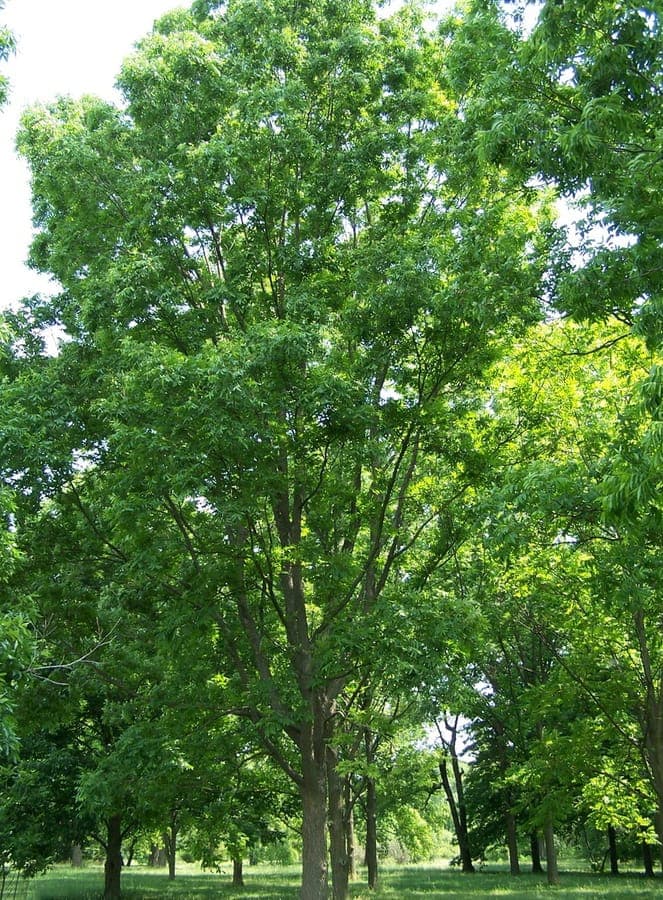
Bruce Marlin / CC BY 3.0, via Wikimedia Commons
Pecan Tree: complete guide
Carya illinoinensis
Want to see Pecan Tree: complete guide in your garden?
1 minute, no credit card
Overview
The Pecan Tree (Carya illinoinensis), also called pecanier, is a large, strikingly elegant nut tree from central and southern North America. The tree grows naturally along waterways and forms an impressive spectacle with its broad, spreading crown and elegant foliage. For food producers and landscapers, the pecan tree is indispensable due to its delicious nuts and ornamental value.
Appearance and Bloom
Pecan trees grow to 30 to 40 meters tall, sometimes taller, with extensive, symmetrical crowns reaching ten to fifteen meters across. The trunk is sturdy and gray-fissured. Foliage consists of elongate, compound leaves with 9-17 lance-shaped leaflets. In early spring, pendant male and female flowers appear separately on the same tree. Nuts ripen in fall, surrounded by a green husk that opens to reveal oval, brown shells.
Ideal Location
Pecan trees grow best in full sun. Ensure the tree receives at least 6 hours direct sunlight daily. This helps build strong, healthy crown structure and optimizes food production. The tree tolerates some shade but grows less robustly and produces fewer nuts in reduced light situations.
Soil
Pecan trees grow best in deep, well-draining sandy-loam soils. They also thrive in heavier loamy soils provided drainage is reasonable. pH range is flexible, from weakly acidic to slightly alkaline (pH 6-7.5). The tree requires regular nutrient supply; soil with moderate fertility is preferred. Ensure soil contains adequate nutrition; avoid overly lean soils.
Watering
Pecan trees, once established, require less watering than many moisture-lovers, but need regular watering until fully rooted, usually 2-3 years. Water well during the growing season, especially during dry periods. Water regularly, approximately 2-3 centimeters per week during growing periods. In dry regions, supplemental watering may be needed to maintain nut production.
Free design
Want to see Pecan Tree: complete guide in your garden? Make a free design now.
Pruning
Pecan trees require minimal pruning once established. In early years, young trees can be lightly pruned to build strong main structure. Remove dead, diseased, or sharp bifurcated branches. Prune in late winter before bloom. Avoid heavy pruning, which can stimulate vigorous shoot growth.
Maintenance Calendar
February-March: Light pruning to build structure April-May: Bloom appears, regular watering June-July: Young nuts develop, ensure consistent moisture August-September: Nuts ripen, reduce watering October-November: Nuts fall, foliage turns gold December-January: Winter rest, no maintenance needed
Winter Hardiness
Pecan trees are reasonably hardy in temperate to warm climates, typically hardiness zones 5-9. They tolerate temperatures down to about -15 degrees Celsius, though young trees require protection in cold climates. In extremely cold regions, young trees may benefit from winter wrapping against cold-related issues.
Companion Plants
Pecan trees can be underplanted with: Vioolas (violets) Liriopes (lily-turf) Liriodendrons (tulip tree, shade side) Gaultheria (wintergreen) Enkianthus (lantern plant) Mahonia (mahonia) Euonymus (wintercreeper)
Closing Remarks
The pecan tree is an impressive specimen for those with space, patience, and commitment to feeding. With its majestic appearance, ornamental value, and wealth of nutrition, it is a valuable long-term garden investment. For best results, choose a full-sun, well-drained location. GardenWorld.app helps you find the ideal spot in your landscape for this beautiful and nutritious tree.
Want to see Pecan Tree: complete guide in your garden? Make a free design now.
Upload a photo, pick a style, and get a photorealistic design with plant list in under a minute.
No credit card required


Similar plants
Texas walnut: complete guide
Juglans microcarpa
Complete guide to Texas walnut (Juglans microcarpa): a small, drought-tolerant walnut tree for gardens. Location, soil, watering, and care advice.
Mockernut hickory: complete guide
Carya alba
Mockernut hickory is a majestic North American tree with ornamental and nut value. Learn everything about care, cultivation and ideal location.
Carya cordiformis: complete guide
Carya cordiformis (Wangenh.) K.Koch
Bitternut hickory: a majestic North American hardwood with golden fall foliage, native value, and wildlife-friendly nuts.