
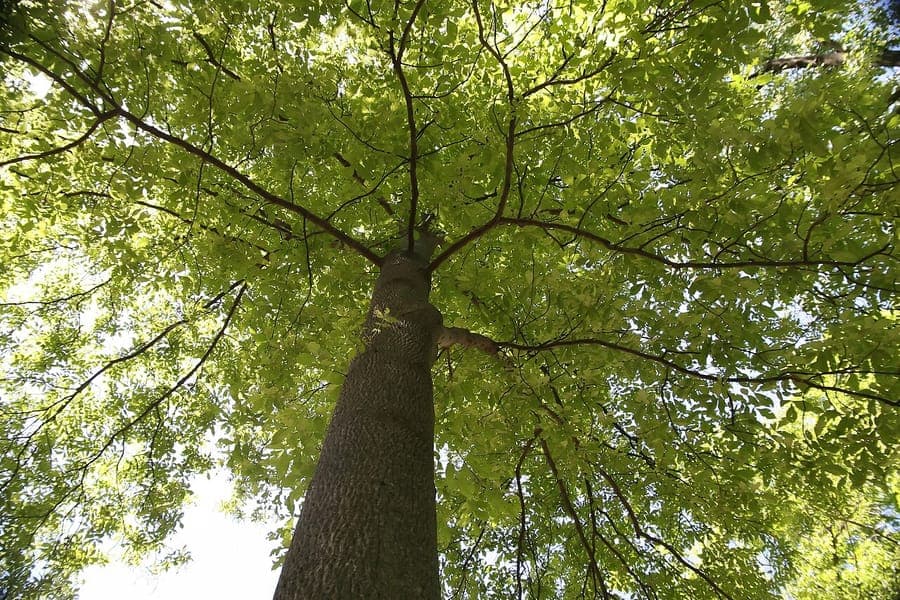
Photo by David J. Stang / CC BY-SA 4.0, via Wikimedia Commons
Mockernut hickory: complete guide
Carya alba
Want to see Mockernut hickory: complete guide in your garden?
1 minute, no credit card
Overview
Mockernut hickory (Carya alba) is an impressive deciduous tree from the walnut family (Juglandaceae) native to North America. This specimen reaches substantial size and is renowned for its strong timber and oval nuts. In the landscape, mockernut hickory delivers a natural, forest-like appeal with golden autumn coloration.
The tree plays an important role in North American ecosystems, providing food for wildlife. For gardeners, it's an impressive specimen tree promising years of growth and beauty.
Appearance & Bloom
Mockernut hickory grows into a large, columnar tree with a dense crown of oval, compound leaves. The foliage is green in summer and transforms to beautiful golden-yellow through brown tones in autumn.
The tree blooms inconspicuously in spring with hanging male catkins and small female flowers. Characteristic are the large, thick-shelled brown nuts developing on an annual cycle.
Ideal Location
Mockernut hickory thrives best in a sunny spot with room for full crown development. A minimum of 6-8 hours of direct daily sunlight promotes healthy growth and nut production.
This specimen requires adequate space - plant at least 6-8 meters away from other large trees and structures. In open landscapes, the tree feels most at home where wind can circulate freely.
Soil
Mockernut hickory grows optimally in deep, well-draining soils. This can be sandy or loamy soil as long as water excess is not retained.
The tree is adaptable to various soil types, including slightly acidic to neutral pH. A substrate with sufficient depth for root penetration is essential for stability and moisture uptake during drought.
Free design
Want to see Mockernut hickory: complete guide in your garden? Make a free design now.
Watering
Once established, mockernut hickory has relatively low water requirements. Trees tolerate dry periods well once rooted.
During the first growing season, regular watering is important. Water deeply and less frequently to encourage a strong root system. In extreme dry periods supplement, especially for young specimens.
Pruning
Mockernut hickory requires minimal pruning. Remove only dead, damaged or crossing branches to support an open structure.
Prune in late winter or early spring for best recovery capacity. The tree develops a natural form without intervention, so avoid excessive shaping.
Maintenance Calendar
Spring: Check for winter damage, add mulch around base. Summer: Monitor water status during heat waves. Fall: Harvest fallen nuts for posterity. Winter: Minimal maintenance needed.
An annual inspection for health and structure suffices for established trees.
Winter Hardiness
Mockernut hickory is fully winter-hardy in Europe due to its North American origin. This tree tolerates temperatures below -20°C without damage.
Once established, the rough timber and root structure provide excellent winter resilience, even in continental climates.
Companion Plants
Plant mockernut hickory with shade-tolerant understory species such as ivy (Hedera), wild ginger (Asarum) and woodland strawberry (Fragaria). These groundcovers prevent erosion and create a forest-like atmosphere.
Layer with native shrubs such as hazel (Corylus) for layered composition.
Closing
Mockernut hickory is a spectacular investment for long-term landscapes with adequate space. This tree offers generations of food, shade and natural beauty. For gardens where majesty and ecological value are central, this American classic certainly deserves attention.
Want to see Mockernut hickory: complete guide in your garden? Make a free design now.
Upload a photo, pick a style, and get a photorealistic design with plant list in under a minute.
No credit card required


Similar plants
Texas walnut: complete guide
Juglans microcarpa
Complete guide to Texas walnut (Juglans microcarpa): a small, drought-tolerant walnut tree for gardens. Location, soil, watering, and care advice.
Pecan Tree: complete guide
Carya illinoinensis
Majestic pecan tree producing delicious nuts. Explore this American native for shade-free growth and abundant harvests worldwide.
Carya cordiformis: complete guide
Carya cordiformis (Wangenh.) K.Koch
Bitternut hickory: a majestic North American hardwood with golden fall foliage, native value, and wildlife-friendly nuts.