
Andreiflorea993 / CC BY-SA 4.0, via Wikimedia Commons
Hottentot fig: complete guide
Carpobrotus edulis
Want to see Hottentot fig: complete guide in your garden?
1 minute, no credit card
Overview
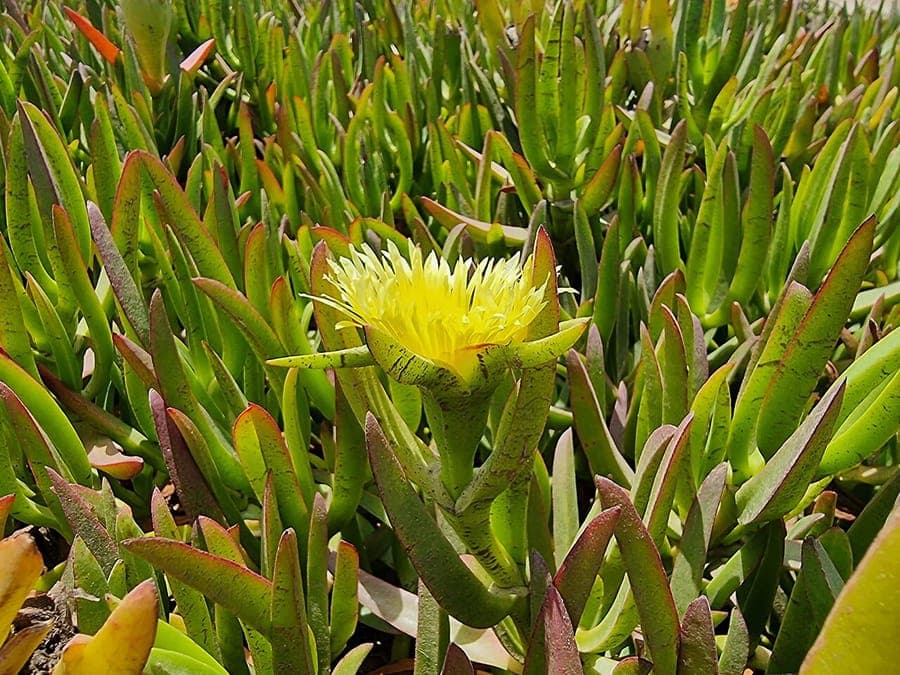
Carpobrotus edulis, commonly known as Hottentot fig, is a sprawling succulent shrub that forms dense mats across dry, sunny areas. Native to the Cape Provinces of South Africa, it thrives in coastal conditions and has naturalised in many parts of southern Europe. In the UK and Ireland, it's mostly limited to milder coastal zones (USDA zone 9-10), where it grows up to 20 cm tall but spreads horizontally up to 1.5 m. Its trailing stems root at the nodes, allowing it to stabilise slopes and cover bare soil quickly.
On gardenworld.app you can design a layout that highlights Hottentot fig as a low-maintenance ground cover, especially in xeriscapes or seaside gardens. The app helps you plan spacing-ideally 30–40 cm apart-for full coverage within one growing season.
Appearance & bloom cycle
The plant has fleshy, triangular leaves up to 5 cm long, arranged in tight clusters along reddish stems. From May to August, it produces large, daisy-like flowers in deep purple, up to 7 cm wide. Each bloom lasts just one day, but new ones open daily, creating a long-lasting floral display. After flowering, edible fruits develop-fig-shaped, green turning yellow, with a sweet-tart flavour. Though not everyone enjoys the taste, they can be used in jams or eaten raw.
This plant spreads aggressively in ideal conditions, so monitor its growth. The fruits attract birds, which can spread seeds, but vegetative spread via stems is the main issue in gardens.
Ideal location
Full sun is non-negotiable-rate it a solid 9 out of 10 for light. Plant it on south- or west-facing banks, rock gardens, or dry retaining walls. It excels in coastal gardens where salt spray and wind are common. Avoid shaded areas; growth becomes leggy and flowering drops sharply. In colder inland regions, grow it against a warm, sheltered wall with excellent drainage. It won't survive prolonged wet soils, even in mild winters.
For gardeners in zone 8, use gardenworld.app to simulate microclimates and identify the warmest, driest spots in your garden for a better survival chance.
Soil requirements
Well-drained soil is essential. Sandy or gravelly soils are perfect. If your soil is heavy clay, amend it with horticultural grit or sharp sand-aim for at least 30% improvement in drainage. The ideal pH is between 7.0 and 7.5 (neutral to slightly alkaline). Avoid rich composts or organic matter; this plant evolved in nutrient-poor conditions and reacts poorly to over-fertilisation. A lean soil keeps it compact and flowering.
Free design
Want to see Hottentot fig: complete guide in your garden? Make a free design now.
Watering
Once established, Hottentot fig is extremely drought-tolerant. Water weekly during the first growing season if rain is scarce. After that, only irrigate during extended droughts (e.g., no rain for 14+ days). Overwatering is the fastest way to kill it-root rot sets in quickly. Water at soil level, never wet the foliage. Drip irrigation or hand-watering at the base works best.
Pruning
Pruning isn't mandatory, but it helps control spread and rejuvenate older patches. In March or September, cut back straggly stems with sharp shears. Remove any dead or mushy growth. Trim back overreaching sections to keep it within bounds. The cuttings root easily-just lay them on dry soil, and they'll take hold in weeks. Be cautious: in some regions, this plant is invasive. Check local guidelines before planting.
Maintenance calendar
- Jan: Dormant; no action
- Feb: Inspect for frost-damaged stems
- Mar: Light pruning if needed
- Apr: Monitor for new shoot emergence
- May: First blooms appear; reduce watering
- Jun: Peak flowering; watch for pests
- Jul: Continue dry conditions; avoid overhead watering
- Aug: Final blooms; fruit begins to ripen
- Sep: Trim runners and shape plant
- Oct: Harvest fruit (optional)
- Nov: Prepare for winter; ensure soil stays dry
- Dec: Dormant; protect only in exposed areas
Winter hardiness
Hardy in USDA zones 9–10. In zone 8, it may survive with protection-plant against a south-facing wall and mulch with gravel or crushed rock to keep crowns dry. Prolonged frost below -5°C can kill the plant, especially if the soil is wet. In colder zones, treat it as an annual or grow in containers that can be moved indoors.
Companion plants
Pair with other drought-tolerant species: Sedum spectabile, Euphorbia characias, Thymus serpyllum, or Festuca glauca. Avoid moisture-loving plants that require frequent watering. For texture contrast, try Carex comans or Melianthus major. In coastal settings, it fits well with sea thrift (Armeria maritima) and sea campion (Silene uniflora). Use gardenworld.app to preview companion combinations and spacing.
Closing
Carpobrotus edulis is a resilient, eye-catching plant that demands little and delivers bold colour and coverage. Plant it in full sun, on well-drained soil, and let it do its thing. It's ideal for stabilising banks, filling gaps in rockeries, or softening hardscapes. Buy young plants from garden centres in spring-look for 9 cm pots from April onwards. While it's low-maintenance, keep an eye on its spread. With thoughtful placement and occasional trimming, Hottentot fig becomes a reliable, long-term feature in sunny gardens.
Want to see Hottentot fig: complete guide in your garden? Make a free design now.
Upload a photo, pick a style, and get a photorealistic design with plant list in under a minute.
No credit card required


Similar plants
Carpobrotus glaucescens: complete guide
Carpobrotus glaucescens
Pigface or angular sea-fig is a succulent from Australia. Learn cultivation, care, and use for coastal and container gardens.
Delosperma nubigenum: complete guide
Delosperma nubigenum
Everything about Delosperma nubigenum: a prolific-flowering succulent from South Africa with orange blooms. Growing tips, care and design ideas for your garden.
Crocea Iceplant: complete guide
Malephora crocea
Discover Crocea Iceplant (Malephora crocea), a South African succulent with coppery-orange flowers. Perfect for dry, sunny gardens and rock gardens.