
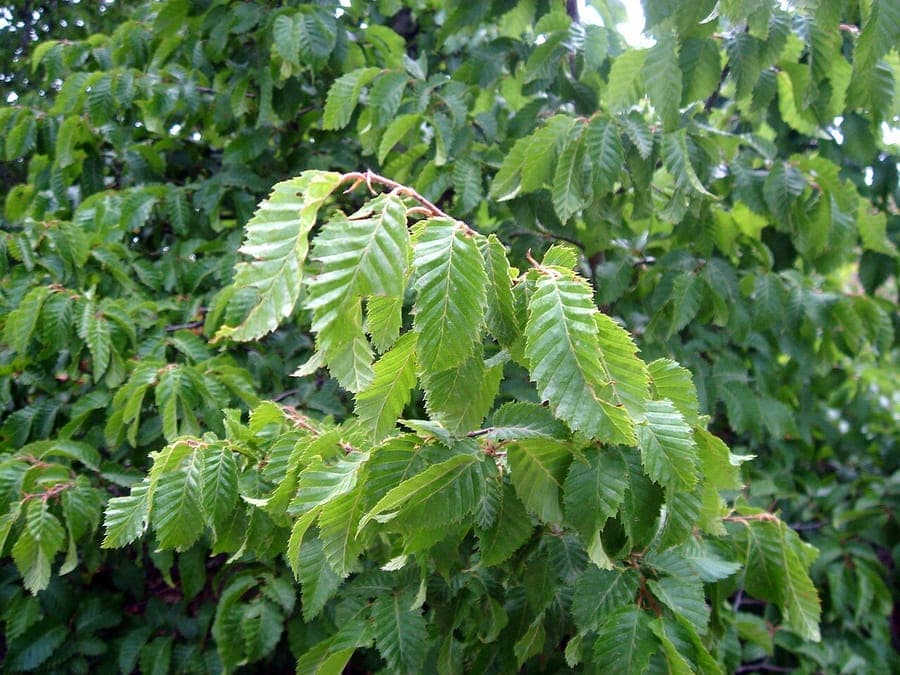
Karduelis / Public domain, via Wikimedia Commons
Eastern hornbeam: complete guide
Carpinus orientalis
Want to see Eastern hornbeam: complete guide in your garden?
1 minute, no credit card
Overview
Carpinus orientalis, the Eastern hornbeam, is a quietly impressive tree that deserves more attention in UK and northern European gardens. Native to southeastern Europe and parts of western Asia, it's more drought-tolerant and slightly smaller than its cousin, the common hornbeam (Carpinus betulus). It typically reaches 6–10 m in height and 4–6 m in spread over 20–30 years, making it perfect for medium to small gardens where space is limited.
What sets this tree apart is its open, graceful habit and attractive, slightly drooping branches. The bark is smooth and silvery-grey, developing shallow fissures with age. It's not just a structural plant - it brings seasonal interest, too. Unlike many ornamental trees, it's tough, low-maintenance, and adapts well once established. Use it as a standalone feature or in small clusters to create depth. On gardenworld.app, you can design a layout that highlights its elegant form without overcrowding.
Appearance & bloom cycle
The leaves are ovate to lanceolate, 4–8 cm long, with finely serrated edges and a soft, downy texture. They emerge bright green in spring, mature to a medium green in summer, and turn golden-yellow to warm copper in autumn - a display that lasts longer than many hornbeam relatives. The fall colour is reliable, even in milder climates.
Flowering happens in April and May. The tree is monoecious, meaning both male and female catkins grow on the same plant. The male catkins dangle and release pollen, while the female ones are shorter and upright. After pollination, the female catkins develop into small nutlets surrounded by leafy bracts. These persist into winter, offering subtle visual interest and food for small birds like finches and sparrows.
Ideal location
Plant in full sun to light shade. At least 6 hours of direct sunlight daily ensures dense foliage and strong growth. In deep shade, the crown becomes sparse and leggy. An east- or south-facing spot works best, especially in cooler regions where warmth helps the tree thrive.
It handles urban conditions well - pollution, compacted soil, and wind - but needs good air circulation to prevent fungal issues. Avoid planting in tight corners or next to large buildings where airflow is restricted. If using as a specimen tree, allow at least 3 m on all sides for mature spread. It's also suitable for large containers when young, but will eventually need transplanting into the ground.
Soil requirements
This species tolerates a wide range of soils but prefers well-drained, sandy loam or loamy soils. It grows in pH from 6.0 to 7.8, so both slightly acidic and slightly alkaline conditions are fine. Avoid heavy clay unless you amend it with grit and compost to improve drainage. Poor drainage leads to root rot, especially in winter.
When planting, dig a hole twice as wide as the root ball but no deeper. Backfill with native soil - don't add rich compost or fertiliser, as this can cause root burn or uneven growth. A 5–10 cm layer of organic mulch (like bark or leaf mould) helps retain moisture and suppress weeds.
Free design
Want to see Eastern hornbeam: complete guide in your garden? Make a free design now.
Watering
Water deeply once a week during the first two growing seasons, applying 20–30 litres per session. Use a slow trickle from a hose or a watering can with a rose to ensure water penetrates deep into the root zone. After establishment, the tree is moderately drought-tolerant but benefits from watering during prolonged dry spells (over 3 weeks without rain).
Avoid frequent shallow watering - it encourages weak surface roots. Always water at the base, not against the trunk. In summer, early morning is the best time to water to reduce evaporation.
Pruning
Pruning is rarely needed. Carpinus orientalis naturally forms a balanced crown. Only remove dead, damaged, or crossing branches, and do this in late winter (February) when the tree is dormant. Avoid heavy pruning - it doesn't respond as well as Carpinus betulus to hard cuts.
If shaping is necessary, limit removal to no more than 20% of the canopy per year. Use sharp, clean secateurs or a pruning saw. Seal cuts over 3 cm in diameter with wound paint to prevent fungal entry. Never use a hedge trimmer - it creates unsightly stubs and increases disease risk.
Maintenance calendar
- Jan: Inspect for storm damage and loose branches
- Feb: Light pruning; apply mulch if not done in autumn
- Mar: Loosen soil around the base, avoid deep digging
- Apr: Watch for catkins; no feeding needed
- May: Check for aphids or powdery mildew
- Jun: Water during dry periods
- Jul: Minimal care; monitor for drought stress
- Aug: Continue watering if no rain
- Sep: No action required
- Oct: Let fallen leaves decompose naturally - they enrich the soil
- Nov: Protect young trunks from rodents with mesh guards
- Dec: Final check for structural issues
Winter hardiness
Carpinus orientalis is hardy to USDA zone 5 (-29°C), but young trees in the UK (zone 7–8) may suffer from late spring frosts or sudden cold snaps. Wrap the trunk of young trees with hessian or spiral guards for the first three winters. Mature trees are fully hardy and require no protection.
In harsh winters, tip dieback can occur, but regrowth in spring is usually strong. Avoid watering when the ground is frozen - instead, water on mild, sunny days to prevent desiccation.
Companion plants
Underplant with shade-tolerant perennials like Alchemilla mollis, Epimedium, or Hosta. For contrast, pair with silver-foliage plants such as Stachys byzantina or Artemisia. Echinacea, Salvia, and Allium add vertical interest in front of the tree. Avoid aggressive ground covers like ivy or pachysandra that compete for moisture and nutrients.
A mulch of pine bark or leaf litter helps retain moisture and discourages weeds.
Closing
The Eastern hornbeam is a quiet achiever - not flashy, but full of grace and resilience. It brings structure, seasonal colour, and year-round interest with minimal effort. Perfect for gardeners who value substance over show. Whether you're creating a modern courtyard garden or a naturalistic border, this tree fits right in. On gardenworld.app, you can explore design ideas that feature Carpinus orientalis as a focal point or supporting player in a layered planting scheme.
Want to see Eastern hornbeam: complete guide in your garden? Make a free design now.
Upload a photo, pick a style, and get a photorealistic design with plant list in under a minute.
No credit card required


Similar plants
Heart-leaf birch: complete guide
Betula cordifolia
Heart-leaf birch is an attractive North American birch tree for large gardens. Discover growth, white papery bark and winter hardiness.
Tropical hornbeam: complete guide
Carpinus tropicalis
Everything about Carpinus tropicalis, the tropical hornbeam from Central America. Growing tips, location, care, and garden use explained.
Japanese Alder (Alnus firma): complete guide
Alnus firma
Learn everything about Japanese Alder in our complete guide. Discover care, growth, and applications for larger gardens.