
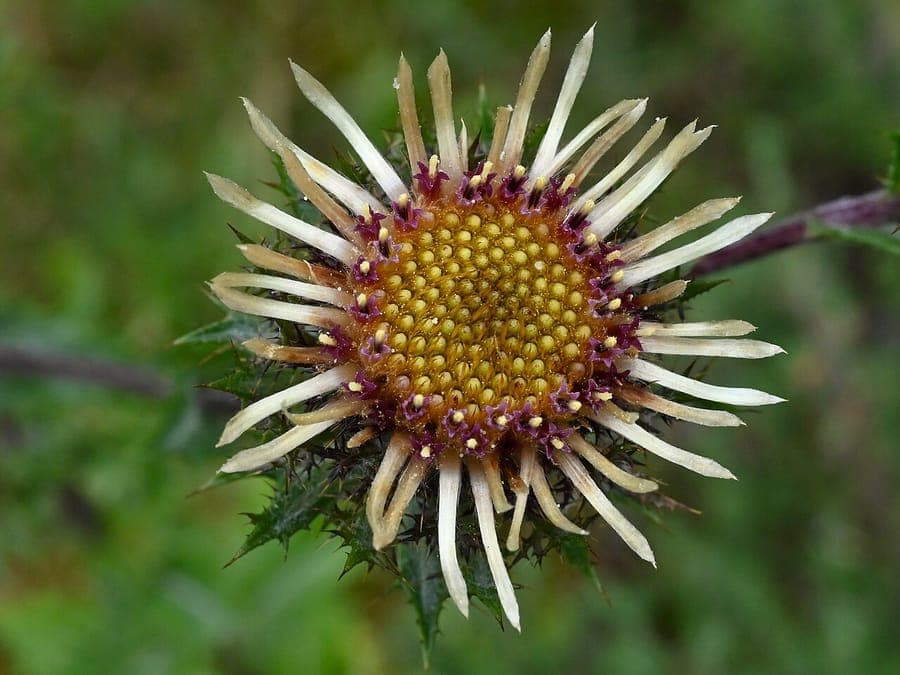
Krzysztof Ziarnek, Kenraiz / CC BY-SA 4.0, via Wikimedia Commons
Carline thistle: complete guide
Carlina vulgaris
Want to see Carline thistle: complete guide in your garden?
1 minute, no credit card
Overview
Carline thistle, or Carlina vulgaris, is a striking herbaceous plant from the Asteraceae family. Native across much of central and southern Europe, it thrives in dry, open habitats like grasslands, sandy slopes, and disturbed ground. In the garden, it's not commonly seen, but it's a rewarding choice for naturalistic planting schemes. It can behave as a biennial or short-lived perennial, depending on conditions, and typically reaches maturity in its second year.
This isn't a plant for the overly tidy gardener - it's wild, structural, and persistent in the best way. On gardenworld.app, you can design a low-fuss planting plan that highlights the architectural form of Carline thistle.
Appearance & bloom cycle
Carline thistle grows between 30 and 60 cm tall, with upright, spiny stems covered in fine, silvery hairs. The leaves are deeply lobed, dark green on top, and woolly white underneath, creating a lovely textural contrast. The flower heads are the star: stiff, silvery-white to pale yellow discs, 4–6 cm wide, ringed by pointed, spine-tipped bracts that remain rigid and dry on the plant.
Blooming runs from July to September. Unlike many thistles, the flowers don't wilt - they dry naturally in place, lasting through winter. This makes them excellent for dried arrangements and adds strong vertical interest to the dormant garden.
Ideal location
Full sun is essential - aim for a light level of 7 or higher, meaning at least 6 hours of direct sunlight daily. Partial shade leads to weak, leggy growth and fewer blooms. Choose an open, airy spot with good air circulation to prevent fungal issues. It works well in gravel gardens, wildlife borders, or neglected corners where little maintenance is desired.
Use gardenworld.app to assess sun exposure across your garden beds and find the perfect microclimate for Carline thistle.
Soil requirements
This plant needs well-drained, lean soil with a neutral to slightly alkaline pH of 7.0–7.5. Sandy or gravelly soils are ideal. Avoid heavy clay or water-retentive loams - the roots will rot in wet conditions. Poor fertility is not a problem; in fact, rich soils encourage floppy growth and reduce flowering.
If your soil is dense, amend it with horticultural grit or coarse sand. Do not add compost or fertilizer - Carline thistle thrives in low-nutrient conditions.
Free design
Want to see Carline thistle: complete guide in your garden? Make a free design now.
Watering
Once established, Carline thistle is highly drought-tolerant. During the first growing season, keep the soil lightly moist, especially in dry spells. Water at the base to avoid wetting the foliage, which can trigger mildew. After the first year, supplemental watering is rarely needed, even in hot summers.
Overwatering is the main risk. Only irrigate during prolonged droughts when young plants show signs of stress.
Pruning
Pruning isn't necessary for plant health, but cutting back old growth in early spring tidies the bed. Leave the dried flower heads through winter for visual interest and wildlife value. In March, cut stems down to ground level before new rosettes emerge.
If you want to limit self-seeding, remove spent flower heads before seeds fully ripen. That said, self-sown seedlings are usually sparse and easy to manage.
Maintenance calendar
- Jan: leave dried flower heads standing
- Feb: continue to leave structures for winter interest
- Mar: cut back old stems; check for new rosettes
- Apr: sow seeds if desired; water seedlings in dry periods
- May: watch for slugs on young foliage
- Jun: monitor for drought stress; stake tall plants if needed
- Jul: flowering begins; inspect for pollinator activity
- Aug: peak bloom; collect seeds for future sowing
- Sep: allow flowers to dry; reduce watering
- Oct: observe birds and insects on seed heads
- Nov: no action needed; plant overwinters
- Dec: maintain structure for winter garden appeal
Winter hardiness
Carline thistle is hardy to USDA zones 5–8. In the UK and most of northern Europe (zone 7–8), it survives winter without protection. The basal rosette often remains semi-evergreen, and the dried flower heads persist, providing food and shelter for insects.
No winter mulch is required. In fact, leaving the plant intact supports biodiversity.
Companion plants
Pair Carline thistle with other drought-tolerant, sun-loving species. Good options include: Sedum 'Herbstfreude', Eryngium planum, Stachys byzantina, or Festuca ovina. It also combines well with upright grasses like Stipa tenuissima or Molinia caerulea for soft contrast.
Avoid aggressive spreaders or moisture-loving plants like hostas or astilbes.
Closing
Carline thistle brings a wild, architectural presence to the garden. It's not flashy, but it's unforgettable - especially when backlit by autumn sun. Its resilience, low needs, and long seasonal interest make it a smart choice for sustainable planting.
Find seeds or plants at garden centres like B&Q, Wyevale, or local independents. It's not always on the shelf, so ask if they can order it. On gardenworld.app, you can also track bloom times and care reminders tailored to your region.
Want to see Carline thistle: complete guide in your garden? Make a free design now.
Upload a photo, pick a style, and get a photorealistic design with plant list in under a minute.
No credit card required


Similar plants
Calendula stellata: complete guide
Calendula stellata
Complete guide to Calendula stellata, the star-flowered marigold from Sicily: location, soil, watering and companion planting tips.
Korean chrysanthemum: complete guide
Chrysanthemum x rubellum
Chrysanthemum x rubellum is a hardy autumn perennial with single pink to copper flowers from August to November. Care and combinations.
Helianthus divaricatus: complete guide
Helianthus divaricatus
Helianthus divaricatus is a North American woodland sunflower with yellow summer blooms, ideal for naturalistic borders and shady edges.