
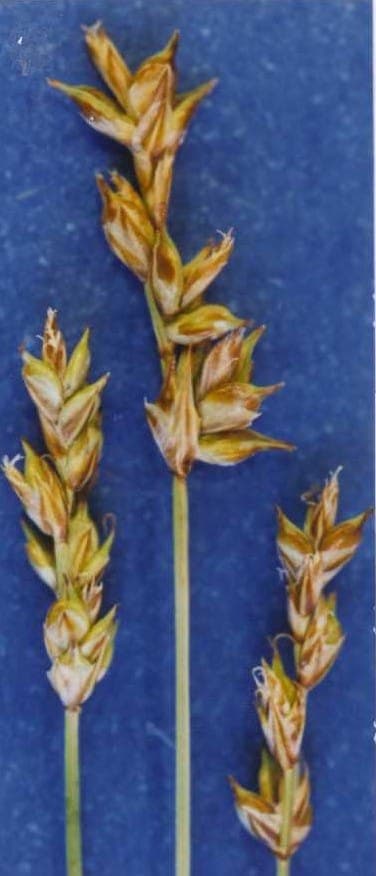
Hurd, E.G., N.L. Shaw, J. Mastrogiuseppe, L.C. Smithman, and S. Goodrich. / Public domain, via Wikimedia Commons
Carex vallicola: complete guide
Carex vallicola
Want to see Carex vallicola: complete guide in your garden?
1 minute, no credit card
Overview
Carex vallicola, the valley sedge, is an elegant North American sedge from the mountain valleys and high-elevation dryland ecosystems. This species naturally occurs across an extensive range from southwestern Canada through the western United States, spanning from British Columbia and Alberta southward through California, Utah, Arizona, New Mexico, with populations extending into Mexico as far south as Hidalgo.
The name "vallicola" refers to this plant's preference for mountain valleys and basin habitats. This sedge holds significant ecological importance in dry mountain ecosystems and subalpine grasslands. For gardeners wishing to establish mountainous or high-elevation dry sites, this represents an essential native plant.
Appearance and Bloom
Carex vallicola develops compact, dense tufts of fine, grass-like foliage, typically reaching 20-50 cm in height. The plant grows compactly and neatly, with light to dark green foliage.
Flower spikes appear from May through June. The spikes are small and inconspicuous, but function effectively in the landscape. The plant maintains its neat, compact form throughout the year.
This species is highly resistant to drought and mountain winds once established. Vegetative spread via rhizomes makes this type excellent for groundcover in alpine ecosystems.
Ideal Location
Carex vallicola thrives in dry mountain valleys, mountain slopes, and elevated grasslands. The plant tolerates full sun to light shade, though direct sun is preferred.
Optimal placements include:
- Dry mountain valleys and basin habitats
- Mountain slopes with excellent drainage
- Subalpine grasslands and meadows
- Dry, rocky, exposed terrain
- Higher-altitude dry zones
- Erosion-prone mountain banks
- Containers for alpine plant collections
This species excels in mountain gardens and alpine sites.
Soil Requirements
Carex vallicola thrives in dry to moderately dry, sharply drained mountain soils. The plant accepts extremely poor, rocky soils - indeed, it grows best in lean substrates.
The pH range is quite low, ideally 5.0-6.5. The plant tolerates very poor, rocky, scree-like soils exceptionally well.
Free design
Want to see Carex vallicola: complete guide in your garden? Make a free design now.
Watering
Once established, Carex vallicola is highly drought-tolerant. Regular watering is necessary only during the planting phase and first growing season.
Once established, this plant requires virtually no supplemental irrigation. In mountain ecosystems where it naturally grows, these plants survive extended dry periods. Summer drought poses no challenge.
Pruning
Maintenance pruning is essentially unnecessary, as the plant grows compactly and neatly. In early spring, the oldest dead foliage can be selectively removed.
The plant spreads slowly via rhizomatous growth. This spread helps with groundcover establishment and erosion control.
Maintenance Calendar
January-February: Inspect mountain site conditions. Check drainage. Remove severely dead foliage.
March-April: Growth commences. Water carefully during initial planting. Young shoots emerge.
May-June: Flowering period. Small, discreet flower spikes appear. Mountain wind acclimation.
July-September: Summer dormancy. Plant requires no supplemental water. Mountain sun can be intense.
October-December: Dormant period. Plant prepares for following season.
Winter Hardiness
Carex vallicola is extremely cold-hardy, rated for USDA zones 3-4 (-30 to -35°C / -22 to -31°F). This is a very cold-tolerant mountain species.
The plant flourishes in extreme alpine winter conditions. Snow and ice present no challenges.
Companion Plants
Carex vallicola combines beautifully with other alpine species:
- Alpine sedges (other Carex) - textural layering
- Alpine false hellebore (Tofieldia) - delicate white flowers
- Kobresia (Kobresia) - compact companion sedge
- Alpine aster (Aster) - yellow accent
- Alpine thyme (Thymus) - herbaceous groundcover
- Rocky habitat plants - alpine ecosystem simulation
These pairings create authentic alpine mountain gardens.
Conclusion
Carex vallicola provides essential beauty and ecological value for mountain gardens. Compact growth and exceptional drought tolerance make this a perfect choice for higher-elevation, dry sites. For gardeners with mountainous properties or alpine gardening interests, this native sedge deserves preference.
Find Carex vallicola at specialty alpine plant suppliers. Explore your mountain garden possibilities on gardenworld.app!
Want to see Carex vallicola: complete guide in your garden? Make a free design now.
Upload a photo, pick a style, and get a photorealistic design with plant list in under a minute.
No credit card required


Similar plants
Flat-stemmed club-rush: complete guide
Bolboschoenus planiculmis
Everything about Bolboschoenus planiculmis: growing conditions, watering, care, and use as a pond margin or wetland plant in garden design.
Great Plains flatsedge: complete guide
Cyperus lupulinus
Everything about Great Plains flatsedge (Cyperus lupulinus): growing conditions, care, garden uses, and ecological value. Tips for pond margins and dry sandy soils.
Golden beak sedge: complete guide
Rhynchospora corymbosa
Everything about golden beak sedge (Rhynchospora corymbosa): a dramatic tropical marginal for pond edges, bog gardens, and wet habitats.