
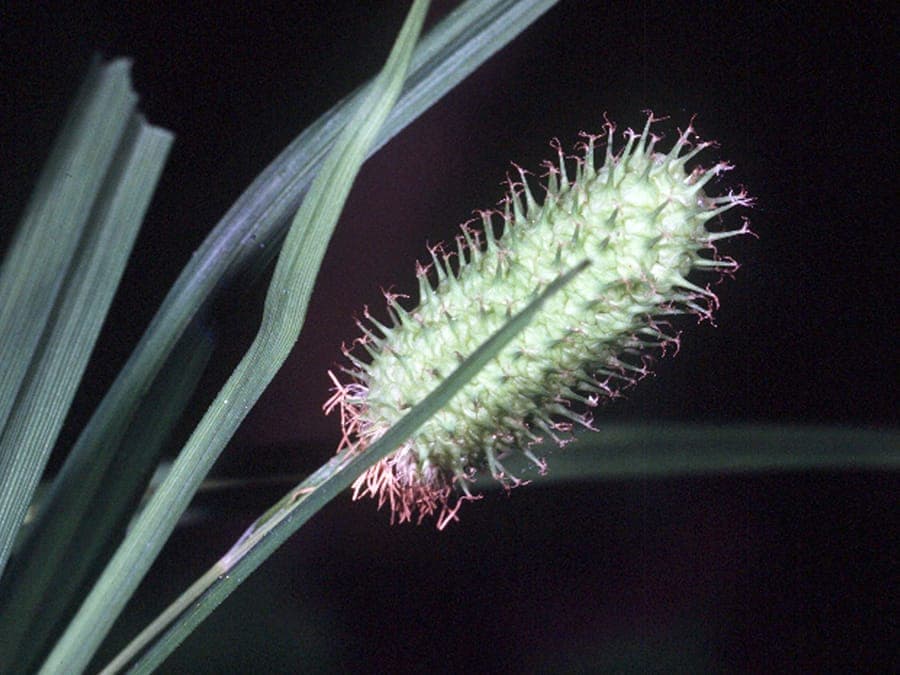
Robert H. Mohlenbrock. USDA SCS. 1989. Midwest wetland flora: Field office illustrated guide to plant species. Midwest National Technical Center, Lincoln. Courtesy of USDA NRCS Wetland Science Institute. / Public domain, via Wikimedia Commons
Carex typhina: complete guide
Carex typhina
Want to see Carex typhina: complete guide in your garden?
1 minute, no credit card
Overview
Carex typhina, commonly called cattail sedge, is a fascinating North American sedge from wet grasslands and water-rich ecosystems. This species naturally occurs from eastern Canada through the central and eastern United States, from Ontario and Quebec southward to Texas and Louisiana.
The botanical name "typhina" refers to the resemblance of the dense, characteristic flower spikes to cattail inflorescences. This sedge holds major ecological significance in wet prairies, marshes, and aquatic ecosystems. For gardeners focused on wetland restoration and native vegetation, this represents a species of indispensable ecological value.
Appearance and Bloom
Carex typhina develops dense, compact tufts with grass-like foliage, typically reaching 30-80 cm in height. The plant grows as a fine, dark green grass-like sedge with graceful habit.
The flower spikes are characteristic and prominently displayed. They exhibit a very dense, compact form strikingly resembling cattail inflorescences - hence the common name. The female spikes sit directly above the male spikes and are extremely dense and firm. The overall spike coloration ranges from greenish to brownish tones.
Flowering occurs from May through June. The plant retains much of its attractiveness year-round, with persistent dry spikes remaining prominent throughout winter.
Ideal Location
Carex typhina thrives in moist to wet grasslands, marshes, and water-rich woodlands. The plant tolerates full sun to partial shade, though more sunlight is preferred.
Optimal placements include:
- Wet meadows and grasslands
- Marshy areas and true wetlands
- Water-rich forest edges
- Erosion-prone banks requiring stabilization
- Bioretention constructed wetlands
- Native wetland restoration projects
- Container growing in moist conditions
This species is highly suitable for native water plant projects.
Soil Requirements
Carex typhina thrives in moist to very wet soils. The plant accepts both acidic and neutral pH ranges. Clay and silty-sandy soils are ideal, though organic-rich, loamy sediments prove most favorable.
The species tolerates periodic submersion very well. It's equally tolerant of nutrient-rich soils - fertility actually promotes denser growth and vigorous vegetative spread.
Free design
Want to see Carex typhina: complete guide in your garden? Make a free design now.
Watering
Once established, Carex typhina requires consistently moist soils. This is not a drought-tolerant species. The plant thrives in moisture-rich conditions.
In standard gardens, the plant can be potted in moisture-retentive potting soil. Regular watering throughout the growing season is essential, particularly in warm months. In naturally wet settings, the plant sustains itself on ambient moisture.
Pruning
Maintenance pruning is essentially unnecessary, as the plant grows compactly and neatly. In early spring, dead foliage from the previous year can be selectively removed.
Old flower spikes can be retained for winter interest or removed in early spring.
Maintenance Calendar
January-February: Check moisture conditions. Retain dry flower spikes for winter interest or remove them. Prepare for new season.
March-April: Growth commences. Maintain consistent moisture. Young shoots emerge.
May-June: Flowering period. Characteristic cattail-like flower spikes appear. Keep moisture consistent.
July-August: Growth period. Plant establishes and spreads. Provide regular moisture.
September-October: Plant reaches full size. Nutrient translocation.
November-December: Dormant period. Moisture conditions remain important.
Winter Hardiness
Carex typhina is extremely cold-hardy, rated for USDA zones 3-4 (-30 to -35°C / -22 to -31°F). This is a very cold-tolerant North American species requiring no special winter protection.
The plant flourishes in harsh winter weather typical of its native range.
Companion Plants
Carex typhina combines beautifully with other moisture-loving species:
- Marsh sneezeweed (Helenium) - yellow-red coloration
- Meadowsweet (Filipendula) - elegant companion
- Marsh blazing star (Liatris) - purple vertical accents
- Ostrich fern (Matteuccia) - delicate fern texture
- Marsh marigold (Caltha) - yellow spring bloom
- Other native sedges - textural layering
These combinations create biodiverse, ecologically rich wet gardens.
Conclusion
Carex typhina provides excellent beauty and ecological value. The characteristic cattail-like flower spikes make this sedge highly prominent in the landscape. For gardeners focused on wetland restoration or native water garden creation, this represents an essential species.
Find Carex typhina at specialty wetland plant suppliers. Explore your wet garden possibilities on gardenworld.app!
Want to see Carex typhina: complete guide in your garden? Make a free design now.
Upload a photo, pick a style, and get a photorealistic design with plant list in under a minute.
No credit card required


Similar plants
Flat-stemmed club-rush: complete guide
Bolboschoenus planiculmis
Everything about Bolboschoenus planiculmis: growing conditions, watering, care, and use as a pond margin or wetland plant in garden design.
Great Plains flatsedge: complete guide
Cyperus lupulinus
Everything about Great Plains flatsedge (Cyperus lupulinus): growing conditions, care, garden uses, and ecological value. Tips for pond margins and dry sandy soils.
Golden beak sedge: complete guide
Rhynchospora corymbosa
Everything about golden beak sedge (Rhynchospora corymbosa): a dramatic tropical marginal for pond edges, bog gardens, and wet habitats.