
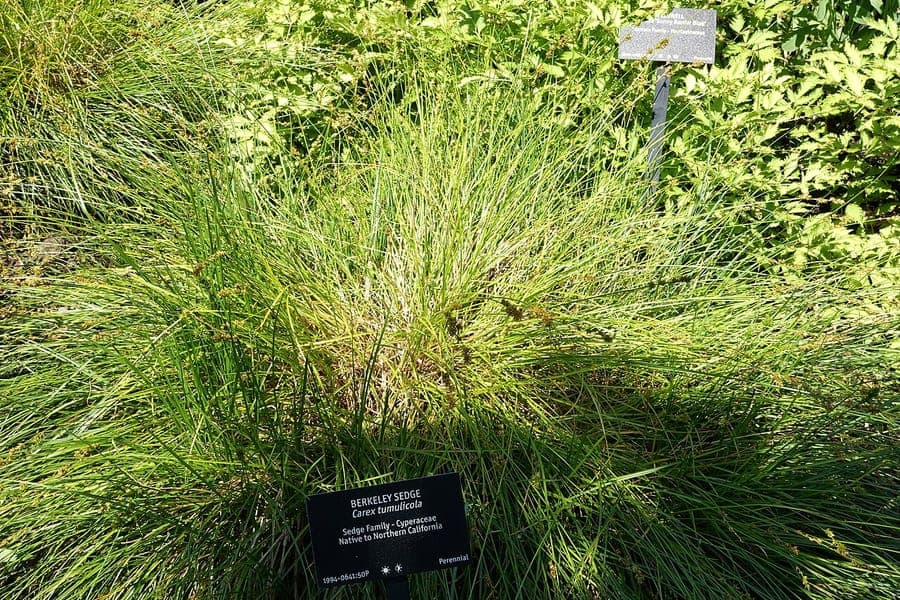
Daderot / CC0, via Wikimedia Commons
Splitawn Sedge: complete guide
Carex tumulicola
Want to see Splitawn Sedge: complete guide in your garden?
1 minute, no credit card
Overview
Splitawn sedge (Carex tumulicola), also known as foothill sedge or slender sedge, is a robust native North American sedge from the Cyperaceae family. This plant naturally grows from South Vancouver Island in British Columbia to California. The name "tumulicola" refers to the hills or hilly landscapes where this sedge naturally occurs.
This is a plant for dry to moderately dry habitats, ideal for gardeners applying xeriscape design or creating low-water gardens. With its attractive green blade form and low maintenance requirements, Splitawn sedge is an underappreciated addition to modern, sustainable gardens.
Appearance and bloom
Splitawn sedge forms compact, open tussocks of narrow green foliage. The plant reaches 25-35 cm height and similar spread, making it suitable for medium-sized borders. The foliage is bright green year-round, providing structure even in dormant winter months.
Flowering occurs from April to June. The female spikelets are small and green, without striking colour. Male flowers are positioned above, equally subtle. This makes Splitawn sedge a plant whose value lies primarily in its foliage.
Reproduction occurs via seeds ripening in July and August. This plant however doesn't self-seed aggressively - seeds typically fall in place unless you deliberately spread them. This makes it a reliable, non-invasive border plant.
Ideal location
Splitawn sedge thrives in full sun to half-shade. For optimal growth choose at least six hours direct sunlight daily. This sedge is equally welcome in dry, warm, sunny spots - you'll see it flourishing there.
This is a plant that naturally grows in foothill habitats and light woodland slopes, so some dappled shade from trees can be tolerated. However, too much shade (more than four hours daily) can result in looser tussocks and reduced performance.
Exposure to warm weather is not a problem. On the contrary, this sedge loves warm, sunny weather. Wind is also not problematic, as this plant is accustomed to exposure.
Soil
Splitawn sedge is completely indifferent regarding soil type - it grows equally on sand as on heavier clay. The crucial aspect is drainage. This plant cannot tolerate waterlogging. Certainly not in winter, where wet soil can lead to root rot.
Add minimal organic material when planting - the plant is accustomed to nutrient-poor soil. In nutrient-rich soils foliage can become somewhat loose and wild. Keep it relatively restrained nutrient-wise.
The pH may be acidic to neutral, anything between pH 5 and 8 is acceptable. This plant is very tolerant of pH variation.
In pots: use a mixture of garden soil, sand and perlite in ratio 1:1:0.5. This provides perfect drainage while moisture retention remains adequate.
Free design
Want to see Splitawn Sedge: complete guide in your garden? Make a free design now.
Watering
Splitawn sedge is very drought-tolerant once established. This is a plant you can water regularly during growing season (April-September), but once winter arrives you can virtually stop supplemental watering.
In natural habitats this plant receives minimal summer rainfall - foothill regions in the Pacific Northwest receive very little summer rain. Even in wet-season the plant is so water-efficient that extra watering isn't essential.
Ensure the soil doesn't remain permanently wet. This is perhaps the most important warning for Splitawn sedge cultivation. In pots check weekly; soil may dry completely between waterings.
Rain is ideal. Tap water also works, especially without chlorine.
Pruning
Splitawn sedge requires minimal pruning. In early spring (February-March) you can carefully remove dead foliage with a fine rake or brush. This must be done very gently to avoid damaging living material.
Aging leaves can be removed for aesthetic reasons, but it's not essential. Many gardeners actually appreciate the natural, slightly tousled look that older leaves provide.
This plant naturally prunes itself compact. No aggressive pruning needed.
Maintenance calendar
Spring (March-April): Remove dead foliage. Begin regular watering as temperatures rise. Plant begins active growth.
Summer (May-September): Regular watering during dry periods, especially in pots. Plant flowers now - enjoy the subtle spikelets.
Autumn (October-November): Gradually reduce watering as rainfall increases. Plant prepares for dormancy.
Winter (December-February): Minimal maintenance. Virtually no supplemental watering needed in well-draining soil. Plant is dormant.
Winter hardiness
Splitawn sedge is very winter hardy - USDA zone 5a to 9a (European zone 4a to 8a). This means this plant can withstand temperatures down to -28C. The plant naturally grows in montane habitats from northern California to British Columbia, so winter cold is not a problem.
The green foliage may turn brown or recede in severe winters, but the plant regrows in spring. This is normal and not a sign of death. Even exposure to snow is no problem.
Companion plants
Splitawn sedge combines beautifully with other dry-loving plants and xerophytes. Agave, Yucca, small Pinus cultivars, or Arctostaphylos species form attractive ensembles. Also Festuca grasses, Stipa species and other sedges combine well.
In mixed borders it fits well between Mediterranean herb plants like Lavender, Rosemary, Thymus species. Its low-growing nature makes it ideal for foreground positions in sunny rock gardens.
In urban garden conditions where water is scarce, this is an ideal plant for water-smart planting alongside hard landscaping accents.
Closing
Splitawn sedge is an excellent choice for gardeners wanting to garden sustainably and water-smart. With its drought tolerance, low maintenance requirements and attractive green colour year-round, this plant offers years of value. Plant it in raised sunny borders, dry rock gardens, or Mediterranean-style gardens where water is precious.
Available from Intratuin and Gamma's ornamental grass section. A plant that embodies modern, responsible gardening without sacrificing elegance. Recommended for those applying xeriscape principles and appreciating low-maintenance gardens.
Want to see Splitawn Sedge: complete guide in your garden? Make a free design now.
Upload a photo, pick a style, and get a photorealistic design with plant list in under a minute.
No credit card required


Similar plants
Flat-stemmed club-rush: complete guide
Bolboschoenus planiculmis
Everything about Bolboschoenus planiculmis: growing conditions, watering, care, and use as a pond margin or wetland plant in garden design.
Great Plains flatsedge: complete guide
Cyperus lupulinus
Everything about Great Plains flatsedge (Cyperus lupulinus): growing conditions, care, garden uses, and ecological value. Tips for pond margins and dry sandy soils.
Golden beak sedge: complete guide
Rhynchospora corymbosa
Everything about golden beak sedge (Rhynchospora corymbosa): a dramatic tropical marginal for pond edges, bog gardens, and wet habitats.