
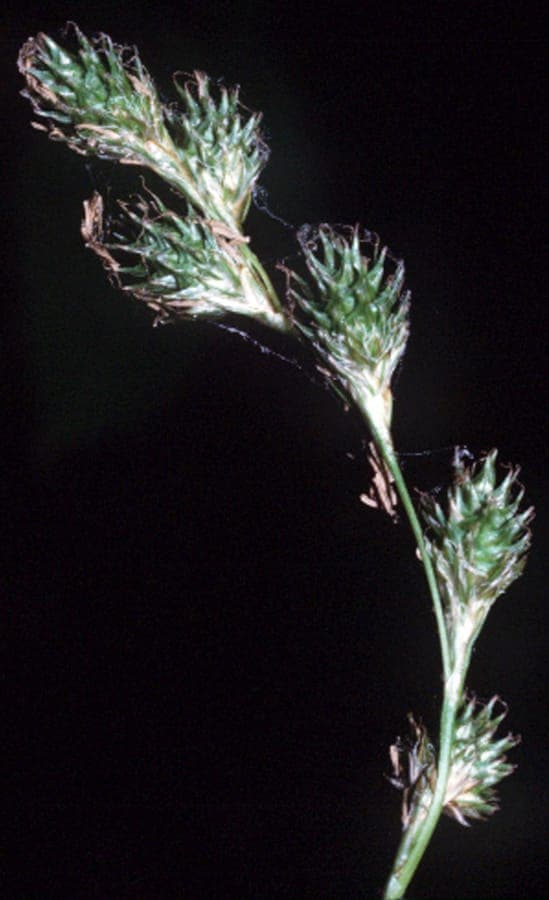
Robert H. Mohlenbrock. USDA SCS. 1989. Midwest wetland flora: Field office illustrated guide to plant species. Midwest National Technical Center, Lincoln. Courtesy of USDA NRCS Wetland Science Institute. / Public domain, via Wikimedia Commons
Carex tenera: complete guide
Carex tenera
Want to see Carex tenera: complete guide in your garden?
1 minute, no credit card
Carex tenera: Complete Guide
Overview
Carex tenera, commonly known as "Quill sedge" or "Tender sedge," is an elegant North American sedge from the Cyperaceae family. Native from Canada to the northern and eastern United States, this plant thrives in moist soils and plays an important role in North American wetlands and prairie ecosystems.
The common name "quill sedge" refers to the fine, pen-like appearance of the fruits. This versatile sedge performs well in borders, container gardens, and natural wetland settings.
Appearance & Bloom
Carex tenera forms loose, open tufts reaching approximately 40-60 cm in height. The leaves are extremely fine and grass-like, bright green with a soft sheen.
Flowering occurs in March-May with small, green flowers that are inconspicuous. The fruits are tiny, ellipsoid capsules with characteristically fine structure (hence "quill"). These remain visible through September.
Ideal Location
Carex tenera performs best in partial shade to full sun. The plant tolerates shade better than many other sedges.
Select a spot with:
- Consistently moist soil (but not permanently wet)
- Well-structured, organic soil
- Moderate wind exposure
- Drainage opportunity after rainfall
Perfect for moist borders, natural water edges, or as underplanting in partly shaded gardens.
Soil
Carex tenera grows in soils with pH 4.9-7.0. Preferred soil conditions include:
- Water-retentive but not saturated
- Moderate to good organic matter
- Sandy, loamy or clay-based
- Well-draining (no stagnant water)
The plant tolerates less extreme moisture conditions better than other sedges, making it ideal for standard border planting.
Watering
Carex tenera requires consistent moisture but not permanent wetness.
Water management:
- Provide consistently moist soil during growing season
- Ensure drainage after rainfall
- Don't allow complete desiccation during dry periods
- In containers: water regularly
- Less water-dependent than other Carex species
Free design
Want to see Carex tenera: complete guide in your garden? Make a free design now.
Pruning
Carex tenera requires minimal maintenance:
- Late-winter pruning: Cut back all dead material in February-March just above ground
- Summer: Remove only obviously damaged foliage
- Seed control: May self-seed - remove seed heads if unwanted
Maintenance Calendar
March: Trim winter-dead leaves, incorporate compost around base April-May: Observe flowering, maintain consistent moisture June-August: Monitor soil moisture, remove dried portions September: Seed dispersal; observe wildlife feeding October-December: Prepare for winter dormancy
Winter Hardiness
Carex tenera is hardy to USDA zone 3 (-35°C). In temperate climates, it performs excellently without winter protection.
Winter protection is normally unnecessary, but in very cold areas, a light mulch layer provides additional security.
Companion Plants
Carex tenera works well with:
- Iris versicolor (American iris)
- Sanguisorba canadensis (Canadian burnet)
- Thalictrum (meadow rue)
- Lobelia cardinalis (cardinal flower)
- Calamagrostis x acutiflora 'Karl Foerster' (feather reed grass)
- Tradescantia (spiderwort)
- Polystichum ferns (Christmas fern)
Closing Thoughts
Carex tenera is an undervalued choice for moisture-loving but not extremely wet gardens. With its elegant appearance and minimal maintenance requirements, it deserves a prominent place in modern borders and water landscapes.
As a native plant, it supports local fauna and flora while adding refined aesthetic value to your garden design.
Available at major garden centres. Visit GardenWorld.app for personalized garden designs incorporating moisture-loving native plants.
Want to see Carex tenera: complete guide in your garden? Make a free design now.
Upload a photo, pick a style, and get a photorealistic design with plant list in under a minute.
No credit card required


Similar plants
Flat-stemmed club-rush: complete guide
Bolboschoenus planiculmis
Everything about Bolboschoenus planiculmis: growing conditions, watering, care, and use as a pond margin or wetland plant in garden design.
Great Plains flatsedge: complete guide
Cyperus lupulinus
Everything about Great Plains flatsedge (Cyperus lupulinus): growing conditions, care, garden uses, and ecological value. Tips for pond margins and dry sandy soils.
Golden beak sedge: complete guide
Rhynchospora corymbosa
Everything about golden beak sedge (Rhynchospora corymbosa): a dramatic tropical marginal for pond edges, bog gardens, and wet habitats.