
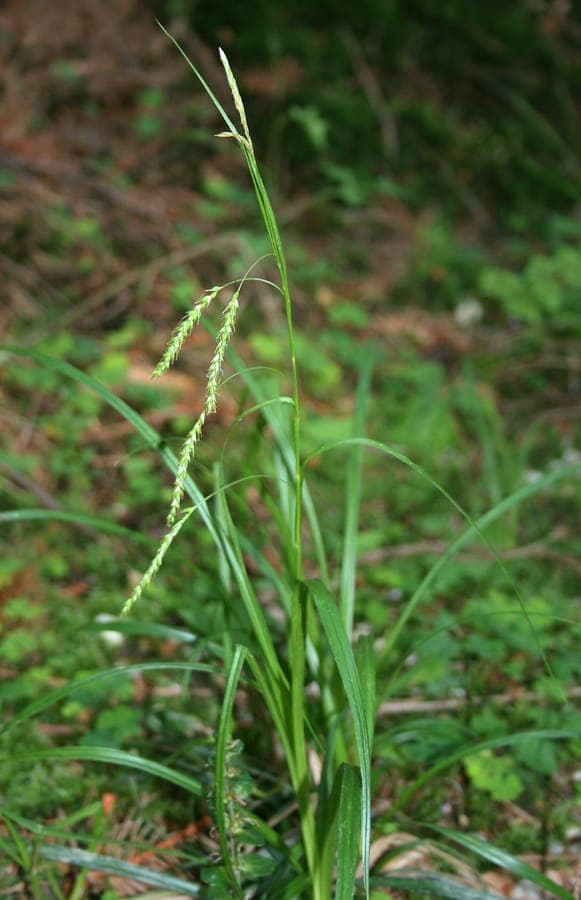
Franz Xaver / CC BY-SA 3.0, via Wikimedia Commons
European woodland sedge: complete guide
Carex sylvatica
Want to see European woodland sedge: complete guide in your garden?
1 minute, no credit card
Overview
Carex sylvatica, commonly known as European woodland sedge, is a quiet but essential player in the shade garden. Native to forests across Central and Eastern Europe, this clump-forming perennial from the Cyperaceae family thrives where many other plants struggle - in cool, shady, moist conditions. It's not flashy, but its soft texture and year-round presence make it a go-to for naturalistic planting schemes. If you're dealing with dry shade under trees, this sedge won't solve everything, but in consistently moist spots, it's a winner.
On gardenworld.app, you can design a planting plan that highlights how Carex sylvatica works with native ferns and spring ephemerals for a layered woodland look.
Appearance & bloom cycle
European woodland sedge forms loose, spreading tussocks of fine, arching leaves that reach 30–50 cm in height. The foliage is bright to mid-green, about 3–5 mm wide, with a subtle central ridge. It has a soft, almost grass-like feel but with more grace and less rigidity than true grasses.
In April and May, slender, triangular flower spikes emerge, rising just above the foliage. These are brownish-green, with male flowers at the tip and female flowers below. By June, the seed heads open into delicate, drooping clusters that catch the light beautifully. They don't last forever, but they add subtle movement and interest before fading naturally by late summer.
The plant stays evergreen in mild winters, though it may yellow or bronze in harsh conditions. New growth flushes in March, pushing through any old foliage with ease.
Ideal location
This sedge loves dappled or partial shade - think under open-canopy trees like beech, hornbeam, or birch. Full sun will scorch the leaf tips, especially in southern exposures or during dry spells. It also does well along woodland paths, under shrubs, or in shaded borders where competition from tree roots isn't too intense.
Give plants at least 40 cm of space between them to allow for gentle spreading. It won't aggressively take over, but it does form a soft, continuous ground cover over time. Avoid cramming it into tight spaces - it needs air circulation to stay healthy. Use gardenworld.app to visualise spacing and companion planting in your garden layout.
Soil requirements
Carex sylvatica prefers moist, humus-rich soil that drains well but doesn't dry out completely. It tolerates a range of soil types - sandy loam, clay loam, even slightly acidic conditions - as long as organic matter is present. If your soil is heavy clay, work in compost or leaf mould to improve structure. On sandy soils, mulch annually with well-rotted manure or leaf litter to retain moisture.
It grows best in pH 5.5 to 7.0. Avoid chalky or highly alkaline soils unless you amend them with plenty of organic matter. It won't survive long-term drought or compacted, waterlogged ground.
Free design
Want to see European woodland sedge: complete guide in your garden? Make a free design now.
Watering
Keep the soil consistently moist, especially in the first growing season. Water weekly during dry spells in spring and summer. Established plants are more resilient, but prolonged drought will cause leaf browning and dieback. In hot summers, a deep soak every 10–14 days helps maintain vigour.
Use rainwater if possible - this sedge can be sensitive to lime-heavy tap water. A 5 cm layer of leaf mulch or bark chips helps reduce evaporation and keeps roots cool.
Pruning
Minimal pruning is needed. In early spring (March), cut back any tatty, discoloured, or damaged foliage to make way for fresh growth. Use shears or secateurs - don't tear the leaves. Leave the old flower spikes over winter; they add subtle texture and help protect the crown.
No feeding is required. In fact, avoid high-nitrogen fertilisers - they promote weak, floppy growth. This plant evolved in nutrient-poor woodland floors, so rich soil can do more harm than good.
Maintenance calendar
- Jan: Check for frost damage; leave old growth intact
- Feb: Remove any persistent dead leaves if needed
- Mar: Cut back old foliage, weed around clumps
- Apr: Monitor soil moisture; water if dry
- May: Flower spikes appear; no intervention needed
- Jun: Seed heads develop; watch for dry spells
- Jul: Seeds disperse; reduce watering as growth slows
- Aug: Maintain moisture during heatwaves
- Sep: Let plant wind down; no feeding
- Oct: Stop watering; leave foliage for winter
- Nov: Check for fungal spots or slug damage
- Dec: Full dormancy; no action required
Winter hardiness
Hardy to USDA zone 5 (-20°C), Carex sylvatica handles winter well. In milder zones, it stays fully evergreen. In colder areas, foliage may bronze or brown but rebounds strongly in spring. No winter protection is needed, but ensure soil doesn't become waterlogged - good drainage is key.
Companion plants
Pair with shade-loving perennials like Helleborus, Pulmonaria, or Tiarella. It works beautifully under deciduous trees with spring bulbs such as Erythronium or Chionodoxa. For contrast, plant with Matteuccia or Dryopteris ferns. Avoid invasive ground covers like English ivy or periwinkle, which will overwhelm it.
It's also effective as an understory layer in mixed borders or along shaded walkways. Try it with carex comans or carex morrowii for a textural sedge mix.
Closing
European woodland sedge isn't a showstopper, but it's a backbone plant for shady areas. It's tough, reliable, and blends seamlessly into naturalistic designs. Buy young plants in spring from local garden centres - look for healthy, green clumps without brown edges. Plant in groups of 3–5 for impact, and let them knit together over time. With basic care, Carex sylvatica will serve you well for years.
Want to see European woodland sedge: complete guide in your garden? Make a free design now.
Upload a photo, pick a style, and get a photorealistic design with plant list in under a minute.
No credit card required


Similar plants
Flat-stemmed club-rush: complete guide
Bolboschoenus planiculmis
Everything about Bolboschoenus planiculmis: growing conditions, watering, care, and use as a pond margin or wetland plant in garden design.
Great Plains flatsedge: complete guide
Cyperus lupulinus
Everything about Great Plains flatsedge (Cyperus lupulinus): growing conditions, care, garden uses, and ecological value. Tips for pond margins and dry sandy soils.
Golden beak sedge: complete guide
Rhynchospora corymbosa
Everything about golden beak sedge (Rhynchospora corymbosa): a dramatic tropical marginal for pond edges, bog gardens, and wet habitats.