
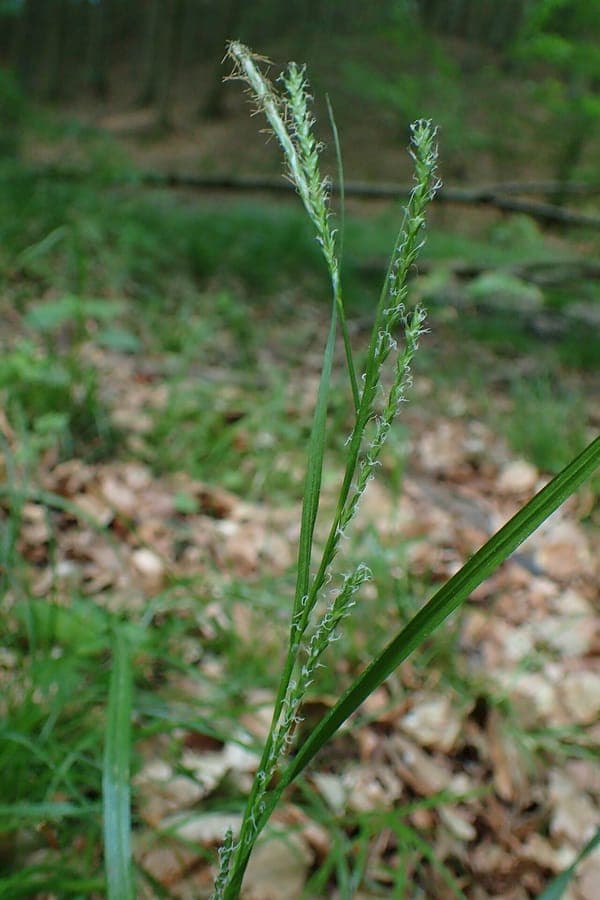
Krzysztof Ziarnek, Kenraiz / CC BY-SA 4.0, via Wikimedia Commons
Thin-spiked wood sedge: complete guide
Carex strigosa
Want to see Thin-spiked wood sedge: complete guide in your garden?
1 minute, no credit card
Overview
Carex strigosa, or thin-spiked wood sedge, is a quietly impressive native of European woodlands. Found from France to Finland, this creeping sedge thrives in shaded corners where other plants struggle. In the garden, it brings subtle elegance, forming soft mounds of fine-textured foliage that stay attractive year-round. Hardy to USDA zone 5, it's a solid choice for low-maintenance, naturalistic planting schemes.
On gardenworld.app, you can build a planting plan that integrates Carex strigosa seamlessly into shaded borders or woodland gardens. Its slow-spreading habit makes it ideal for filling space under trees or along pathways without becoming invasive.
Appearance & bloom cycle
This sedge reaches 8–14 inches (20–35 cm) in height and spreads slowly to about 16 inches (40 cm) via rhizomes. The leaves are narrow, bright to olive-green, and arch gently, creating a soft, grass-like mound. From May to June, slender brownish flower spikes rise slightly above the foliage, reaching up to 12 inches (30 cm) tall. They're not flashy, but they add vertical interest and subtle texture.
The foliage is semi-evergreen, turning light brown in winter but rarely dying back completely. This provides year-round structure, especially valuable in winter gardens where texture matters more than color.
Ideal location
Thin-spiked wood sedge prefers partial to full shade. It performs best under deciduous trees or along north-facing borders where sunlight is dappled or indirect. In full sun, it requires consistently moist soil; otherwise, leaf tips may scorch in hot summers. In cooler zones (USDA 5–6), it tolerates more sun, but in zones 7 and up, shade is essential.
For best effect, plant in groups of 5–7, spaced 10 inches (25 cm) apart. This creates a dense, weed-suppressing carpet within 2–3 years. Avoid overcrowding with aggressive spreaders - this sedge grows slowly and needs room to establish.
Soil requirements
It's adaptable but thrives in moist, well-drained loam or sandy loam with a pH between 5.5 and 7.5. It tolerates clay if drainage is improved with compost or leaf mold. On dry sandy soils, it survives but benefits from mulch to retain moisture. Avoid waterlogged conditions - prolonged wet feet can lead to root rot.
On gardenworld.app, use the soil profiler tool to match your garden's conditions with Carex strigosa's needs, including organic matter recommendations and mulching tips.
Free design
Want to see Thin-spiked wood sedge: complete guide in your garden? Make a free design now.
Watering
Water regularly during the first growing season - about 1–2 gallons per plant weekly during dry spells. Once established, it's moderately drought-tolerant but looks best with consistent moisture. In prolonged summer heat, give a deep soak every 10–14 days.
Use drip irrigation or a watering can to avoid wetting foliage in full sun, which can encourage fungal issues. Morning watering is ideal.
Pruning
Pruning isn't required, but in late winter (February to early March), you can tidy up by cutting back old or tattered foliage to about 4 inches (10 cm). Wear gloves - the leaf edges are slightly rough. Don't cut too low; new growth emerges from the base and can be damaged if over-pruned.
If the plant spreads beyond its intended area, dig and divide the rhizomes. Replant or share - it's an easy way to expand your planting.
Maintenance calendar
- Jan: No action
- Feb: Light trim of old leaves
- Mar: Monitor spread, divide if needed
- Apr: Apply thin layer of compost
- May: Flower spikes emerge, check moisture
- Jun: Peak bloom, watch for dryness
- Jul: Observe during heatwaves
- Aug: Avoid pruning, let foliage stand
- Sep: Leave seed heads for winter interest
- Oct: Let fallen leaves mulch the base
- Nov: No action
- Dec: Dormant, semi-evergreen foliage visible
Winter hardiness
Hardy to USDA zone 5 (–20°C / –4°F). It survives most winters without protection. The semi-evergreen foliage insulates the crown and adds winter texture. In areas with heavy, persistent snow, no action is needed - snow acts as a natural blanket.
In wet winters, ensure drainage to prevent crown rot. No mulch is required unless soil is very sandy or exposed.
Companion plants
Pair with shade-loving perennials like Hosta, Heuchera, Polygonatum, or Epimedium. Its fine texture contrasts beautifully with bold-leaved plants. It also works well beneath shrubs like Fothergilla or Cornus, or alongside spring ephemerals like Erythronium or Anemone blanda.
Avoid pairing with aggressive ground covers like Lamium or ground elder - they'll outcompete the slow-growing sedge.
Closing
Carex strigosa is a reliable, understated performer in the shade garden. It asks little and gives back with year-round presence, soft texture, and quiet charm. Available at most garden centres, especially those specializing in woodland or native plants. Look for 1L pots - avoid unlabeled Carex mixes, as species can vary.
On gardenworld.app, you can preview how thin-spiked wood sedge fits with companions, lighting, and soil type. Use it to design a low-effort, high-character garden. Once established, it's a set-and-forget plant that improves with age.
Want to see Thin-spiked wood sedge: complete guide in your garden? Make a free design now.
Upload a photo, pick a style, and get a photorealistic design with plant list in under a minute.
No credit card required


Similar plants
Flat-stemmed club-rush: complete guide
Bolboschoenus planiculmis
Everything about Bolboschoenus planiculmis: growing conditions, watering, care, and use as a pond margin or wetland plant in garden design.
Great Plains flatsedge: complete guide
Cyperus lupulinus
Everything about Great Plains flatsedge (Cyperus lupulinus): growing conditions, care, garden uses, and ecological value. Tips for pond margins and dry sandy soils.
Golden beak sedge: complete guide
Rhynchospora corymbosa
Everything about golden beak sedge (Rhynchospora corymbosa): a dramatic tropical marginal for pond edges, bog gardens, and wet habitats.