
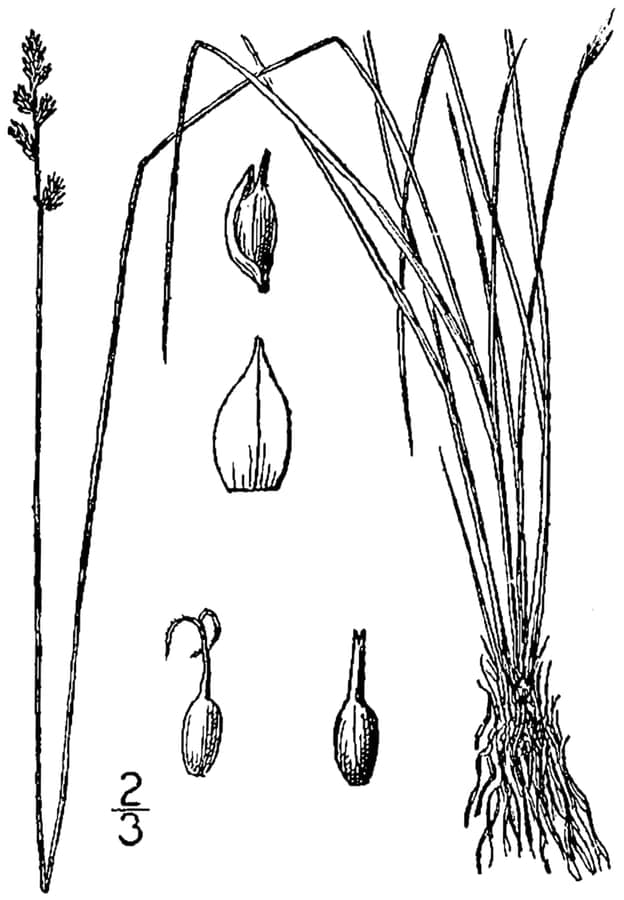
Britton, N.L., and A. Brown. 1913. An illustrated flora of the northern United States, Canada and the British Possessions. 3 vols. Charles Scribner's Sons, New York. Vol. 1: 377. Courtesy of Kentucky Native Plant Society. Scanned by Omnitek Inc. / Public domain, via Wikimedia Commons
Carex sterilis: complete guide
Carex sterilis
Want to see Carex sterilis: complete guide in your garden?
1 minute, no credit card
Overview
Carex sterilis, commonly called sterile sedge or dioecious sedge, is a North American sedge specializing in wet marshes, ditches, and low-lying wetlands. The name "sterilis" refers to the female-less nature of flowering in some clones.
This is a robust, low-maintenance sedge for moist garden landscapes. With its broad range from Canada to North Carolina, eastern and central United States, it demonstrates remarkable adaptability to variable habitats.
Appearance and Bloom
Carex sterilis grows as a stiff, upright sedge 20-50 centimeters tall. Leaves are linear, dark green to gray-green in color, forming dense tufts. The plant creates compact, swollen clumps that provide structure to moist areas.
Flower spikes appear May-June. The characteristic feature is the thick, densely-packed fruiting spikes with small, round fruits. The spikes have a star-like appearance from certain angles, distinguishing it from closely related species.
The plant remains semi-evergreen in mild winters and provides valuable winter structure in moist gardens.
Ideal Location
Carex sterilis thrives in full sun to partial shade in moist, low-lying garden areas. Plant it along water features, in rain gardens, along ditches, or in wet corners where other plants fail.
The plant feels at home in woodland edges and stream banks where regular moisture variation occurs. Not suitable for dry locations, but tolerates full clay and silt soils.
Soil
Carex sterilis grows best in heavy clay to silty substrates with high water-holding capacity. The plant tolerates moist to even waterlogged soils. Slightly acidic to neutral pH (5.5-7.0) is suitable.
Organic enrichment helps but isn't essential; this sedge grows even in skeletal soils. Add peat or leaf mold for better water retention in drier gardens.
Watering
Abundant moisture is essential from April to October. Water must be regularly available. In dry periods, daily or twice-daily watering may be necessary. Don't allow soil to dry completely.
In naturally wet sites or along water features where the plant is regularly submerged, supplemental watering is usually unnecessary. Mulch helps retain moisture in somewhat drier conditions.
Free design
Want to see Carex sterilis: complete guide in your garden? Make a free design now.
Pruning
Minimal pruning required. In early spring (March), remove dead winter foliage and damaged parts. The plant spreads rhizomatously but doesn't expand aggressively. Annual cleanup pruning is sufficient.
After spikes have dried (July-August), dried spikes can be removed, but it's not essential. The plant maintains its form naturally.
Maintenance Calendar
- January-February: Minimal observation; plant is semi-dormant.
- March: Remove dead foliage; initiate moisture regime.
- April-May: Growth accelerates; moisture management essential.
- June-July: Flowering period; continue moisture retention.
- August-September: Fruit formation; water still important.
- October-November: Growth slows; watering can be reduced.
- December: Winter preparation; minimal care.
Winter Hardiness
Carex sterilis is fully hardy throughout North America and Europe. Temperatures to -25C pose no threat. The plant remains semi-evergreen in mild winters. Underground rhizomes overwinter reliably.
Companion Plants
Carex sterilis combines well with other moisture-tolerant garden plants:
- Hostas (shade-loving, moisture-tolerant)
- Iris laevigata (Japanese water iris)
- Astilbe species (feathery plumes)
- Caltha palustris (kingcup, yellow spring flowers)
- Lobelia cardinalis (red water flowers)
- Filipendula (meadowsweet species)
- Mentha aquatica (water mint)
- Acorus gramineus (sweet flag)
In marshes and rain gardens: plant with other sedges and rushes for natural texture and ecological value.
Conclusion
Carex sterilis offers reliable performance in wet, challenging garden corners. With its North American heritage and proven strength in moist conditions, it's a valuable groundcover for wet landscapes. Find it at garden centers specializing in native and water plants. Visit www.gardenworld.app for more inspiration on water plants and moisture-tolerant garden design.
With minimal maintenance, this sedge grows into an ornamental addition to moist garden areas while providing ecological value for water-dependent insects and birds.
Want to see Carex sterilis: complete guide in your garden? Make a free design now.
Upload a photo, pick a style, and get a photorealistic design with plant list in under a minute.
No credit card required


Similar plants
Flat-stemmed club-rush: complete guide
Bolboschoenus planiculmis
Everything about Bolboschoenus planiculmis: growing conditions, watering, care, and use as a pond margin or wetland plant in garden design.
Great Plains flatsedge: complete guide
Cyperus lupulinus
Everything about Great Plains flatsedge (Cyperus lupulinus): growing conditions, care, garden uses, and ecological value. Tips for pond margins and dry sandy soils.
Golden beak sedge: complete guide
Rhynchospora corymbosa
Everything about golden beak sedge (Rhynchospora corymbosa): a dramatic tropical marginal for pond edges, bog gardens, and wet habitats.