
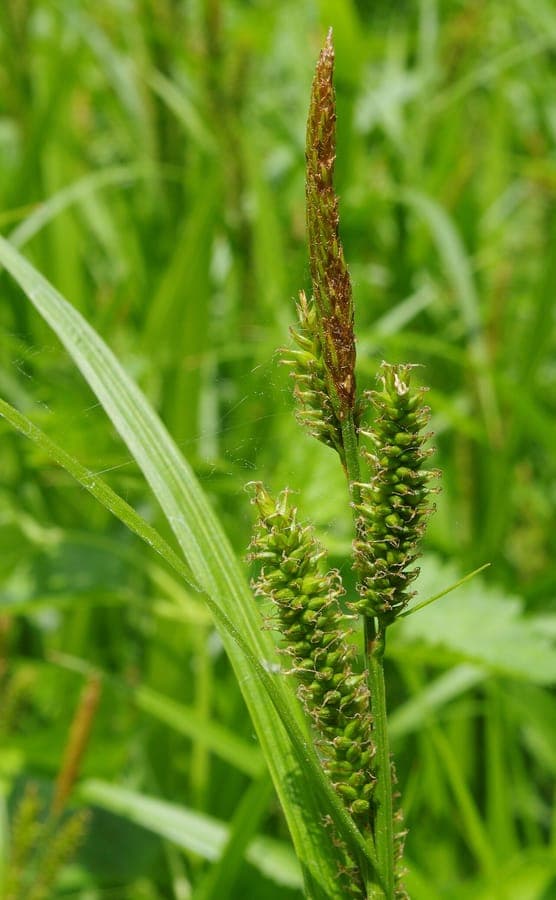
El Grafo / CC BY-SA 3.0, via Wikimedia Commons
Eastern rough sedge: complete guide
Carex scabrata
Want to see Eastern rough sedge: complete guide in your garden?
1 minute, no credit card
Eastern rough sedge (Carex scabrata), also known as scabrous sedge or rough sedge, is a North American native that naturally grows from Quebec to Georgia and from Ontario to Missouri. This sedge is ideal for gardeners seeking a sturdy, coarse-textured groundcover that tolerates shade and moist conditions. The plant forms dense, low-growing clumps with rough, stiff blades of dark green. It grows somewhat faster than many other sedge species, creating full groundcover quickly.
The growth pattern of Eastern rough sedge is moderate. The plant reaches 40 to 60 centimeters in height and spreads via stolons (horizontal, surface-level stems). This enables rapid establishment and faster maturation. In July and August, inconspicuous, green-brown flowers appear on short spikes. The growth habit is tufted-spreading, meaning individual plants gradually merge together, creating a very dense mat. This is where this species finds its strength: a robust, long-lasting groundcover layer.
Ideal location: Eastern rough sedge thrives in partial shade to deep shade. Full sun can cause leaf bleaching and reduced vigor. Ensure at least 2 to 3 hours of indirect light daily. It flourishes in damper, lower-lying garden zones, such as near ponds, drainage patterns, or wet fields. This is an excellent plant for marshes, forest edges, and damp, shady corners where little else grows. It is proven hardy to USDA zone 4, possibly zone 3 with winter protection. This makes it suitable for much of the eastern and central North America and similar temperate climates.
Soil requirements: Eastern rough sedge grows on virtually all soils, from heavy clay to sandy loam, provided moisture persists. The pH can range from acidic (4.7) to neutral (6.8), so highly adaptable. Indeed, it performs better on slightly acidic soils. While not demanding of nutrients, it grows faster in nutrient-rich soils. Waterlogging is completely tolerated; indeed, Eastern rough sedge can survive weeks in standing water with minimal damage.
Watering: Eastern rough sedge enjoys consistent moisture input from May through October. The soil should remain consistently moist, though not waterlogged. During rainy seasons, supplemental watering is rarely needed. In dry spells, provide ample water; this plant can even tolerate seasonal flooding zones if your garden site contributes. In winter, minimize moisture input, but avoid complete drying.
Pruning: Eastern rough sedge requires no pruning, though you may remove last year's dead foliage in April. Pull dead foliage manually from the clump or trim with scissors. This encourages new green growth. In case of winter damage, prune the plant back vigorously to 5-10 cm; it regrows quickly. No other maintenance trimming needed.
Maintenance calendar: April: Remove dead foliage; inspect for winter damage. May to July: No specific care beyond moisture maintenance. August: Plant tolerates slightly drier conditions. September to October: Begin reducing moisture input. November to March: Minimal care; maintain moisture only in extremely dry winters.
Winter hardiness: Eastern rough sedge is highly cold-hardy and thrives to at least USDA zone 4, possibly zone 3. It withstands temperatures as low as minus 30 degrees Celsius with minimal damage. Foliage may suffer light winter injury, but roots are very robust and regrow quickly. For maximum benefit in very cold areas, add leaf mold in winter or mulch around the base.
Applications and companions: Eastern rough sedge excels in marsh border planting, along pond edges, in rain gardens, and moist, shady fields. Pair with other moisture-loving and shade-tolerant plants such as skunk cabbage, black snakeroot, hellebores, and various ferns. Also forms effective erosion control on moist banks. In urban settings, it can serve as fine, low groundcover beneath trees where grass refuses to grow.
Conclusion: Eastern rough sedge offers a reliable, low-maintenance groundcover option for moist, shady gardens. With coarse, dense foliage and moisture-loving temperament, this sedge is increasingly popular in gardens prioritizing water management and ecological value. Once established, it thrives for many years with minimal intervention.
Want to see Eastern rough sedge: complete guide in your garden? Make a free design now.
Upload a photo, pick a style, and get a photorealistic design with plant list in under a minute.
No credit card required


Similar plants
Flat-stemmed club-rush: complete guide
Bolboschoenus planiculmis
Everything about Bolboschoenus planiculmis: growing conditions, watering, care, and use as a pond margin or wetland plant in garden design.
Great Plains flatsedge: complete guide
Cyperus lupulinus
Everything about Great Plains flatsedge (Cyperus lupulinus): growing conditions, care, garden uses, and ecological value. Tips for pond margins and dry sandy soils.
Golden beak sedge: complete guide
Rhynchospora corymbosa
Everything about golden beak sedge (Rhynchospora corymbosa): a dramatic tropical marginal for pond edges, bog gardens, and wet habitats.