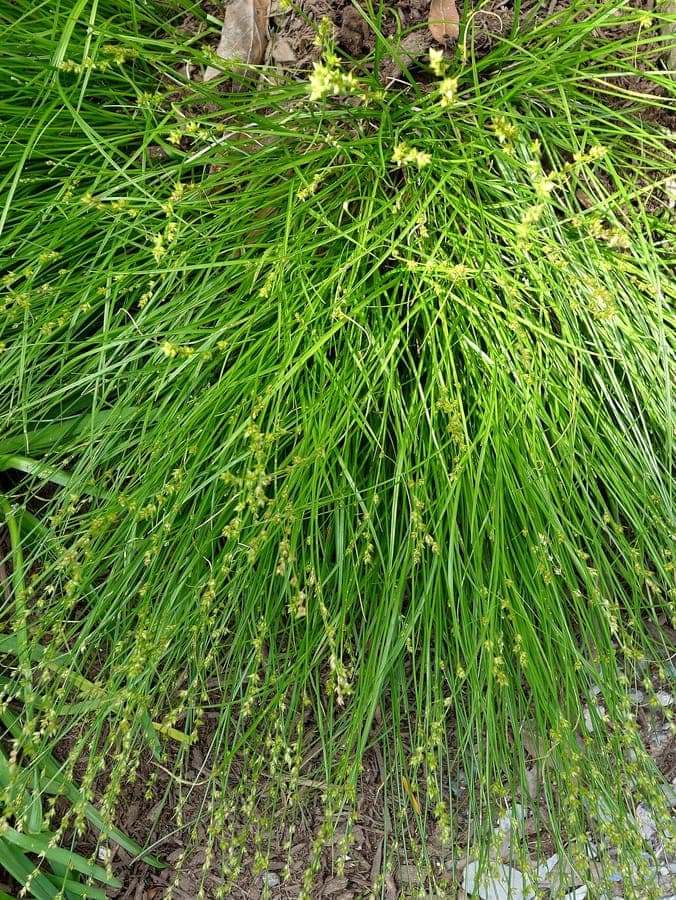
Daderot / CC0, via Wikimedia Commons
Eastern Star Sedge: complete guide
Carex radiata
Want to see Eastern Star Sedge: complete guide in your garden?
Full design in HD: €7.99
Look after your Eastern Star Sedge with the GardenWorld app
Identify plants with your camera and get a care calendar with reminders for this plant.


Overview
Eastern Star Sedge (Carex radiata), also known as Bracted Sedge or Radiate Sedge, is a refined North American sedge distinguished by unique seed head arrangements. The fruits grow radially outward like stars, giving the plant exceptional ornamental value during summer and autumn. This is a groundcover grass suited to woodland edges, shaded gardens, and wet depressions in temperate climates.
Appearance and Bloom
Carex radiata grows in compact, spreading tufts approximately 20-25 cm tall with fine, dark green foliage. In May-June appear the seed heads that make the plant famous: small, star-like radially spreading fruits. This unique fruit form gives the plant excellent ornamental value. The female flowers are small and greenish. The planting remains light green with bronzing in autumn.
Ideal Location
Carex radiata grows best in dappled to deep shade in moist soils. It establishes at woodland edges, beneath oaks and birches, and along wet streams. It can also thrive in dappled sun, moist locations as long as temperatures do not become extremely hot. Wind is not problematic for this plant. Excellent for woodland character or moist areas with forest character.
Soil
This plant thrives best in clay to sandy loam with good water retention. pH 5.5 to 6.8 is ideal. The soil may be moister but must not have water stagnation for extended periods. Add some peat moss or leaf mold when planting for better acidification and moisture retention. In very heavy clay it grows less quickly.
Watering
Ensure the planting substrate remains consistently moist throughout the growing season (March through October), but not saturated. Regular watering during active growth stages (May through August) is essential. In shaded locations, water evaporates more slowly, so adjust watering amounts based on weather conditions. In very moist soils, supplemental watering is rarely needed.
Free preview
Want to see Eastern Star Sedge: complete guide in your garden? Make a free preview of your design.
Pruning
Carex radiata requires very minimal maintenance. In March, gently remove dead foliage from the previous season using hands or a soft comb. Leave the ornamental seed heads standing through October-November - they remain decorative. In very dry summers, leaf tips may brown slightly; gently trim these. Division is rarely needed; the plant eventually forms nice groups by itself.
Maintenance Calendar
March: Remove dead foliage, maintain moisture; April-May: Growth activity, water regularly; June-July: Seed heads appear in star-like form; August-September: Seed ripening, maintain moisture content; October-November: Enjoy yellow seed colors and brown tints; December-February: Rest period, minimal watering.
Winter Hardiness
Carex radiata is hardy to USDA zone 3 (-35C), very suitable for the UK, Ireland, northern France and Germany. The plant remains largely evergreen and provides summer presence in dark winter landscapes. Snow does not damage the plant.
Companion Plants
Combine Eastern Star Sedge with woodland moist-loving plants: Asarum canadense (wild ginger), Carex pensylvanica (Pennsylvania sedge), Hepatica nobilis (liverwort), Polystichum acrostichoides (Christmas fern), Helleborus foetidus (stinking hellebore). For more color: Epimedium species (bishop's hat), Liriope (lilyturf). Excellent in woodland edge planting schemes.
Closing
Eastern Star Sedge is a subtle, elegant plant for those who appreciate refinement. The unique star-shaped seed heads are truly worth seeing. For online ordering, seek North American sedge nurseries or specialized woodland plant suppliers. Gardenworld.app helps you optimally integrate this special sedge into woodland and shade garden designs.
Frequently asked questions about Eastern Star Sedge
Is Eastern Star Sedge winter hardy?
Carex radiata is hardy to USDA zone 3 (-35C), very suitable for the UK, Ireland, northern France and Germany. The plant remains largely evergreen and provides summer presence in dark winter landscapes.
When and how do you prune Eastern Star Sedge?
Carex radiata requires very minimal maintenance. In March, gently remove dead foliage from the previous season using hands or a soft comb.
How much water does Eastern Star Sedge need?
Ensure the planting substrate remains consistently moist throughout the growing season (March through October), but not saturated. Regular watering during active growth stages (May through August) is essential.
Where does Eastern Star Sedge grow best?
Carex radiata grows best in dappled to deep shade in moist soils. It establishes at woodland edges, beneath oaks and birches, and along wet streams.
What soil does Eastern Star Sedge need?
This plant thrives best in clay to sandy loam with good water retention. pH 5.5 to 6.8 is ideal. The soil may be moister but must not have water stagnation for extended periods.

See it in your garden
See Eastern Star Sedge in your garden
One photo of your garden and a few questions. You see the result in about a minute.
Try it with a photoIdentify this plant in your own garden. Identify a plant
Similar plants
Carex conica: a small evergreen sedge for edges
Carex conica
Carex conica is a compact evergreen sedge from Japan and Korea. A guide to 'Snowline', where to plant it, soil, tidying, dividing and how hardy it really is.
Carex oshimensis: the evergreen striped sedge
Carex oshimensis
Carex oshimensis is an evergreen Japanese sedge with fine, striped leaves. How to plant, place, tidy and divide 'Evergold' and the EverColor series in your garden.
Orange New Zealand sedge (Carex testacea): a guide
Carex testacea
Orange New Zealand sedge (Carex testacea) turns copper and orange in sun and cold. Where to plant it, which soil it likes, how to tidy it and how hardy it is.
