
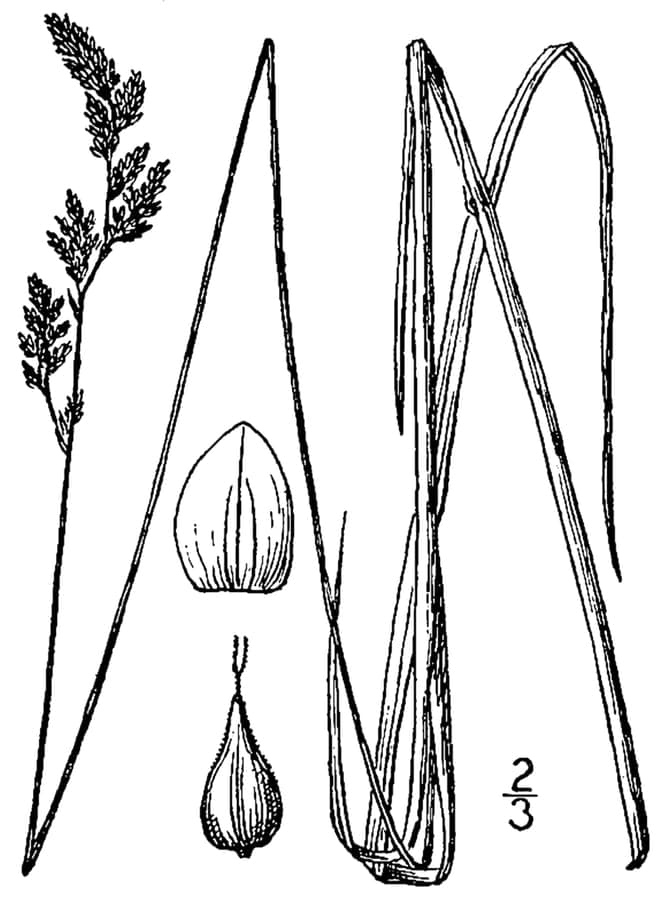
Britton, N.L., and A. Brown. 1913. An illustrated flora of the northern United States, Canada and the British Possessions. 3 vols. Charles Scribner's Sons, New York. Vol. 1: 370. Courtesy of Kentucky Native Plant Society. Scanned by Omnitek Inc. / Public domain, via Wikimedia Commons
Carex prairea: complete guide
Carex prairea
Want to see Carex prairea: complete guide in your garden?
1 minute, no credit card
Overview
Carex prairea, commonly called prairie sedge or prairie carex, is a significant native sedge from the wet prairie and grassland ecosystems of North America. This species naturally occurs across an extensive range from Canada through the central and eastern United States, spanning from Alberta to Quebec in the north, and southward to Virginia, Iowa, and Nebraska.
This sedge is renowned for its exceptional ability to tolerate wet, marshy environments. The plant forms dense, compact tufts that function beautifully in water gardens, wetland restorations, and naturally moist grassland-like settings. For gardeners wishing to establish native water-loving vegetation, Carex prairea represents an essential species.
Appearance and Bloom
Carex prairea develops compact, dense tufts of fine, grass-like foliage typically reaching 30-60 cm in height. The plant grows as a finely textured grass-like sedge with attractive olive-green coloration.
Flowering appears from May through June. The flower spikes are small and inconspicuous, though they function critically for vegetative reproduction. The plant is renowned for its capacity to form dense mats and tufts, making it invaluable for erosion control and wetland restoration.
The foliage maintains year-round appeal, developing winter tints during cold months.
Ideal Location
Carex prairea thrives in wetland, water-rich grassland, and marsh environments. The plant tolerates full sun to partial shade, though more direct sun promotes more compact growth.
Optimal placements include:
- Wet grasslands and meadow-like areas
- Marshy areas and true wetlands
- Riparian forest edges with high water tables
- Constructed wetlands and bioretention features
- Erosion-prone banks requiring stabilization
- Native wetland restoration projects
- Containers with consistent moisture
This species is a perfect choice for gardeners working with native water plants.
Soil Requirements
Carex prairea thrives in wet to very wet soils. The plant adapts to both acidic and neutral pH ranges. Clay-loam and silt-loam soils are ideal, though organic-rich sediments prove most favorable.
The species tolerates periodic submersion exceptionally well. It's equally tolerant of nutrient-rich soils - indeed, fertility promotes denser growth and vigorous vegetative spread.
Free design
Want to see Carex prairea: complete guide in your garden? Make a free design now.
Watering
Once established, Carex prairea essentially requires persistently moist soils year-round. This is not a drought-tolerant species - regular moisture is fundamental to optimal performance.
In standard gardens, the plant can be container-grown in moisture-retentive potting soil. Regular watering throughout the growing season is essential, particularly in warm months. In naturally wet settings, the plant sustains itself entirely on ambient moisture.
Pruning
Maintenance pruning is essentially unnecessary, as the plant grows compactly and neatly without intervention. In early spring, dead foliage from the previous year can be selectively removed.
If the plant becomes significantly overgrown, old foliage can be carefully trimmed.
Maintenance Calendar
January-February: Assess moisture conditions. Remove dead foliage. Prepare for new growing season.
March-April: Growth commences. Maintain consistent moisture. Young shoots emerge.
May-June: Flowering period. Flower spikes appear, though inconspicuous. Keep moisture consistent.
July-August: Active growth period. Plant establishes and spreads. Provide regular moisture.
September-October: Plant reaches full stature. Nutrient translocation begins.
November-December: Dormant period. Moisture conditions remain important for root zone health.
Winter Hardiness
Carex prairea is extremely cold-hardy, rated for USDA zones 3-4 (-30 to -35°C / -22 to -31°F). This is a rugged North American species requiring no special winter protection in temperate maritime climates.
The plant thrives even in harsh winter conditions typical of its native range.
Companion Plants
Carex prairea combines beautifully with other wetland-loving species:
- Marsh sneezeweed (Helenium) - complementary yellow-red coloration
- Meadowsweet (Filipendula) - elegant herbaceous companion
- Marsh blazing star (Liatris) - vertical purple accents
- Ostrich fern (Matteuccia) - delicate fern texture
- Dwarf willow species - structural contrast
- Other native sedges like Carex lacustris - textural layering
These pairings create biodiverse, ecologically rich wetland garden pictures.
Conclusion
Carex prairea is essential for wet gardens, wetland restoration, and native vegetation projects. This sedge offers beauty, ecosystem services, and water absorption benefits. With its North American origin and natural wet preference, this species deserves a place in modern water-conscious garden design.
Find Carex prairea at specialty wetland plant suppliers. Explore your water garden possibilities on gardenworld.app!
Want to see Carex prairea: complete guide in your garden? Make a free design now.
Upload a photo, pick a style, and get a photorealistic design with plant list in under a minute.
No credit card required


Similar plants
Flat-stemmed club-rush: complete guide
Bolboschoenus planiculmis
Everything about Bolboschoenus planiculmis: growing conditions, watering, care, and use as a pond margin or wetland plant in garden design.
Great Plains flatsedge: complete guide
Cyperus lupulinus
Everything about Great Plains flatsedge (Cyperus lupulinus): growing conditions, care, garden uses, and ecological value. Tips for pond margins and dry sandy soils.
Golden beak sedge: complete guide
Rhynchospora corymbosa
Everything about golden beak sedge (Rhynchospora corymbosa): a dramatic tropical marginal for pond edges, bog gardens, and wet habitats.