
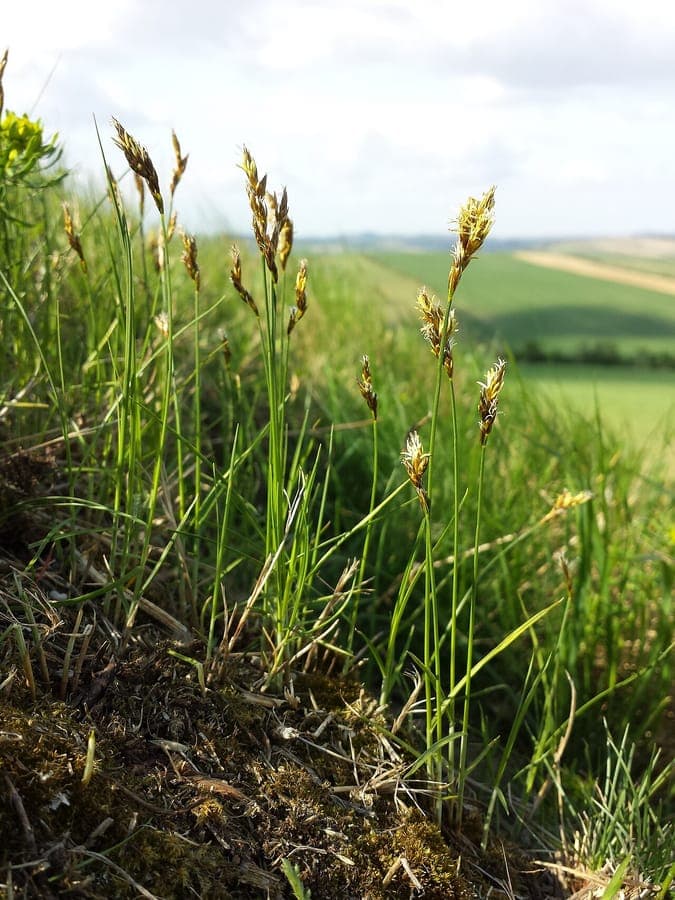
Stefan.lefnaer / CC BY-SA 4.0, via Wikimedia Commons
Early sedge: complete guide
Carex praecox
Want to see Early sedge: complete guide in your garden?
1 minute, no credit card
Overview
Carex praecox, commonly known as early sedge, is a quiet achiever in the UK and northern European garden. Native to regions including the Baltic States, Austria, and parts of central Russia, it's adapted to cool, damp conditions where many plants struggle. The name 'praecox' means 'early', and it refers to its flowering period – one of the first sedges to bloom, often as early as late February in mild areas. It's not a flashy plant, but it's reliable, structural, and perfectly suited to naturalistic planting schemes.
You won't find it screaming for attention at garden centres, but once you've planted it, you'll appreciate its steady presence. It thrives where other perennials fail – under trees, in damp corners, or on heavy clay. On gardenworld.app you can design a garden layout that highlights early sedge in shaded, moist zones, ensuring it's placed where it performs best.
Appearance & bloom cycle
Early sedge forms tight, arching tussocks 25–40 cm tall, with slender, bright green leaves that emerge fresh in spring. The flower spikes appear in late winter to early spring (February–April), rising just above the foliage. They're brownish to olive-green, slender, and somewhat inconspicuous, but valued for their early emergence. After flowering, the spikes fade, but the foliage remains evergreen in mild winters or semi-evergreen in colder zones.
The leaves have a soft, fine texture that contrasts well with bolder plants. Seed heads develop in May and are dispersed by wind or small animals. While not ornamental in the traditional sense, early sedge supports early pollinators like hoverflies and provides shelter for ground insects. Its subtle beauty grows on you over time.
Ideal location
This sedge loves partial to full shade, especially under deciduous trees or on the north side of buildings. It can tolerate sun if the soil stays consistently moist. Avoid hot, dry, south-facing spots unless you're prepared to irrigate regularly. Plant in groups of 3–5 for visual impact, spacing them 30 cm apart to form a dense cover within two to three seasons.
It's ideal for woodland gardens, damp borders, or along stream banks. In urban gardens with compacted soil under trees, it's a smart choice. On gardenworld.app you can simulate its growth pattern and spacing to plan a cohesive, low-maintenance planting scheme.
Soil requirements
Early sedge prefers moist, humus-rich soil with a pH of 5.5–7.0. It tolerates clay and even occasional waterlogging, but not permanent standing water. Avoid chalky or highly alkaline soils – it performs poorly in those conditions. In sandy soils, amend with well-rotted compost or leaf mould to improve moisture retention.
If planting in heavy clay, loosen the soil and mix in some grit or composted bark to improve drainage. The plant doesn't need rich soil, but it does need consistent moisture. In dry summers, especially in southern UK, watch for leaf browning at the tips – a sign of drought stress.
Free design
Want to see Early sedge: complete guide in your garden? Make a free design now.
Watering
During the first growing season, water weekly if there's less than 25 mm of rain. Once established, it's moderately drought-tolerant but thrives best with consistent moisture. During prolonged dry spells (over 14 days), provide deep watering at the base to prevent stress.
Avoid overhead watering – wet foliage can encourage fungal issues. Drip irrigation or soaker hoses work best. In naturally damp areas or near ponds, supplemental watering is rarely needed.
Pruning
No pruning is required, but an annual tidy-up in late winter (February) improves appearance. Cut back old, tatty foliage to 10 cm above ground level before new growth emerges. Use sharp shears and wear gloves – the leaves can be tough.
After 5–6 years, the center of the clump may die out. This is the time to divide. Lift the plant in March or September, split with a spade or knife, and replant divisions 30 cm apart. Discard the woody center and compost healthy outer sections.
Maintenance calendar
- Jan: Check for winter damage, avoid walking on wet soil
- Feb: Cut back old foliage, prepare for new growth
- Mar: Divide or plant new clumps, apply light mulch
- Apr: Monitor early flower spikes, watch for slugs
- May: Check for pests, maintain soil moisture
- Jun: No action needed, plant growing steadily
- Jul: Observe during dry periods, water if needed
- Aug: Assess plant health, check for stress signs
- Sep: Divide or transplant if required
- Oct: Leave foliage for winter interest
- Nov: Apply leaf litter as natural mulch
- Dec: Leave undisturbed
Winter hardiness
Carex praecox is hardy in USDA zones 5–9, making it suitable for most of the UK and northern Europe. It remains evergreen in mild winters; in colder zones, foliage may turn brown but regrows in spring. No winter protection is needed, except for container-grown plants – move to a sheltered spot or wrap the pot.
Companion plants
Pair early sedge with shade-loving perennials like Hosta, Alchemilla mollis, or Lamium maculatum. Under trees, it combines well with Anemone nemorosa or Pulmonaria. For contrast, plant alongside dark-leaved shrubs like Ilex crenata. In wet areas, try it with Carex elata 'Aurea' or rodgersia.
Avoid invasive spreaders like bamboo or leycesteria. On gardenworld.app you can explore companion planting combinations that balance texture, height, and moisture needs.
Closing
Early sedge isn't showy, but it's a dependable performer in tough spots. Buy it from garden centres in spring – often sold in 1L pots. Plant in groups, give it a good start, and it will reward you for years. It's a plant that works quietly in the background, holding soil, adding texture, and thriving where others fail.
Want to see Early sedge: complete guide in your garden? Make a free design now.
Upload a photo, pick a style, and get a photorealistic design with plant list in under a minute.
No credit card required


Similar plants
Flat-stemmed club-rush: complete guide
Bolboschoenus planiculmis
Everything about Bolboschoenus planiculmis: growing conditions, watering, care, and use as a pond margin or wetland plant in garden design.
Great Plains flatsedge: complete guide
Cyperus lupulinus
Everything about Great Plains flatsedge (Cyperus lupulinus): growing conditions, care, garden uses, and ecological value. Tips for pond margins and dry sandy soils.
Golden beak sedge: complete guide
Rhynchospora corymbosa
Everything about golden beak sedge (Rhynchospora corymbosa): a dramatic tropical marginal for pond edges, bog gardens, and wet habitats.