
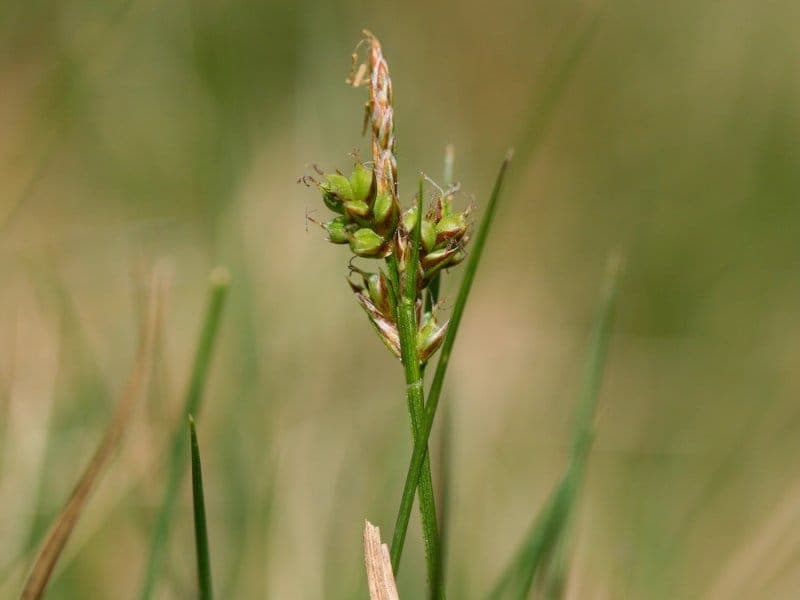
Kristian Peters -- Fabelfroh 11:03, 8 May 2007 (UTC) / CC BY-SA 3.0, via Wikimedia Commons
Pill sedge: complete guide
Carex pilulifera
Want to see Pill sedge: complete guide in your garden?
1 minute, no credit card
Overview
Carex pilulifera, commonly known as pill sedge, is a compact, clump-forming perennial from the Cyperaceae family. Native to regions across Northern and Central Europe-including Finland, the Baltic States, Belarus, and parts of France-it's perfectly suited to cool temperate climates. Though not native to the UK or much of North America, it adapts well to shaded garden spots, especially in woodland-style plantings.
This sedge grows slowly but steadily, forming dense mounds of arching, fine-textured foliage. It doesn't rely on showy flowers for appeal; instead, its charm lies in subtle structure and year-round presence. The name 'pill sedge' comes from the small, round green flower clusters that resemble tiny pills, appearing in late spring. These sit nestled among the leaves, adding quiet interest.
Pill sedge is ideal for gardeners looking to add understated texture to shaded borders or understorey plantings. On gardenworld.app, you can visualise how pill sedge integrates into a shaded garden design, especially when paired with spring bulbs or ferns.
Appearance & bloom cycle
Mature plants reach 15–25 cm in height with a spread of 20 cm. The narrow, linear leaves are bright green to grey-green, 2–3 mm wide, and gently arch outward, creating a soft, fountain-like effect. In winter, the foliage often takes on a bronze or russet tint, especially in colder zones, adding seasonal interest.
The bloom cycle runs from May to June. The flower spikes are short and inconspicuous, bearing the signature round green 'pills'-technically utricles-that give the plant its name. These mature to a brownish hue by late summer. Though not ornamental in a traditional sense, they contribute to the plant's naturalistic character.
Ideal location
Pill sedge thrives in partial to full shade. It performs best under deciduous trees, along north-facing walls, or in woodland edges where sunlight is dappled. Full sun is acceptable only if the soil remains consistently moist, but in hot, dry summers, leaf scorch is common.
This sedge is a reliable choice for tricky spots where few other plants succeed-under shrubs, in narrow side borders, or beneath dense canopies. It's excellent for naturalistic gardens, shaded rockeries, or as a groundcover in moist woodland settings. Use gardenworld.app to map out shaded zones in your garden and see where pill sedge might fit best.
Soil requirements
Pill sedge prefers moist, humus-rich, well-drained soil with a pH between 5.5 and 7.0. It tolerates clay if it doesn't become waterlogged, but struggles in sandy, fast-draining soils unless irrigated regularly. Organic matter like leaf mould or compost should be mixed in at planting to retain moisture and improve soil structure.
Avoid highly calcareous soils-this sedge prefers slightly acidic to neutral conditions. If your soil is alkaline, consider growing it in a raised bed with amended soil.
Free design
Want to see Pill sedge: complete guide in your garden? Make a free design now.
Watering
Keep the soil consistently moist, especially during the first growing season and in dry spells. Pill sedge has moderate to high water needs and won't tolerate prolonged drought. Water deeply once or twice a week in summer if rainfall is low.
Rainwater is preferable, as tap water high in lime can affect long-term health. A 5 cm layer of organic mulch (such as bark or leaf litter) helps conserve moisture and suppress weeds.
Pruning
Minimal pruning is needed. In late winter or early spring (February to March), comb through the clump with your fingers or use sharp scissors to remove any dead or damaged foliage. This encourages fresh growth and prevents old leaves from smothering new shoots.
Avoid cutting back too hard-pill sedge grows from the centre, and over-pruning can delay regrowth.
Maintenance calendar
- January: Monitor for frost damage; avoid walking on clumps when frozen.
- February–March: Light tidy-up, remove old leaves, apply mulch if needed.
- April–September: Regular watering in dry periods, check for slugs on young shoots.
- October–December: No active care required. Mulch lightly to protect roots in harsh winters.
Winter hardiness
Pill sedge is hardy in USDA zones 5 to 8, tolerating temperatures down to -20°C. In zone 7 (typical of the UK and much of the northeastern US), it remains evergreen but may show some bronzing in severe cold. No winter protection is needed in most climates.
In areas with heavy winter rainfall, ensure good drainage to prevent crown rot. A gravel mulch around the base can help in wet gardens.
Companion plants
Pair pill sedge with other shade-loving perennials like Hostas, Heucheras, Epimediums, and Hellebores. It makes an excellent textural contrast to bold-leaved plants and works well as a foreground plant in mixed borders.
Spring bulbs such as Scilla, Chionodoxa, or dwarf Narcissus emerge beautifully through its foliage. Ferns like Dryopteris or Athyrium complement its form and thrive in similar conditions.
Avoid invasive groundcovers like ground ivy or aggressive grasses that could outcompete it.
Closing
Carex pilulifera is a quietly dependable plant for shaded gardens. It offers structure, texture, and year-round interest with minimal effort. Its non-invasive habit and slow spread make it ideal for curated plantings. For best effect, plant in groups of 5 or more to create a lush, continuous carpet. Look for pill sedge at garden centres across the UK and North America, especially in spring. Retailers like garden centres in the UK often stock it in 9 cm pots or as bare-root plugs for larger areas.
Want to see Pill sedge: complete guide in your garden? Make a free design now.
Upload a photo, pick a style, and get a photorealistic design with plant list in under a minute.
No credit card required


Similar plants
Flat-stemmed club-rush: complete guide
Bolboschoenus planiculmis
Everything about Bolboschoenus planiculmis: growing conditions, watering, care, and use as a pond margin or wetland plant in garden design.
Great Plains flatsedge: complete guide
Cyperus lupulinus
Everything about Great Plains flatsedge (Cyperus lupulinus): growing conditions, care, garden uses, and ecological value. Tips for pond margins and dry sandy soils.
Golden beak sedge: complete guide
Rhynchospora corymbosa
Everything about golden beak sedge (Rhynchospora corymbosa): a dramatic tropical marginal for pond edges, bog gardens, and wet habitats.