
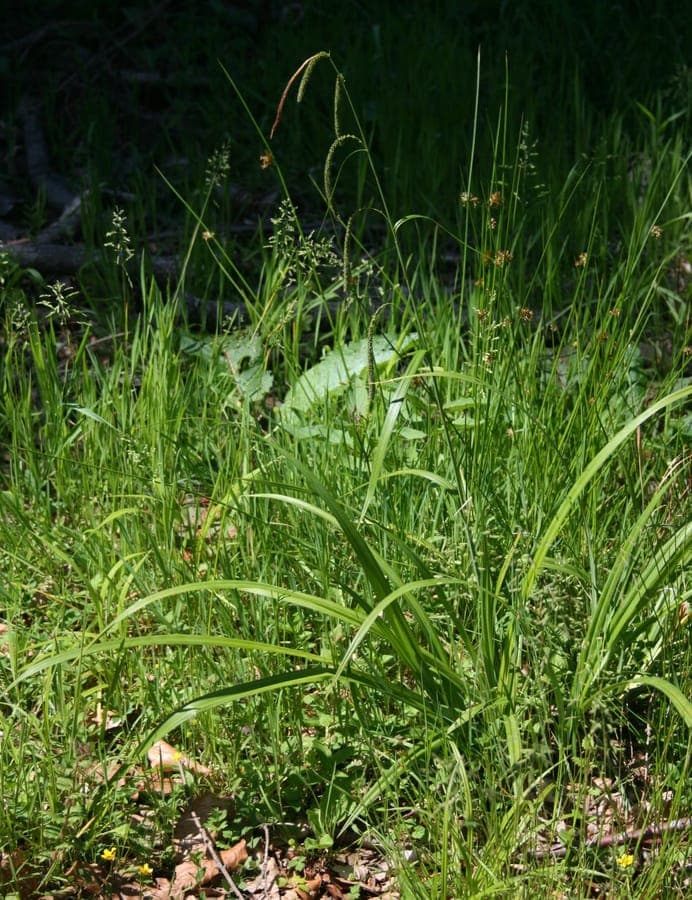
Franz Xaver / CC BY-SA 3.0, via Wikimedia Commons
Drooping sedge: complete guide
Carex pendula
Want to see Drooping sedge: complete guide in your garden?
1 minute, no credit card
Overview
Carex pendula, commonly known as drooping sedge, is a striking ornamental grass that thrives in damp, shady areas where few other plants succeed. Native to regions across Western and Southern Europe - including France, Germany, the UK, and parts of the Mediterranean - this member of the Cyperaceae family adapts well to UK and Irish gardens. It's not native to Britain, but it's become a popular choice for naturalistic planting schemes, waterside edges, and woodland gardens.
This sedge forms dense, arching clumps and stands out with its long, pendulous flower spikes that drape dramatically from the foliage. Unlike upright sedges like Carex vulpinoidea, Carex pendula has a softer, more fluid silhouette, making it ideal for softening hardscapes or adding movement to still areas. It's a perennial that establishes slowly via rhizomes and won't take over your garden. On gardenworld.app, you can design a planting scheme that highlights drooping sedge's natural sway, pairing it with complementary textures and heights.
Appearance & bloom cycle
Mature plants reach 80–120 cm in height, with leaves spreading up to 1 m long and 1–2 cm wide. The foliage is bright green, glossy, and slightly drooping, creating a fountain-like effect. From April to June, slender stems emerge, extending up to 150 cm, each bearing long, dangling brownish-green flower spikes. These hang like tassels, giving the plant its common name.
After flowering, the spent spikes remain through late autumn, adding structure and movement to the garden. The plant stays semi-evergreen in mild winters, though foliage may brown in prolonged cold. It reliably regrows in spring, especially when cut back in March. The visual impact lasts nearly year-round, peaking in late spring and early summer.
Ideal location
Drooping sedge prefers partial to full shade. Avoid hot, south-facing spots - direct afternoon sun scorches the leaves and dries the soil too quickly. Opt for north-facing borders, under deciduous trees, or near ponds and damp corners of the garden. It's perfect for bog gardens, stream banks, or shaded rain gardens.
Its graceful form contrasts beautifully with rigid hardscaping, such as wooden decks or stone steps. For inspiration on where to place it, use gardenworld.app to visualise how drooping sedge flows alongside hostas, ferns, or moisture-loving perennials in a shaded border.
Soil requirements
This sedge thrives in moist, humus-rich soil. It tolerates a pH range from slightly acidic to neutral (5.5–7.0). Heavy clay is ideal - it holds moisture well - but sandy soils can work if enriched regularly with compost or leaf mould. Avoid dry, nutrient-poor substrates.
It's particularly suited to areas with high water tables, like low-lying spots or near downspouts. If your soil dries out quickly, mulch thickly with bark or compost to retain moisture. Prolonged drought causes leaf tip dieback and stunted growth.
Free design
Want to see Drooping sedge: complete guide in your garden? Make a free design now.
Watering
During the first growing season, water weekly with 10–15 litres per plant, increasing during dry spells. Once established, it's moderately drought-tolerant for short periods but performs best with consistent moisture. Water deeply rather than frequently - this encourages deeper root development.
Use rainwater when possible, as drooping sedge can be sensitive to lime in tap water. Avoid waterlogging, which may lead to root rot. If planting in containers, ensure drainage holes are clear and saucers are emptied after rain.
Pruning
Pruning isn't essential but improves appearance and air circulation. In March, cut back old foliage to 20–30 cm above ground level using sharp shears. Remove any damaged or browned leaves. This encourages fresh, upright growth and prevents the clump from becoming too dense.
Leave the flower spikes over winter - they add texture and shelter for overwintering insects. If you prefer a tidier look, remove them in late autumn.
Maintenance calendar
- Jan: inspect for damage, leave old growth
- Feb: protect young plants if needed
- Mar: cut back old foliage, apply compost
- Apr: monitor for new shoots, water if dry
- May: flowering begins, check for slugs
- Jun: full bloom, avoid cutting
- Jul: maintain moisture, watch for stress
- Aug: continue watering in dry periods
- Sep: no feeding, check for mildew
- Oct: leave spent spikes
- Nov: tidy up if desired
- Dec: no protection needed in mild areas
Winter hardiness
Drooping sedge is hardy in USDA zones 6–9. In the UK (zone 8), it survives winter without protection. Young plants may benefit from a mulch of leaf litter or compost in their first winter to prevent heaving. Foliage may yellow or brown but typically rebounds in spring.
Companion plants
Pair with moisture-loving companions: hostas, ferns, astilbes, rodgersia, or lysimachia. It also works well with gunnera in large damp areas, or with carex elata 'Aurea' for golden contrast. Avoid drought-tolerant species like lavender or sedum.
For a natural pond edge, combine with irises or tall grasses. Use gardenworld.app to test plant pairings digitally before planting.
Closing
Drooping sedge brings elegance and movement to shaded, wet areas with minimal care. It's not flashy, but it's reliable and adds depth to planting schemes. Buy it from local garden centres or online retailers. With proper placement and watering, it will thrive for years. On gardenworld.app, you can preview how drooping sedge integrates into your garden's microclimates, helping you make smarter planting decisions.
Want to see Drooping sedge: complete guide in your garden? Make a free design now.
Upload a photo, pick a style, and get a photorealistic design with plant list in under a minute.
No credit card required


Similar plants
Flat-stemmed club-rush: complete guide
Bolboschoenus planiculmis
Everything about Bolboschoenus planiculmis: growing conditions, watering, care, and use as a pond margin or wetland plant in garden design.
Great Plains flatsedge: complete guide
Cyperus lupulinus
Everything about Great Plains flatsedge (Cyperus lupulinus): growing conditions, care, garden uses, and ecological value. Tips for pond margins and dry sandy soils.
Golden beak sedge: complete guide
Rhynchospora corymbosa
Everything about golden beak sedge (Rhynchospora corymbosa): a dramatic tropical marginal for pond edges, bog gardens, and wet habitats.