
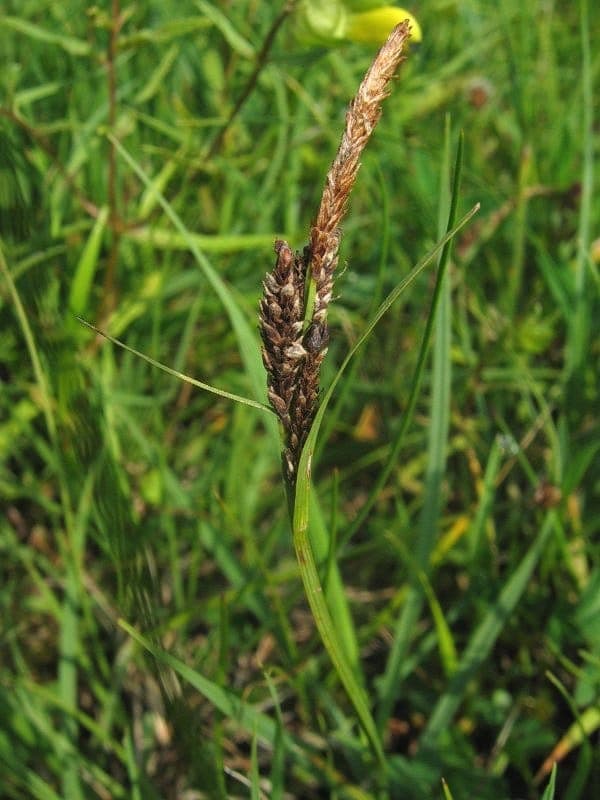
Kristian Peters -- Fabelfroh 15:28, 18 July 2006 (UTC) / CC BY-SA 3.0, via Wikimedia Commons
Carnat sedge: complete guide
Carex panicea
Want to see Carnat sedge: complete guide in your garden?
1 minute, no credit card
Overview
Carex panicea, commonly known as Carnat sedge, is a graceful, clump-forming perennial from the Cyperaceae family. Native to damp woodlands and fens across central and eastern Europe, it thrives in cool, moist conditions where many other plants struggle. In the garden, it's a go-to for shaded, boggy corners, stream edges, or under deciduous trees. Its fine, blue-green foliage and airy flower spikes add movement and texture, making it a favourite for naturalistic planting designs.
On gardenworld.app, you can design a planting scheme that highlights the subtle beauty of Carnat sedge, placing it exactly where it'll thrive.
Appearance & bloom cycle
Carnat sedge grows 30–60 cm tall with a spread of about 30 cm. It forms tight mounds of narrow, arching leaves with a distinctive blue-green to silvery hue. From May to June, slender stems rise above the foliage, bearing delicate, panicle-like flower spikes in pale brown to greyish tones. The blooms are not flashy, but their fine structure catches the light and sways gently in the breeze.
After flowering, the seed heads persist well into autumn and even through winter, offering visual interest when many plants have died back. The foliage remains semi-evergreen in mild winters, turning yellowish in colder zones. It doesn't die back completely, giving the garden some structure year-round.
Ideal location
Plant Carnat sedge in partial to full shade. It tolerates a bit of morning sun if the soil stays moist, but avoid hot afternoon sun, which can scorch the leaves. Ideal spots include under trees, along pond margins, in damp borders, or in rain gardens. It prefers shelter from strong winds that can flatten the delicate flower stems.
In modern gardens, use it as a textural contrast against bolder-leaved plants like Rodgersia or Gunnera. For naturalistic schemes, group it with other moisture-loving perennials. On gardenworld.app, you can visualise how this sedge fits into your existing garden layout.
Soil requirements
Carnat sedge does best in moist, humus-rich, loamy or clay-loam soils. The soil should retain moisture but not become waterlogged. Sandy soils drain too quickly unless amended with compost or well-rotted manure. The ideal pH range is 5.5 to 7.0-slightly acidic to neutral. Avoid highly calcareous soils, as they can cause yellowing due to iron deficiency.
When planting, mix in a bucket of compost or leaf mould into the planting hole. This helps retain moisture and provides nutrients during the first growing season.
Free design
Want to see Carnat sedge: complete guide in your garden? Make a free design now.
Watering
Keep the soil consistently moist, especially during the first year and in dry spells. Water weekly during hot summers if rainfall is low. This sedge isn't drought-tolerant-dry conditions lead to browning leaf tips and weak growth. Use rainwater when possible, as it's less likely to contain lime that can affect soil pH.
In naturally damp areas or near water features, additional watering is rarely needed.
Pruning
Carnat sedge requires minimal pruning. In late winter or early spring (February to March), cut back old, damaged, or yellowing foliage to make way for fresh growth. Use sharp shears and cut just above the new shoots emerging from the base. Avoid cutting into the crown, as this can damage the plant.
Leave the flower stems through winter for visual interest and to protect the crown. Cut them back only when new growth appears in spring.
Maintenance calendar
- January: Check for winter damage. Leave stems intact.
- February: Prepare for spring. Cut back old foliage if needed.
- March: Prune, divide, or plant. Add compost to soil.
- April: Begin regular watering. Watch for slugs.
- May: Flowering begins. No feeding required.
- June: Peak bloom. Maintain soil moisture.
- July: Monitor for drought stress. Provide shade if needed.
- August: Reduce watering in wet summers. No fertiliser.
- September: Plant looks good. No action needed.
- October: Leave everything for winter structure.
- November: No pruning. Mulch young plants with leaf litter in cold areas.
- December: Final check. Keep stems for winter interest.
Winter hardiness
Carnat sedge is hardy to USDA zone 5 (-20°C). It survives most UK and northern European winters without protection. In harsh conditions, the leaves may yellow or brown, but the rootstock usually remains alive. Young plants benefit from a light mulch of leaves or straw in colder regions.
Companion plants
Pair Carnat sedge with other moisture lovers: Carex elata 'Aurea', Filipendula ulmaria, Molinia caerulea, or Iris versicolor. Under trees, it works well with Tellima grandiflora or Alchemilla mollis. For contrast, try bright yellow Caltha palustris or deep purple Lythrum salicaria.
Avoid drought-tolerant plants like Lavandula or Echinacea-they need drier conditions and won't thrive in the same spot.
Closing
Carnat sedge is a quiet achiever in the shade garden. It asks for little but gives back with texture, movement, and year-round presence. Plant it in groups of at least three for the best effect. You'll find it at garden centres across the UK, often in 1-litre pots. Once established, it spreads slowly but stays well-behaved. And if you're unsure where to place it, gardenworld.app lets you test-drive the plant in a virtual garden plan before you buy.
Want to see Carnat sedge: complete guide in your garden? Make a free design now.
Upload a photo, pick a style, and get a photorealistic design with plant list in under a minute.
No credit card required


Similar plants
Flat-stemmed club-rush: complete guide
Bolboschoenus planiculmis
Everything about Bolboschoenus planiculmis: growing conditions, watering, care, and use as a pond margin or wetland plant in garden design.
Great Plains flatsedge: complete guide
Cyperus lupulinus
Everything about Great Plains flatsedge (Cyperus lupulinus): growing conditions, care, garden uses, and ecological value. Tips for pond margins and dry sandy soils.
Golden beak sedge: complete guide
Rhynchospora corymbosa
Everything about golden beak sedge (Rhynchospora corymbosa): a dramatic tropical marginal for pond edges, bog gardens, and wet habitats.