
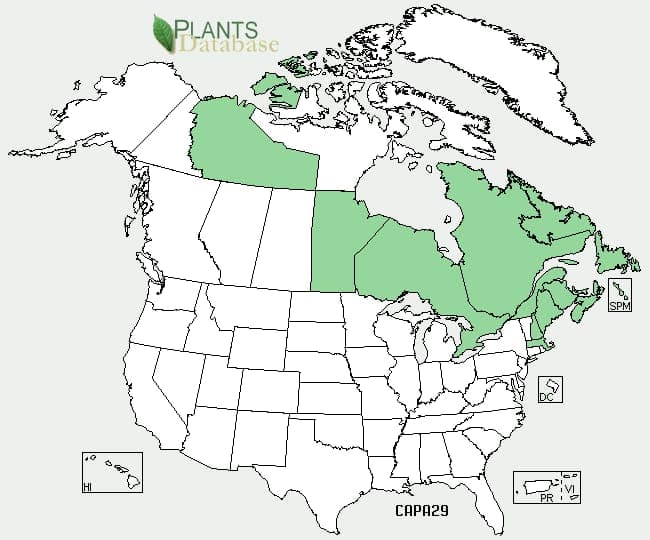
USDA / Public domain, via Wikimedia Commons
Chaffy sedge: complete guide
Carex paleacea
Want to see Chaffy sedge: complete guide in your garden?
1 minute, no credit card
Overview
Carex paleacea, commonly known as Chaffy sedge, is a hardy, grass-like perennial native to coastal wetlands across northern North America and parts of northern Europe. It thrives in marshes, fens, and damp meadows, where fluctuating water levels are common. In the garden, it's an excellent choice for wet, poorly drained areas that challenge most plants. This sedge forms tight clumps of narrow, arching foliage that stays visually engaging year-round. With natural habitats stretching from Maine to Finland, it's well adapted to cool, moist climates and performs reliably in USDA zones 4 to 8.
Appearance & bloom cycle
Carex paleacea grows 40–60 cm tall with a spread of about 50 cm. The leaves are slender (3–5 mm wide), light green to grey-green, and gracefully arching, creating a soft, flowing texture. In late spring to early summer-typically June to July-small, brownish flower spikes emerge on upright stems. These are inconspicuous but add subtle structure. The bracts around the spikes are papery and chaff-like, giving the plant its common name. The seed heads persist through summer and into autumn, adding seasonal interest even after flowering ends.
Ideal location
This sedge thrives in full sun to light shade, scoring an 8 on the 1–10 light scale. It performs best with at least 6 hours of direct sunlight, ideally morning sun with afternoon shade in hotter regions. In cooler climates like the UK or northern US, full sun is ideal. Position it in consistently moist to wet areas-along pond margins, in rain gardens, or in damp borders. Avoid dry, sandy spots unless you can provide regular irrigation. On gardenworld.app, you can design a planting scheme that matches your garden's moisture zones perfectly.
Soil requirements
Carex paleacea prefers moist, well-drained loam or clay-loam soils with a neutral to slightly alkaline pH of 7.0–7.5. It tolerates minor pH fluctuations but struggles in highly acidic conditions. Improve heavy soils with compost to boost organic content and water retention. For sandy soils, amend with peat or composted manure. A light mulch of leaf mould in spring helps retain moisture and suppress weeds.
Watering
Consistent moisture is key-never let the soil dry out completely, especially during the first growing season. Established plants are more resilient but still need weekly watering during dry spells. In containers or raised beds, check soil moisture every few days. If planted near a water feature, it will often self-regulate. During prolonged droughts, supplement with deep soakings. Drip irrigation works well for larger plantings. On gardenworld.app, you can simulate water flow patterns to plan ideal sedge placement.
Free design
Want to see Chaffy sedge: complete guide in your garden? Make a free design now.
Pruning
Minimal pruning is required. In late winter or early spring (February to March), cut back old, tattered foliage to 10–15 cm above ground level. Use sharp shears and avoid cutting into the crown. This encourages fresh growth and maintains a tidy appearance. Leave some stubble to protect new shoots and insulate the root zone. Do not prune in autumn-overwintering foliage provides frost protection.
Maintenance calendar
- Jan: Check for frost damage
- Feb: Begin light cleanup; prepare tools
- Mar: Cut back old growth; apply compost
- Apr: Divide clumps if needed; plant new specimens
- May: Monitor for slug damage; maintain moisture
- Jun: Flowers emerge; inspect for pests
- Jul: Peak bloom; ensure consistent watering
- Aug: No pruning; enjoy seed heads
- Sep: Leave seed heads for winter interest
- Oct: Remove dead material if unsightly
- Nov: Reduce watering as growth slows
- Dec: Protect young plants with mulch
Winter hardiness
Hardy in USDA zones 4–8, Carex paleacea withstands winter temperatures down to -30°C. In zone 8 and milder areas, it remains semi-evergreen. In colder zones, foliage may turn brown but regenerates in spring. No special protection is needed for mature clumps, though a light mulch of straw or shredded leaves helps young plants survive harsh winters. Avoid heavy mulching, which can lead to crown rot.
Companion plants
Pair Chaffy sedge with moisture-loving perennials like Eutrochium maculatum, Iris versicolor, or Molinia caerulea. Its soft green hue contrasts well with bold bloomers such as Liatris spicata or dark-leaved Carex elata 'Aurea'. Avoid drought-tolerant plants like lavender or yarrow. Near water, it blends naturally with Sagittaria latifolia or Pontederia cordata. Use it as a transition plant between open water and drier border zones.
Closing
Carex paleacea is a practical and attractive choice for damp garden areas. It's low-maintenance, long-lived, and adds texture and movement where few plants thrive. Its adaptability to wet soils makes it a go-to for rain gardens and pond edging. You can find it at garden centres across the US and UK, often in the ornamental grass or waterside plant section. Once established, it asks for little and delivers consistent visual appeal. Use gardenworld.app to visualise how this sedge can enhance your garden's structure and function.
Want to see Chaffy sedge: complete guide in your garden? Make a free design now.
Upload a photo, pick a style, and get a photorealistic design with plant list in under a minute.
No credit card required


Similar plants
Flat-stemmed club-rush: complete guide
Bolboschoenus planiculmis
Everything about Bolboschoenus planiculmis: growing conditions, watering, care, and use as a pond margin or wetland plant in garden design.
Great Plains flatsedge: complete guide
Cyperus lupulinus
Everything about Great Plains flatsedge (Cyperus lupulinus): growing conditions, care, garden uses, and ecological value. Tips for pond margins and dry sandy soils.
Golden beak sedge: complete guide
Rhynchospora corymbosa
Everything about golden beak sedge (Rhynchospora corymbosa): a dramatic tropical marginal for pond edges, bog gardens, and wet habitats.