
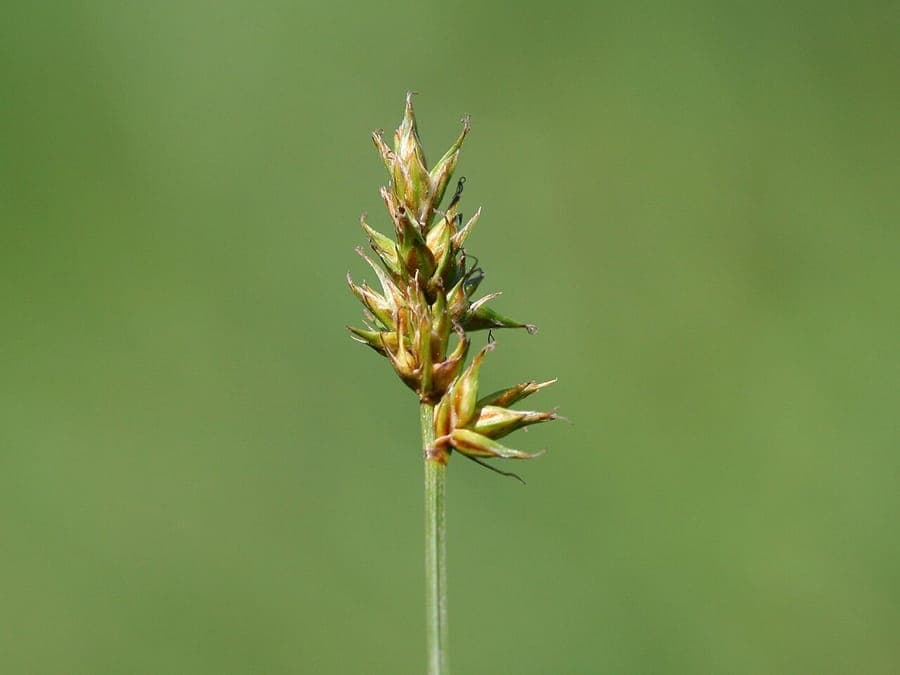
Kristian Peters -- Fabelfroh 07:53, 29 June 2007 (UTC) / CC BY-SA 3.0, via Wikimedia Commons
Pricky sedge: complete guide
Carex pairae
Want to see Pricky sedge: complete guide in your garden?
1 minute, no credit card
Overview
Pricky sedge, or Carex pairae, is a quietly dependable ornamental grass that earns its place in temperate gardens across Europe. Native to parts of Central and Western Europe, including Belgium, Austria and the Azores, it thrives in cool, moist conditions where many other plants struggle. As a member of the Cyperaceae family, it shares the typical sedge growth habit-clump-forming, grass-like, and resilient. What sets Pricky sedge apart is its fine texture, dark evergreen foliage, and ability to form tight, cushion-like mounds up to 30 cm tall. It's not flashy, but it's a backbone plant for shaded borders, woodland edges, and damp spots.
In the UK and northern Europe, gardeners use Pricky sedge as a groundcover under deciduous trees or along stream banks. It's perfect for low-maintenance schemes where consistent greenery matters more than seasonal blooms. With gardenworld.app, you can design a planting plan that accounts for shade patterns, soil moisture, and companion plants-making it easy to slot Carex pairae into your garden with confidence.
Appearance & bloom cycle
Carex pairae forms dense tufts of narrow, dark green leaves, typically 1–2 mm wide and 25–30 cm long. The blades are stiff, slightly arching, and have a subtle sheen. From April to May, small, inconspicuous flower spikes emerge-brownish and nestled within the foliage. They're not ornamental in the traditional sense, but they add a whisper of texture to the plant's profile. After flowering, tiny nutlets form, but these rarely draw attention.
The real appeal lies in its year-round presence. Unlike many grasses that die back in winter, Pricky sedge retains most of its foliage, providing structure and colour during the dull months. It doesn't spread aggressively, forming neat clumps that expand slowly over 3–5 years.
Ideal location
This sedge prefers partial to full shade, scoring a 5 on the light scale (1–10). It performs best in dappled shade under light-canopy trees like birch or hazel, or on north-facing slopes. While it can tolerate a few hours of morning sun, avoid hot afternoon exposure-especially in southern regions-where it may scorch or dry out. Ideal spots include understorey plantings, damp woodland clearings, or beside ponds where moisture is consistent.
If your garden has heavy clay that stays wet in winter or sandy soil enriched with organic matter, Pricky sedge will adapt. Use gardenworld.app to map your garden's microclimates and find the best zone for planting-no guesswork needed.
Soil requirements
Carex pairae thrives in moist, humus-rich soil with a pH between 5.5 and 6.5. It dislikes dry, chalky, or compacted soils. Heavy clay is acceptable as long as it doesn't become waterlogged for weeks on end. For sandy soils, amend with 3–4 litres of compost or leaf mould per square metre to improve water retention.
When planting, dig a hole twice as wide as the root ball and mix in organic matter. Space plants 30–40 cm apart for full coverage within two seasons. Avoid liming the soil-this sedge prefers slightly acidic conditions.
Free design
Want to see Pricky sedge: complete guide in your garden? Make a free design now.
Watering
Consistent moisture is key. During the first growing season (March to June), water weekly with 15–20 litres per m² if rainfall is below 25 mm per week. Established plants are more forgiving but still suffer in prolonged drought. In dry summers, water deeply every 7–10 days. Use a soaker hose or watering can with a rose to avoid disturbing the soil.
Mulch with 5 cm of leaf litter or bark in spring to conserve moisture and suppress weeds. Replenish annually.
Pruning
Pruning is minimal. In late winter (February), remove any brown or damaged leaves with sharp shears, cutting back to about 10 cm above the crown. Avoid cutting into the old growth too hard-this plant recovers slowly. Every 4–5 years, if the clump becomes dense and congested, lift and divide it in early spring. Discard the woody centre and replant the healthy outer sections.
Maintenance calendar
- Jan: Check for frost damage, remove debris
- Feb: Trim dead foliage, prepare for new growth
- Mar: Apply mulch, monitor soil moisture
- Apr: Flower spikes appear, no feeding needed
- May: Flowering ends, watch for dry spells
- Jun: Water weekly if dry, mulch if not done
- Jul: Protect from intense sun, avoid drought
- Aug: Final summer watering if needed
- Sep: Stop feeding, let plant harden off
- Oct: Clear fallen leaves, keep foliage dry
- Nov: Final inspection, no action unless extreme wet
- Dec: Dormant period, light monitoring only
Winter hardiness
Pricky sedge is hardy in USDA zones 5–8, tolerating temperatures down to -20°C. It survives most UK and European winters without protection. In areas with persistent ice or heavy snow, a light mulch of straw or pine needles can help insulate the crown. Avoid thick coverings-moisture buildup can lead to rot.
Companion plants
Pair Carex pairae with shade-loving, moisture-tolerant companions:
- Tellima grandiflora – for airy green flowers in spring
- Hosta 'Blue Angel' – for bold leaf contrast
- Lysimachia nummularia – as a golden creeping groundcover
- Ferns like Polystichum setiferum – for layered texture
- Astilbe 'Sprite' – for feathery summer blooms
Use it as an edging plant along shaded paths or as a filler between taller perennials. Its fine texture contrasts beautifully with coarser foliage.
Closing
Pricky sedge won't win awards for drama, but it's a quietly essential plant for any gardener dealing with shade and damp. It asks for little and gives back reliable green structure all year. You'll find Carex pairae at garden centres across the UK and Europe, including OBI and Hornbach in Germany, Truffaut and Jardiland in France, and standard UK garden centres. Look for firm, green clumps without browning. Plant in groups of 5 or more for impact. And remember, with gardenworld.app, you can create a custom garden layout that fits your soil, light, and style-perfect for integrating Pricky sedge seamlessly.
Want to see Pricky sedge: complete guide in your garden? Make a free design now.
Upload a photo, pick a style, and get a photorealistic design with plant list in under a minute.
No credit card required


Similar plants
Flat-stemmed club-rush: complete guide
Bolboschoenus planiculmis
Everything about Bolboschoenus planiculmis: growing conditions, watering, care, and use as a pond margin or wetland plant in garden design.
Great Plains flatsedge: complete guide
Cyperus lupulinus
Everything about Great Plains flatsedge (Cyperus lupulinus): growing conditions, care, garden uses, and ecological value. Tips for pond margins and dry sandy soils.
Golden beak sedge: complete guide
Rhynchospora corymbosa
Everything about golden beak sedge (Rhynchospora corymbosa): a dramatic tropical marginal for pond edges, bog gardens, and wet habitats.